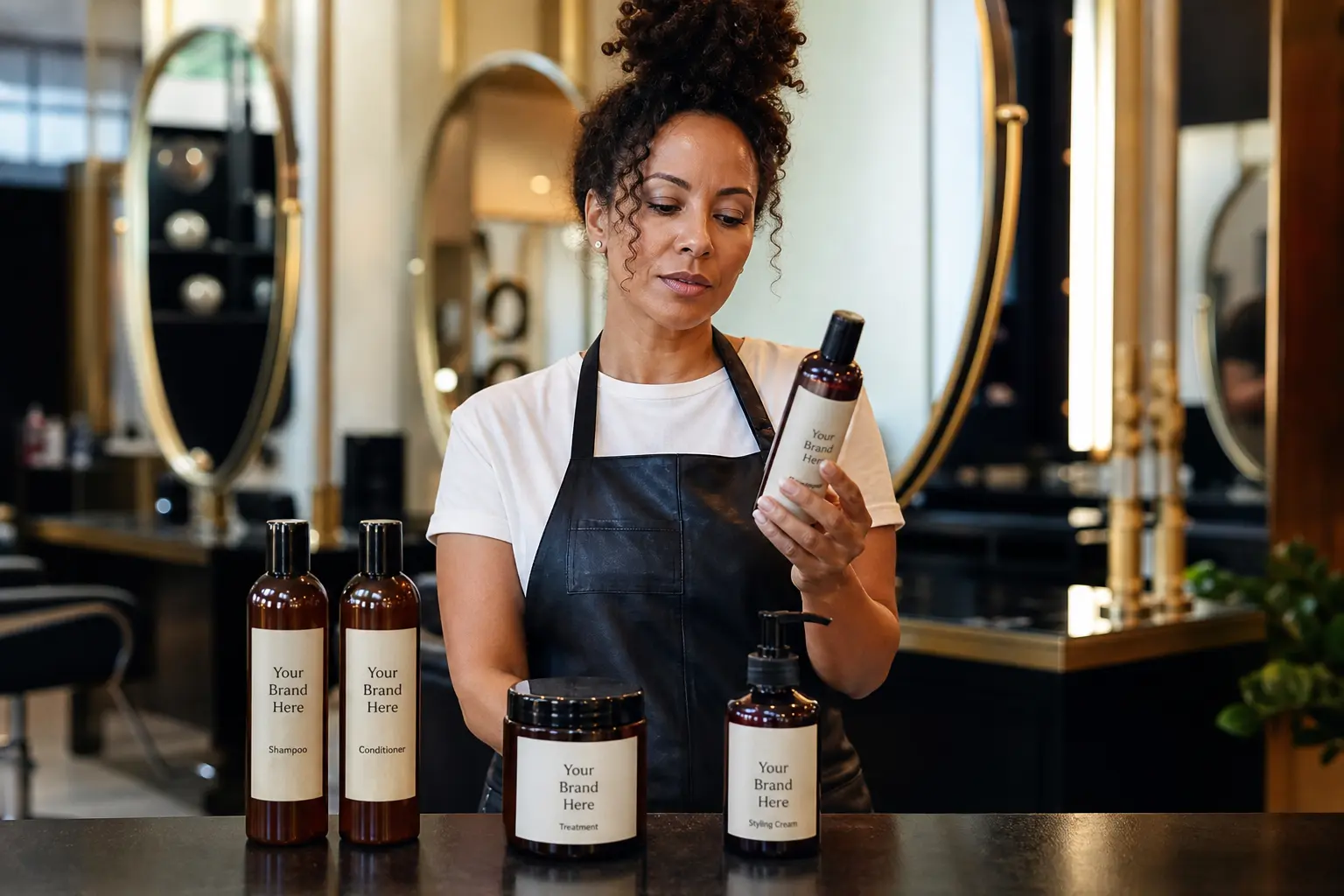
A haircare product line is a coherent set of hair products (typically shampoo, conditioner, treatment, and styling) designed to work as a system for a specific hair type or concern, sold under a single brand that stands for something clear in a crowded category.
The category is judged at the sink, not at the shelf. A formula that tests well on paper but feels bad during use does not build repeat buyers.
Most haircare content online is written by people who have never worked with real hair on real heads. They copy generic frameworks, change the words, and publish. That is why so many first-time haircare brands launch products that look great on Instagram but do not actually perform.
I spent my early career as a hairdresser before moving into cosmetic product development. 30 years later, I have guided brand launches across the sector and I can tell you: the brands that win in haircare are the ones built with an understanding of what actually happens between the product and the hair.
These are the strategic decisions behind a haircare line, from someone who has stood behind a salon chair and designed the products that sit on its shelf.
What Makes a Haircare Line Actually Work?
Haircare is a category with its own customer behavior, its own economics, and its own rules for what builds a brand. Understanding those rules is where every serious haircare founder starts.
Four things define whether a haircare line succeeds or disappears.
Customers switch often, and that cuts both ways.
The typical haircare customer tries a new shampoo almost every time they run out. They chase volume one month, shine the next, frizz control the next.
This makes haircare harder to build loyalty in, but also easier to break into. A new brand can take market share faster than in most cosmetic categories, if the product actually delivers.
Professional credibility moves haircare more than marketing credibility.
A haircare brand is often only taken seriously by engaged consumers once professionals (hairdressers, colorists, salon owners) use it and recommend it.
A great Instagram presence alone does not move haircare the way it moves other beauty categories. Stylists standing behind chairs, telling clients "this is what I use on your hair," is still the most powerful endorsement in the category.
The sink experience is the product.
Haircare is used in a very specific physical ritual: wet hair, apply, rinse, towel dry.
The lather, the slip, the scent, the rinse-out feel, how the hair behaves once dry. All of this is the product.
None of it shows up on a spec sheet. Customers judge a haircare product almost entirely by feel, not by the ingredient list on the back of the bottle.
A customer with curly hair does not cross-shop with a customer with fine straight hair.
This segmentation is deep, permanent, and drives every other decision you make about the brand: hero product, packaging, positioning, channel, pricing.
In haircare, the customer feels the result at the sink. Formulate for feel, not just for the label.
This is the mindset every haircare founder needs before looking at categories, pricing, or distribution. If the product does not work at the sink, nothing else matters.
The skinification trend and what it actually means
One haircare trend worth understanding because it is shaping the category right now: skinification.
Skinification refers to applying skincare principles to haircare, focusing on long-term scalp and hair health rather than short-term cosmetic results. It pulls skincare ingredients (hyaluronic acid, niacinamide, ceramides, peptides) into hair formulas, and it treats the scalp as skin that needs its own care routine.
This is a genuine trend, not a passing fad. Mass brands like Neutrogena, OGX, and Dove are launching skinification-positioned lines. The trend is also pushing the premium segment toward scalp-focused products, serums, and multi-step routines that were previously only seen in skincare.
For a new haircare founder, skinification matters because it opens specific white spaces: scalp-care ranges, prevention-positioned products, ingredient-forward haircare with skincare-level substantiation.
If your brand can credibly bring skincare-grade formulation thinking to haircare (proper stability data, clinically-backed actives, scalp-health positioning), this is currently one of the clearest market opportunities in the category.
Just understand the difference between using the skinification trend (a real positioning angle for a new brand) and copying generic skincare playbooks onto haircare products (what most average haircare content does). The first can build a brand. The second does not.
Haircare categories and where the opportunity is
Not every haircare category is equally open for a new brand.
Shampoo and conditioner. The biggest category, the most crowded, but also where customers switch the most.
Launching a shampoo alone is hard. Launching a shampoo + conditioner duo that delivers at the sink can build real traction.
Treatments and masks. Higher margin, lower volume.
A well-formulated bond builder, deep conditioner, or scalp treatment can anchor a brand. Customers are willing to pay for treatments that produce a visible change.
This is where real differentiation happens. Curly hair styling, heat protection, volume, texture: specific use cases let a brand own a corner of the market.
Scalp care. A growing segment that many brands ignore. Scalp-focused products can build a loyal customer base that standard haircare does not reach.
Color-care. Customers who color their hair will pay a premium for products that genuinely protect color and condition chemically treated hair. Niche but profitable.
Professional-only (salon) ranges. Sold wholesale to salons who resell at retail. Different go-to-market entirely, built around stylist relationships rather than consumer marketing.
The instinct is to launch a full range, look professional, cover every need.
Launching 8 products means splitting attention, marketing budget, and inventory across 8 stories instead of 1.
Most first-time haircare brands that launch with 8 products do not build any of them into something customers remember.
Better approach: launch with a minimum coherent line of 4 to 5 products.
The 4-to-5 product launch model for haircare
The core haircare routine is smaller than most cosmetic routines. Four products, used in sequence at the sink and after, cover what most customers actually use daily.
1 hero product. Usually either a treatment, a mask, or a standout styling product. Not a shampoo, unless the shampoo is genuinely different from what is already on the market.
A shampoo + conditioner duo. These two are almost always bought together. Launching them as a pair is more efficient than launching one.
1 or 2 complementary products. A styling cream, a leave-in treatment, a scalp serum, or a heat protectant. Products that complete the ritual the hero product starts.
The range-building framework, summarized:
Product role
Type
Purpose
Example
Hero
Mask, treatment, signature styler
Defines brand, drives marketing
Bond repair treatment, curl-defining cream
Cleanse
Shampoo
Foundation of the routine
Gentle daily shampoo
Condition
Conditioner
Always bought with the shampoo
Moisturising conditioner
Finish
Styling product, leave-in
Completes the in-salon or at-home result
Leave-in conditioner, heat protectant
Four products at launch is usually the sweet spot. Five if the customer genuinely needs it (for example, curly hair, which requires shampoo + conditioner + leave-in + styling + refresh).
How to pick the hero product in haircare
The hero in haircare is the product that makes a professional say "this works," not "this is nice."
That word matters. In haircare, hair either behaves better after the product, or it does not.
There is no "maybe," no "I think I see a difference."
The hair is either easier to comb, shinier, less frizzy, more defined, stronger to the touch, or it is not.
Hero product options by brand positioning:
For a repair-positioned brand, the hero is usually a bond-building or protein-based treatment. Customers come to you because their hair is damaged.
The hero has to deliver visible repair in 1 to 3 uses, not in 3 months.
For a curl-positioned brand, the hero is typically a curl definition cream or a leave-in conditioner that handles the specific curl type you target (3A vs 3C vs 4B needs different formulations).
For a scalp-positioned brand, the hero is a treatment or serum that addresses a specific scalp concern (oiliness, sensitivity, flaking, thinning).
For a color-positioned brand, the hero is a color-preserving mask or treatment that visibly extends color life.
For a professional/salon brand, the hero is often a styling product with a unique texture or application that professionals cannot easily find elsewhere.
Pick the hero based on what your customer already cannot find in the market. Then build the shampoo, conditioner, and supporting products around the hero’s promise.
For more on how hero ingredient selection affects product development decisions, see the cosmetic ingredients guide.
Pricing a haircare line
Haircare pricing is tight.
Customers have stronger reference points than in most cosmetic categories (they have bought dozens of shampoos) and are less forgiving of products they consider overpriced.
A realistic mid-market price architecture for a 4-product haircare line:
Hero treatment or mask: 28 to 35 EUR/USD
Shampoo: 18 to 22 euros
Conditioner: 20 to 25 euros
Styling or leave-in product: 22 to 28 euros
(Pricing examples throughout this article are indicative estimates that vary by manufacturer, region, and project scope.)
Total full routine: 88 to 110 euros.
For professional-only (salon) lines, the pricing logic changes. You sell to the salon at roughly 50 to 55 percent of the retail price, and the salon resells at full retail and keeps the margin. Your per-unit revenue is lower than a direct-to-consumer sale, but volume per customer (the salon) is higher because salons reorder regularly for both cabin use and resale.
Two pricing traps show up in first-time haircare brands.
The first is luxury pricing without luxury signals.
A 55-euro shampoo does not work unless the packaging, the brand story, the distribution, and the customer all match luxury.
Most first-time brands cannot deliver all four.
The second is mass-market pricing with indie overhead. Pricing a shampoo at 12 euros might feel competitive, but at small production volumes the margin disappears.
The brand has the cost structure of a premium product and the pricing of a drugstore one.
This is a recipe for running out of cash.
Match price to customer, and production volume to price. Check that the math works before you commit to a tier.
Should You Go Professional, Retail, or Both?
This is the single most strategic decision in launching a haircare brand, and the one most founders get wrong.
The instinct is "both, eventually." It almost always fails in practice when founders treat "both" as two parallel launches from day one.
Professional and retail are two different businesses: different customers, different sales cycles, different pricing structures, different marketing approaches.
There are three real paths: professional only, retail only, and a structured dual-channel model that serves both but with clear rules. Pick the one that fits your background and resources.
The professional-only path
You sell only to salons, stylists, and professional distributors. The salon uses the product in services, recommends it to clients, and carries retail sizes on the shelf.
How the economics work.
When you sell to a salon, you do not sell at retail price. You sell at wholesale with a margin that lets the salon resell at retail and make their own profit.
Typical structure: you sell to the salon at roughly 50 to 55 percent of the retail price. The salon resells at full retail and keeps the rest as their margin.
This means your margin per unit is lower than if you sold direct-to-consumer, but your volume per customer (the salon) can be significantly higher because a busy salon buys regularly for both cabin use and resale.
Pros.
Stylist recommendation is the most trusted endorsement a haircare brand can get. A stylist telling a client "this is what I use on your hair" converts better than any paid ad.
Steady reorder patterns once a salon commits. Professionals reorder on a rhythm (monthly, every six weeks) that retail customers do not follow.
Direct product feedback loop with professionals who test your formulas on dozens of real heads every week.
Cons.
Slower to scale: you grow salon by salon. Sales cycle is long (a salon may take 3 to 6 months to try, then another 3 to decide).
Marketing is still required, just different. You market to salons, not to consumers. That means trade shows, stylist education programs, salon visits, professional content. That budget is spent differently, and it is no smaller.
Professional buyers compare you to established brands like Kerastase, L’Oréal Professionnel, Redken, and Davines, with decades of education, technical support, and salon service behind them.
You cannot copy their go-to-market. You need a different angle.
Who it works for. Founders with strong salon relationships, a deeply technical formulation story, and patience for a slower growth curve. A former hairdresser launching a brand is almost always better off starting professional. For more on the specifics of building a salon-first distribution model, see the salon distribution guide.
The retail-only path
You sell directly to consumers, through your own website, Amazon, or specialty retailers. Salons are not part of the model.
Pros.
Faster to scale if marketing works. Higher consumer margin than selling at wholesale.
Full control over branding, customer data, and pricing. Easier to pivot and iterate based on consumer feedback.
Cons.
Marketing-heavy and expensive. Without professional endorsement, you are competing entirely on content, brand, and paid acquisition.
Customer loyalty is weaker without a stylist saying "this is what I use on your hair."
Consumer haircare is the most crowded and expensive category to advertise in online.
Who it works for. Founders with strong content and brand-building skills, significant marketing capital (50,000 euros plus for a credible launch), and a specific consumer angle (curly hair, clean haircare, men’s haircare) that creates organic word of mouth.
The dual-channel path
Some brands serve both salons and the general public under the same brand, from the beginning. This is where most experienced haircare founders end up.
The key rule: start from the professional side, not from retail.
A line designed for salons first, then opened to the public, works. Go the other way round, retail first and salons later, and it almost never does. Professionals can tell immediately when a product was designed for Instagram, not for their chair.
So the build order is:
Design the line for salon use first, with all the characteristics professionals need (performance, consistency, application behavior, professional-grade formulation).
Where it makes sense, produce two formats: a larger size for in-salon use, and a smaller size for retail sold by the salon to the client. Shampoos and conditioners are the clearest example. Treatments and styling products often work in a single format.
Sell the professional line to salons, and let them resell to their clients with their margin.
In parallel, sell the retail sizes directly to the public through your website, Amazon, or specialty retail.
The pricing discipline that keeps the model alive.
This is the rule most founders violate, then wonder why salons stop reordering.
If your retail size sells for 25 euros at the salon, your own website cannot sell the same product at 15 euros. You will destroy the salon’s margin, and the salon will drop you within six months.
The rule: the price at which you sell online to the public has to protect the margin the salon needs. Typically this means selling online at close to the same retail price the salon charges, never at a meaningful discount. Controlled exceptions (subscriptions, bundles) are acceptable only if the salon’s margin is still protected.
Salons are your partners in this model. If the partnership is not profitable for them, the model collapses.
Professional-only products: do not sell them online to the public.
Some products in a haircare line are strictly for professional use: bleaches, developers, color oxidants, technical treatments used during salon services.
These should never be publicly available on your consumer-facing site. You can keep a page that describes them for informational purposes, but the actual purchase must be restricted to professional accounts (login required, salon credentials verified).
If you sell technical cabin-only products to the general public, two things happen: the perceived value of your professional line drops in the eyes of salons, and the relationships you have built with salons start to erode. Salons expect the technical side of your brand to stay on their side of the line.
The dual-channel structure on your website should look like:
Public area: retail sizes only (shampoo, conditioner, treatments, styling)
Professional area (login required, verified salon credentials): full professional range, including cabin-only technical products, bulk sizes, starter kits
Pros.
Multiple revenue streams: wholesale to salons (lower margin, higher volume) + direct retail online (higher margin, lower volume per customer).
Brand credibility reinforced by professional use. Consumers buying online know the product is used in salons, which accelerates trust.
More resilient during market shifts. If one channel slows, the other can carry the brand through.
Cons.
Operationally more complex: two pricing structures, two types of customer service, two sets of packaging formats to manage.
Pricing discipline is difficult to maintain. One wrong promotion online can damage years of salon relationships.
Requires a clear, working separation between the professional site area and the consumer site area.
The biggest mistake I see founders make in the dual-channel model is undercutting their salon partners online. You do it once, you lose the trust of your professional base, and rebuilding it takes years.
How Do You Compete With Established Haircare Brands Like Kerastase, Wella, and Davines?
This is the question I get asked most often by haircare founders: how do I compete with Kerastase, L’Oréal Professionnel, Redken, Davines, Schwarzkopf?
The answer is: you do not. Not directly.
Those brands spent decades building professional education, technical service teams, global distribution, and stylist loyalty programs.
A new brand cannot out-compete them on their own terms.
What new brands can do is find a corner those giants underserve.
Specific hair type specialization. A brand that is genuinely the best at one hair type (3C curly hair, fine Asian hair, chemically straightened hair) can own that segment even with the giants in the room.
Specific philosophy. A fully clean professional line, a fully vegan one, a science-forward biotech one. Philosophy positioning that the big brands cannot credibly match because they serve too many customer segments at once.
Specific stylist type. Brands built around independent stylists, booth renters, or mobile stylists who feel underserved by legacy brand programs designed for large salon chains.
Specific service segment. A brand built entirely around color-service aftercare, or around chemical service repair, or around lightening-induced damage.
The giants cannot chase every niche. Find one where you can be the clear best choice for a specific customer, and build there.
What 30 years behind a chair taught me about haircare products
Most haircare content is written by marketers who have never seen the product fail in a client’s hands.
Three observations from the chair that change how I think about haircare product development.
Clients lie about their routines.
A client tells the stylist she washes her hair twice a week with a sulphate-free shampoo and uses a leave-in every day. The reality, most of the time, is she washes every other day, uses whatever is in the shower, and skips the leave-in on busy mornings.
This matters because brands that formulate for the "ideal" routine produce products that fail in the real one. A conditioner that requires 5 minutes of dwell time to work is used for 30 seconds in real life. A leave-in that needs to be applied section by section is applied as a single spray across the whole head.
Design for what people actually do, not what they say they do. Products that work in 30 seconds build loyalty. The ones that require discipline die after the third use.
Smell sells the second bottle, performance sells the third.
The first bottle is bought because of packaging, brand, or recommendation. The second because the customer remembers the smell and the sink experience. And the third only if the hair is genuinely better after using the line for a month.
Most brands over-invest in the first-bottle sale (packaging, marketing, launch) and under-invest in what converts a first buyer into a loyal one (performance over time). You build a haircare brand on the third bottle, not the first.
The same formula works differently on different hair types.
A shampoo that is perfect for European straight hair can feel stripping on African-textured hair, greasy on Asian hair, or too heavy on fine hair. Brands that test their products on one hair type and launch to everyone ship products that work for a fraction of their potential customer base.
If your brand serves a specific hair type, formulate and test for that hair type specifically. If your brand claims to serve all hair types, you need a testing panel that actually includes all of them before you launch, not after.
Common Mistakes First-Time Haircare Founders Make
Across the brand launches I have guided, and with a hairdresser’s memory of what actually works on real clients, these are the mistakes I see most often.
Mistake 1: Designing the product from the Instagram feed down
The founder picks a bottle that looks great on Instagram, picks a color palette that pops in a flat-lay, then designs the formula to fit the aesthetic.
This is backwards. Haircare is judged at the sink, in a shower, on a blowdry.
A beautiful bottle with a mediocre formula does not build repeat buyers.
Fix: design the formula to deliver at the sink first. Design the bottle around the best formula you can produce for your budget, not the other way around.
Mistake 2: Copying professional formulas and selling them retail
A founder sources a "professional-grade" formula from a private label manufacturer, puts it in a consumer bottle, and markets it as a salon-quality haircare brand for home use.
The problem is that most "professional-grade" stock formulas are average consumer formulas with a stronger marketing story.
Real professional brands formulate specifically for professional use (higher concentration, different rheology, specific application behavior).
Borrowing the word "professional" without delivering professional performance is a credibility problem waiting to happen.
Fix: if the brand claims professional quality, the formula has to perform professionally. Test it with stylists before launch. If they say it is average, it is average.
Mistake 3: Ignoring the fragrance
In haircare, fragrance is central. Customers pick shampoos largely based on how they smell. A formula can be technically excellent but fail in the market because the scent is wrong or weak.
Underestimating the fragrance budget is one of the fastest ways to kill a haircare launch.
A good fragrance can cost 15 to 30 percent of the formula cost.
Cutting the fragrance budget to save money produces a product that no one wants to use twice.
Fix: invest in the fragrance. Work with a fragrance house that has haircare expertise. Test the fragrance both in the bottle and on damp hair and dry hair (it smells different in all three states).
Mistake 4: Launching a professional or dual-channel line without stylist validation
If your brand sells to salons (professional-only path or dual-channel path), stylist validation before launch is the entire credibility test.
The founder tests the product on themselves, on family, on a few friends. None of them are stylists. They all say it is great.
Then the first real review from a professional says "this does not deliver." The brand never recovers credibility in the professional market.
For a retail-only launch, stylist validation is still valuable but not mandatory. You can build a retail haircare brand validated primarily by your target consumer, as long as the formula actually performs.
For professional or dual-channel launches, validation with stylists is required before launch.
Fix: if you plan to sell to salons in any form, have at least 5 independent stylists use the product on real clients across different hair types for at least 3 weeks. One thing to settle before you hand anything over: in the EU, giving a product to a salon that will use it on paying clients counts as putting it on the market, even when you give it away for free. So the units you hand out are not test units in the legal sense: they already need a designated responsible person, a completed safety assessment and a CPNP notification behind them. Listen to the feedback. If the stylists say the formula needs work, reformulate before you scale the launch, not after, and treat the reformulated version as a new product: updated safety assessment, updated notification. For how manufacturer selection supports reformulation iterations, see the cosmetics manufacturer selection guide.
Mistake 5: Wrong packaging format for the use case
A thick cream in a bottle with a tiny hole, a spray in a bottle that leaks, a treatment in a jar that gets messy in the shower.
The product might be good, but the packaging kills the user experience.
Haircare is used in specific ways: at the sink, under the shower, at the blow dryer station. The packaging has to work in those conditions.
If you sell to salons, some products need to be produced in two formats: a larger professional size for in-salon use (typically 500 ml to 1 liter for shampoos and conditioners), and a smaller retail size for clients buying at home (250 ml). Pushing a 250 ml shampoo as a salon product wastes the stylist’s time and signals you do not understand how salons actually operate.
Fix: match packaging format to use context. Shower products need flip-tops that open with wet hands. Styling products need containers that work with product-covered hands, and treatments need an applicator that lets the customer apply cleanly. For professional lines, plan the salon format from the start, not as an afterthought. Test packaging in the actual use environment before ordering production volumes.
The takeaway
A haircare line that works is built from the sink backwards.
You start with the hair type and the feel you want to deliver. You pick a hero that solves a real problem that real professionals recognize.
You build the supporting routine around the hero. You pick your channel model (professional-only, retail-only, or a structured dual-channel) and commit to it.
You validate with stylists if your line touches salons in any form.
The haircare brands that fail are the ones built to look good on Instagram. The ones that succeed are built to feel good at the sink.
Get the product right at the sink, get the channel decision right, and the rest of the brand story can be built on top of a product that actually works.
Miss on either, and no amount of packaging or content fixes a haircare line that does not perform.
Frequently Asked Questions
How much does it cost to launch a haircare line?
For a 4 SKU launch with hybrid approach formulation, budget 38,000 to 93,000 euros total. This covers formulation and testing (10,000 to 25,000 euros), packaging (6,000 to 18,000 euros), fragrance development (3,000 to 8,000 euros), initial production run (6,000 to 12,000 euros), compliance (3,000 to 5,000 euros), and launch marketing (10,000 to 25,000 euros). That total carries the launch marketing inside it, which is why it sits far above the product-only budgets quoted in the beginners guide. A professional-only launch has different marketing costs (trade shows, stylist education, salon visits instead of consumer ads) but the total budget is similar. Initial inventory for professional launches also needs to cover salon starter kits and cabin-use sizes.
How long does it take to create a haircare product line?
Plan 5 to 12 months from concept to products in warehouse, depending on the path. White label (catalog formula with your label) can launch faster, around 2 to 3 months at the total-project level. Hybrid approach (existing formula customized) typically takes 5 to 8 months. Full custom formulation runs 6 to 12 months, with haircare usually landing at the upper end of that range. Haircare tends to run on the longer side because fragrance development adds 1 to 2 months, sink-testing iterations often require 2 to 3 rounds of sampling, and surfactant-based stability testing is complex because the formula interacts with packaging materials in specific ways.
Do I need a cosmetology or hairdressing background to launch a haircare brand?
No, but it helps more in haircare than in almost any other cosmetic category. If you do not have the background, compensate by building a strong stylist advisory group before and during product development. Include at least 2 to 3 active stylists in your sampling and validation process. Their feedback will catch problems you would otherwise only discover after launch.
What is the difference between professional and retail haircare formulas?
Professional formulas are designed for the way stylists use them: larger volumes per application, different consistency for blow-dry tools, different rheology for mixing with color, different active concentrations for salon services. Retail formulas are designed for at-home use: smaller application amounts, packaging made for wet shower hands, simpler application instructions. A formula optimized for one is rarely ideal for the other.
Can I sell the same product in both professional and retail channels?
You can sell a similar product in both channels, but usually not exactly the same one. Most brands that serve both channels offer a "professional" version (larger bottle, stronger concentration, salon-specific application) and a "retail" version (smaller bottle, home-use positioning, consumer packaging). Selling the same SKU to both channels tends to frustrate professionals, who expect something distinct from what their clients can buy directly.
Which haircare products have the highest margin?
Treatments, masks, and leave-in products have the highest per-unit margins (4-5x markup). Shampoos and conditioners have lower margins (3-3.5x) because price competition is heavy and customers have strong price anchors. Styling products have variable margins depending on the format: creams and serums are higher margin, aerosol sprays are lower margin because of packaging costs and regulatory testing overhead.
How do I build relationships with salons as a new brand?
Start small and local. Identify 10 to 20 salons within a 2-hour radius whose aesthetic, clientele, and values genuinely match your brand. Visit them personally, leave samples, follow up, offer education. Do not cold-email 500 salons hoping 10 respond. The salon channel rewards relationships built with genuine interest in the stylist’s work, not mass outreach.
Honest assessment of AI in cosmetics from an industry veteran with 30 years of experience. What AI can do, what it cannot, and how to use it smartly in your brand.
How to request, evaluate, and give feedback on cosmetic product samples. A practical guide to the sampling process that prevents expensive production mistakes.