
LabelCheck reads your cosmetic label before print and shows what breaks the rules.
Give it the finished artwork. In a few minutes you get what is wrong, the corrected text, and the rule each point rests on.
Covers the European Union and Northern Ireland (Reg. (EC) No 1223/2009) and Great Britain, with the assimilated British rules.
Made for the people who make the product, place it, and sign for it.
You check every client label before it prints, on every version. LabelCheck runs the routine pass so your chemist only weighs the hard calls.
If you import the product, or place it on the market under your own name or trademark, the label duty is legally yours. LabelCheck reads the whole label before print and hands back what to change, with the rule behind each point.
You sign Part B of the safety report, and the label has to line up with it. LabelCheck reads the label side against the current Annexes, so the transcription is already done when it reaches you.
A label mistake is the one you pay for twice: the print run, then the retailer.
One wrong line on the back can scrap a whole print run or get your batch rejected by the retailer. In the worst case it triggers a recall. Catching it before print is your job, and the law doesn’t make it optional.
You give the final artwork one last read, often in a hurry, on a file reworked a dozen times, against a regulation hundreds of pages long that keeps changing. One pair of eyes, one pass. That is too little to feel safe.
LabelCheck is the second check. It reads the whole regulation every time, in the version we re-read from the official sources twice a month.
You give it the artwork. It checks what the law requires and hands back the fix, with the law behind it.
Simple. You load the artwork: a PDF or an image. LabelCheck analyses it against the European rules and, a few minutes later, gives you back a clear report. A Word file or pasted text works too, for everything that does not need to see the artwork.
How serious it is
Blocking, to review, or a note, so you know what to fix first.
The corrected text, ready to copy
So you or your designer can fix it in a few minutes.
The law behind it
The Regulation, article or Annex entry a point rests on, whenever that rule has one.
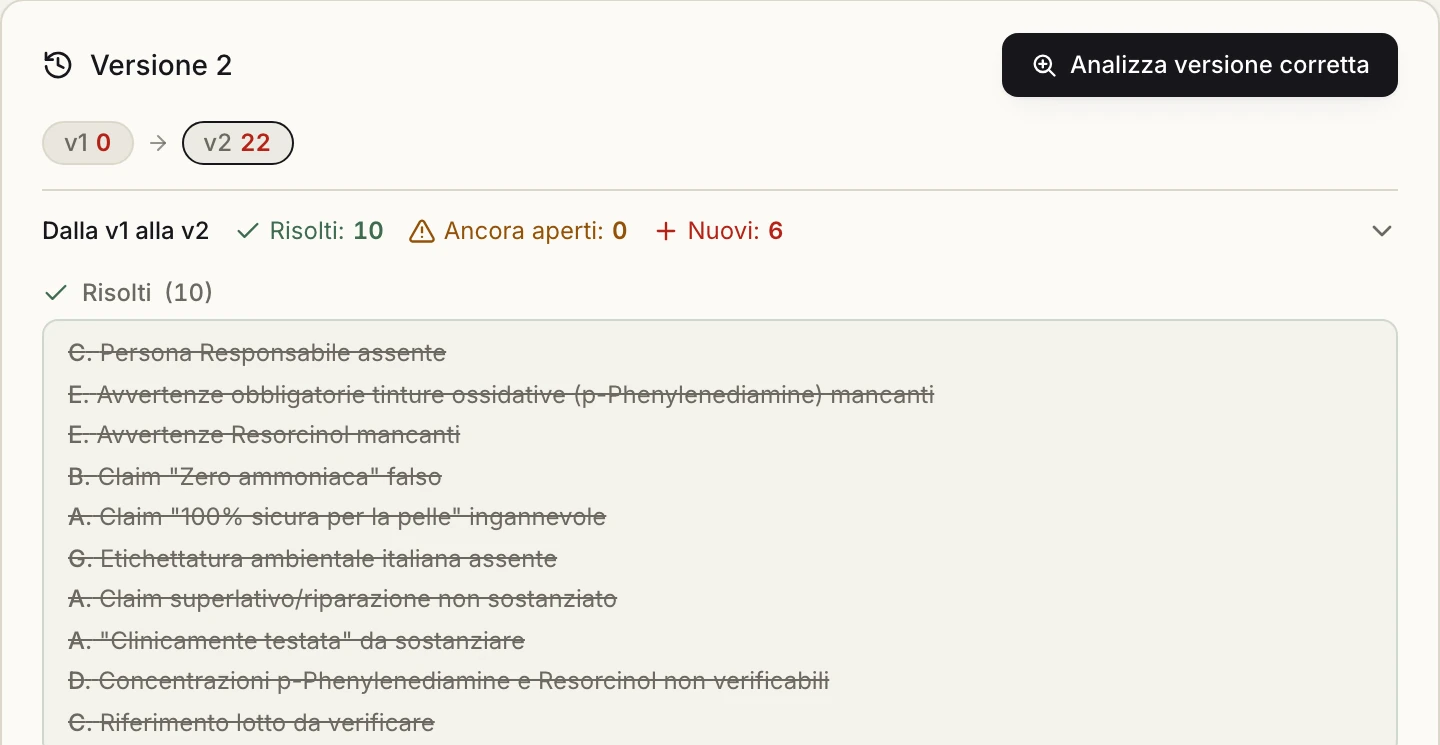
Fix and re-run: resolved findings stay struck through, the score rises
It looks at the whole label, in one pass.
Watch it read a label that looked print-ready.
Three points from a LabelCheck report, replayed on a sample label. Press the button and read what it found.
LUMIÈRE COLOR CREAM, name changed, not a real brand
LUMIÈRE COLOR CREAM
Permanent hair colour, shade 6.0 Dark Blonde

DIRECTIONS: Mix the colour cream with the developer 1:1.5.
Apply to dry hair, leave for 30 to 35 minutes, rinse thoroughly.

The only hair colour that repairs the hair while it colours.
Clinically proven. Zero ammonia. 100% safe for the skin.

INGREDIENTS: Aqua, Cetearyl Alcohol, Propylene Glycol,
p-Phenylenediamine, Resorcinol, Ammonium Hydroxide, Parfum,
Sodium Sulfite, Limonene, Linalool, Citronellol, ...

Net 60 ml e   |   Batch: see base of pack
Made in Italy   |   [PAO symbol: 12M]
Nothing to upload. Three real points, replayed here without a network call.
That was a sample. Now run it on one of your own labels.
Request access- BlockingC. Mandatory itemsResponsible Person name and address missing
Problem: No Responsible Person name and address on the back panel.
Why: Article 19(1)(a) of Reg. (EC) No 1223/2009 requires it on the container and the packaging.
Reg. (EC) 1223/2009, Art. 19(1)(a)Correction: The Responsible Person block, in place. - BlockingD. INCI & allergensFragrance allergens not individually declared
Problem: The formula contains the newly regulated fragrance allergens; the label declares only a few.
Why: Under Reg. (EU) 2023/1545 the listed allergens above threshold must be named individually on the EU market, Northern Ireland included; Great Britain still runs the legacy set.
Reg. (EU) 2023/1545 (Annex III)Correction: The allergens, named individually, in the right place. - To reviewA. ClaimsOver-promising claims
Problem: ‘Zero ammonia’ sits on a label whose INCI lists Ammonium Hydroxide, and ‘100% safe’ is used as an absolute.
Why: Article 20(1) of Reg. (EC) No 1223/2009 forbids a label implying characteristics the product does not have, and criterion 4 (Honesty) of Reg. (EU) No 655/2013 stops a presentation going beyond the supporting evidence.
Reg. (EU) 655/2013; Art. 20, Reg. (EC) 1223/2009Correction: The same marketing intent, in wording you can back with your evidence.
Because this is a hair colour, the law fixes the warning word for word. LabelCheck hands it back as text ready to copy, never a paraphrase. Shown in English as published in the Regulation.
Hair colourants can cause severe allergic reactions.
Read and follow instructions.
This product is not intended for use on persons under the age of 16.
Temporary “black henna” tattoos may increase your risk of allergy.
Do not colour your hair if:
— you have a rash on your face or sensitive, irritated and damaged scalp,
— you have ever experienced any reaction after colouring your hair,
— you have experienced a reaction to a temporary “black henna” tattoo in the past.
Contains phenylenediamines.
Do not use to dye eyelashes or eyebrows.
Reg. (EC) No 1223/2009, Annex III, entry 8a, general use (a) (as amended by Reg. (EU) No 344/2013)That took seconds, because it is a replay. On your label it is the same check, a few minutes before the file goes to print.
One label, three jobs, one regulatory base.
Every part of the label against the current rule, before the file prints.
The label rewritten for every market you sell in, with the mandatory warnings taken from the official language version of the Regulation.
Your CPNP (European Union and Northern Ireland) or SCPN (Great Britain) package prepared, so the portal holds no surprises.
It checks every detail for you, and hands you the work ready for your designer.
In one pass it checks all the details that take a careful manual review, and hands them back ready to fix.
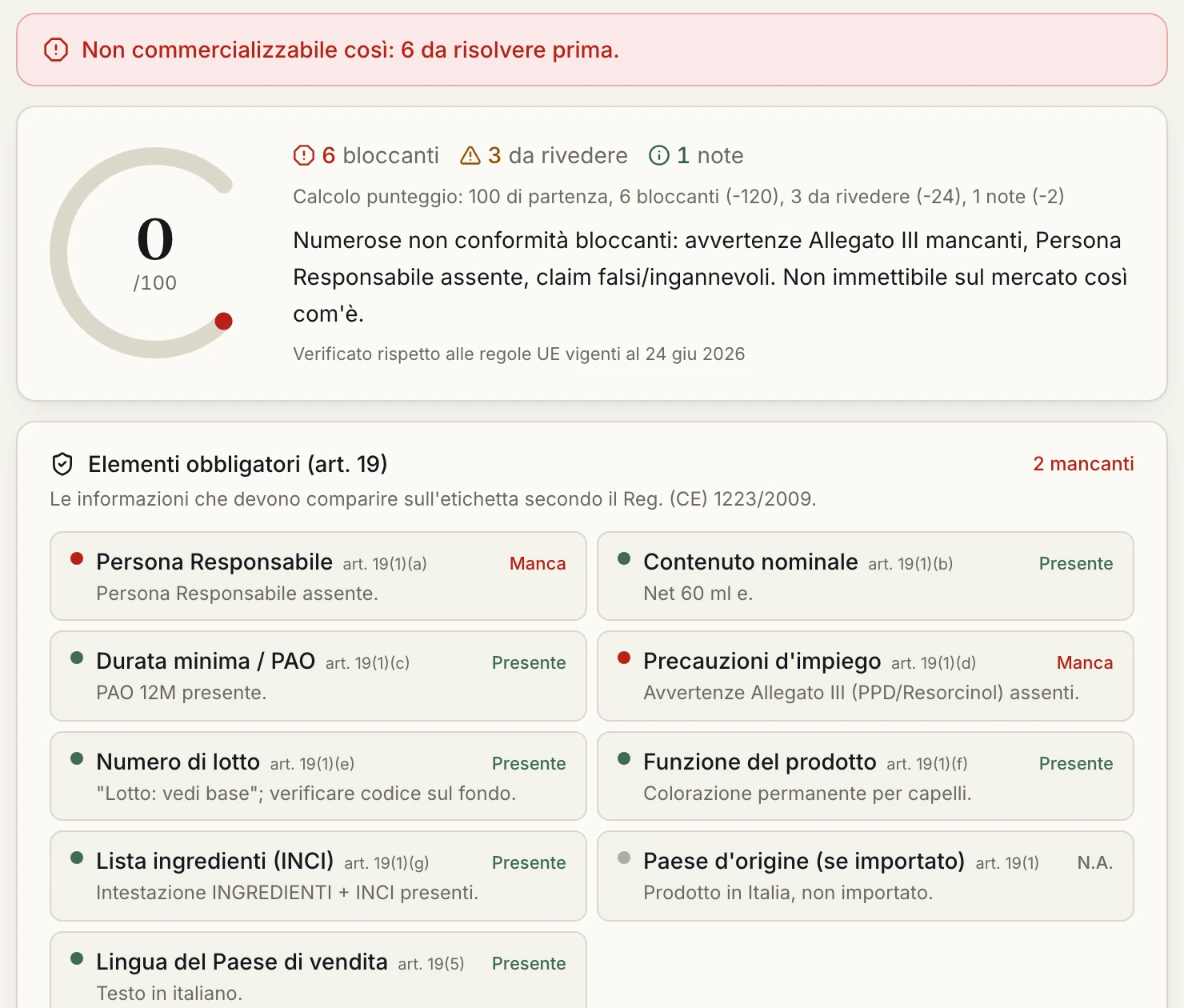
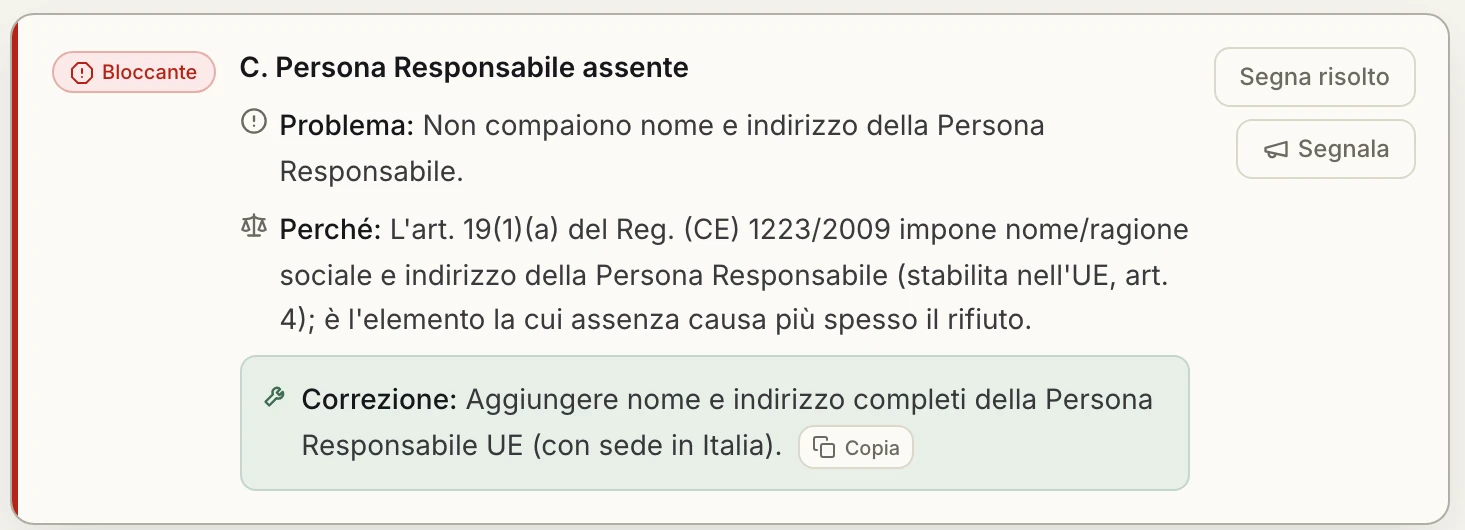
Real app screenshots · demo account
Corrected text ready to copy. Findings your chemist resolved stay struck through.
It is the pass a person makes by hand, done in a few minutes, on every version of the file. And it all stays in your account: every analysis you have run, always within reach.
The regulatory base is rebuilt from the official sources twice a month, EUR-Lex and CosIng for the Union, the British regulators for Great Britain, so the legal changes are not yours to chase.
The final judgement stays with your chemist and your consultant. LabelCheck takes the repetitive checks off their desk.
It handles the complex labels too, in every market’s language.
The categories most likely to carry a fixed legal warning are exactly the ones it is most useful on: hair colour and bleach, perms, aerosols and hairsprays, gel and UV nails, sunscreens, oral care, self-tan, depilatories, professional and solid formats.
And a label that is correct in one country can be wrong in the next, because the nominal content, the durability date, the precautions for use and the function must appear in each market’s language. LabelCheck checks that market by market, for the countries you tell it you sell in.
Right in one country, wrong in the next. It writes your label for every market you sell in.
The same label can be fine in Italy and against the rules in Germany: the nominal content, the durability date, the precautions for use and the product function have to appear in each market’s language, exactly as that law wants them.
Mandatory warnings come word for word from the official language version of the Regulation. Where we already hold that version, that is exactly the wording that goes on your label; everywhere else the warning comes back in the source wording, flagged, instead of machine-translated. Your INCI stays untouched. The description and the instructions get rewritten to read like a local wrote them, every claim kept inside what that market allows.
Across borders this usually means a translator for every country. Here it is one more job on the same label, built for cosmetics.
If you import the product, or place it on the market under your own name or trademark, the label duty is yours.
If you import a cosmetic into the EU, or place one under your own name or trademark, the law makes you the Responsible Person. Otherwise the role sits with the EU manufacturer until a written mandate moves it, accepted in writing. Either way the label duty lands on the Responsible Person, and LabelCheck gives you a read you can follow step by step, each point tied to the rule behind it and to the article whenever that rule has one, so you sign off on the file knowing what you signed.
The label is right. Now get the notification ready, without the portal headache.
Before a cosmetic can be placed on the market, it has to be notified: the CPNP for the European Union and Northern Ireland, the SCPN for Great Britain.
A dedicated tab walks the notification with you, tells you at a glance how ready you are, and lists exactly what is still missing before you open the portal.
It prepares the package. Your Responsible Person still submits it on the official portal and answers for it. What changes is that you know what the portal wants before you open it.
Allergens: the first date has already passed.
Until this date, a label that does not declare them could still be placed on the market.
Stock placed before the first date can still be sold through until this one.
Regulation (EU) 2023/1545 widened the list of fragrance allergens that have to be named one by one once they pass the threshold: 24 were already declarable before it, and the amendment added dozens more on the EU market. The labels most at risk are the ones that already passed a check: the law moved, and the label did not.
The Regulation let a label that does not name them be placed on the Union market only until 31 July 2026. What is left is the sell-through window for stock that made it in time. Two entries run on their own later calendar, Citral and Benzyl Salicylate, under Reg. (EU) 2026/909. None of these dates is ours to set: they are printed in the Regulation, in footnote (40) to Annex III of the consolidated text.
Quick questions before you try it.
Is it easy to use?+
Yes. You load the finished artwork, tell it which markets you sell in, and read what comes back. The artwork on its own covers every check that does not need the formula, symbols included; add the technical sheet and it also reads your claims and your fragrance allergens against the actual formula.
Is this a certification?+
No. LabelCheck is a pre-check: it does the routine, every-part pass and tells you exactly what to change. You, your Responsible Person, or your chemist still decide and sign.
It found things on a label that looked fine. How do I trust it?+
Each point names the rule it rests on, and the article or Annex entry where there is one, so you can open the official text and read the sentence yourself. The rules come from the consolidated text on EUR-Lex, and from the assimilated British rules when Great Britain is one of your markets. Points about wording and spelling come back marked as text quality, so a label that reads well can still pick up a point or two.
What does it cost me to try it?+
Nothing to start, and a few minutes of your time. Every company gets a free trial of 300 credits once a person has read its request, and the detailed report comes back grouped clearly, with a clean PDF you can hand to your designer. After the trial, the plans and top-ups are on the Pricing page.
What happens to my labels and formulas?+
The label text is read to produce your report and is not kept: what stays in your account is the report itself, with every point and the rule behind it, on servers in the European Union, yours to ask for and take away whenever you want and to delete when you are done. It leaves the Union at one point only, while the models are reading it, under the European Commission’s standard contractual clauses, and your content is excluded from model training. Beyond your report we keep a set of counts, which kinds of point come up and in which markets, with nothing in them that points back to your label or to you. Register a quantitative formula on a declaration and the software records that the document exists, while the content itself stays with you. The full terms are on the LabelCheck privacy and security pages.

Who built this, and why.
I am Claudio Nicodemo, and I built LabelCheck. I have spent 30 years in the hair and beauty sector, and I have watched a good product get held up, or sent back, over a label nobody had time to read properly.
LabelCheck is the second read I always wanted on the bench: every part of the label, every time, against the current rule, before the file goes to print. I made it for the people who actually make the product. The chemist and the Responsible Person still decide and sign; LabelCheck just puts the expensive problems on their desk while they still cost nothing to fix.
Run a full check on one of your labels.
Put one of your own labels in front of it and read what comes back.
Every company starts with a free trial of 300 credits, once a person has read its request. You put your own labels in front of it and help shape it. The price list is public, on the Pricing page.
LabelCheck by cosmetiFULL. An AI regulatory pre-check for cosmetic labels under Regulation (EC) No 1223/2009 in the European Union and the assimilated rules in Great Britain. It assists, it does not certify: the qualified human decides and signs.