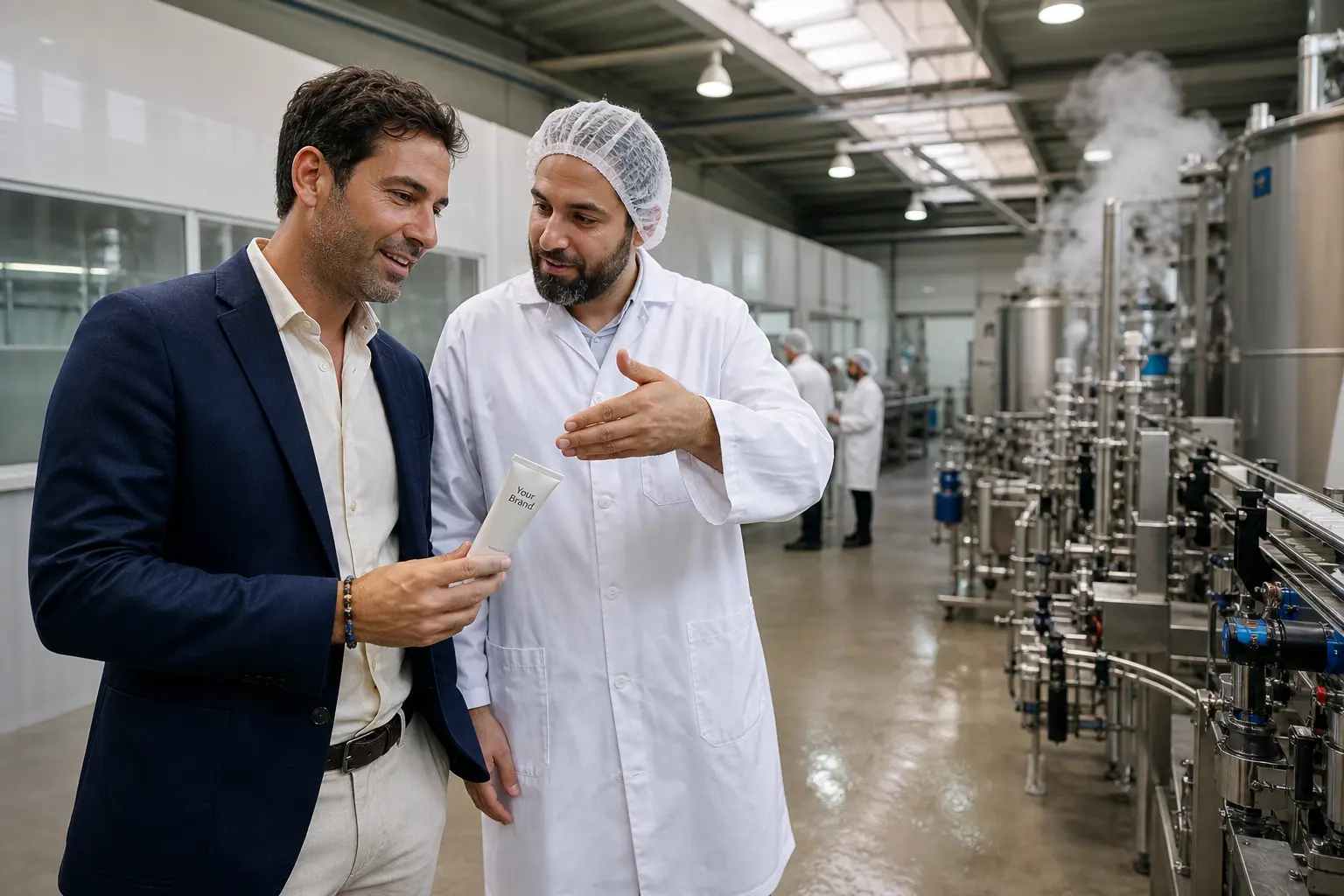
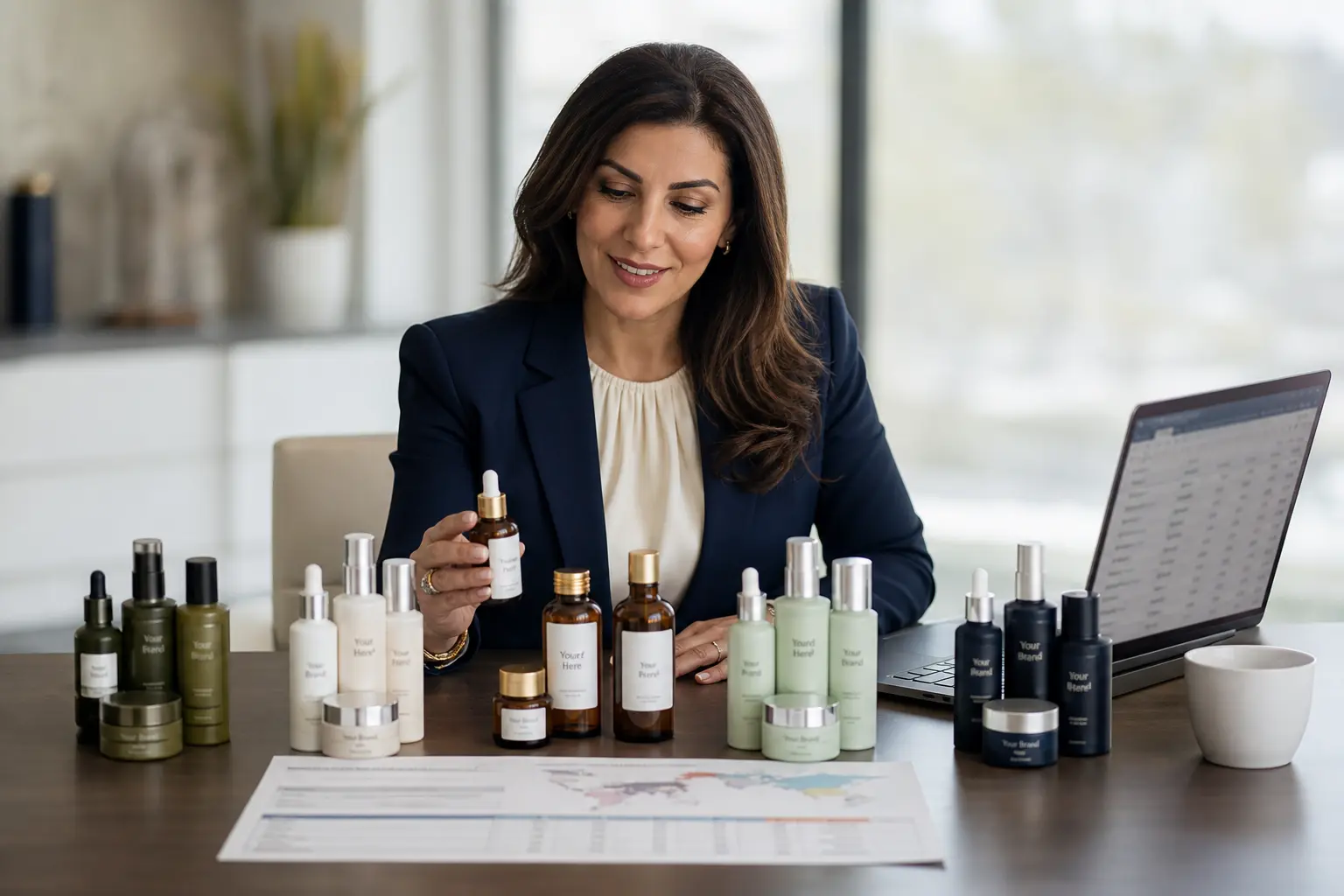
A cosmetics manufacturer is a facility that produces finished cosmetic products on behalf of a brand, covering formulation, raw materials, filling, packaging, quality testing, and release.
That is the technical definition.
The strategic reality is different.
Your manufacturer is the single biggest operational decision you will make as a founder. It shapes unit cost, formulation options, minimum volumes, regulatory exposure, and your ability to switch supplier later.
Most first-time founders approach the choice backwards. They start from a catalog, pick a product that looks good, and fit a brand around it.
In 30 years in the hair and beauty sector, most recently in private label cosmetics, with 14+ partners across Europe, Turkey, China, and the US, the biggest losses I have seen came from the wrong manufacturer picked for the wrong reason, not from bad formulas.
Founders locked into MOQs they could not sell. Manufacturers that changed a raw material supplier and broke the formula. "GMP certified" factories that turned out not compliant for the target market.
Every one was preventable in the selection phase.
This guide covers the types of manufacturers and who each one fits, how to evaluate a factory beyond its pitch, the commercial terms that matter, and the workflow to vet a partner in 2026.
Why Manufacturer Selection Is a Strategy Decision, Not a Purchasing Decision
Most content on this topic treats the manufacturer search like a procurement task. Define specs, collect quotes, pick the best price-quality ratio, sign.
That framing is wrong.
A manufacturer is not a vendor you can swap next quarter if the numbers stop working.
What you are actually locking in when you sign
Every manufacturer relationship carries hidden dependencies that only become visible after production starts.
Formula ownership. With most private label contracts, the formula stays with the manufacturer.
You can sell it, but you cannot take it to another factory.
If the relationship ends, the product dies with it.
Packaging compatibility. The bottles, pumps, closures, and filling equipment the manufacturer runs will constrain your container options. Changing factories often means changing packaging too.
Regulatory filing chain. The EU and the US work differently here. Your MoCRA product listing in the US is hooked to the registration of the facility that makes the product. Your notification on the EU Cosmetic Products Notification Portal (CPNP) is not: it is a per product filing made by the responsible person, and Article 13(1) of Regulation (EC) No 1223/2009 never asks for a manufacturing site, a factory address or an establishment number.
So moving production does not by itself mean re-notifying in the EU. Article 13(7) ties the update duty to what was notified, and the plant is not on that list. What the move can change is the country of origin, if the product is imported and the new plant sits elsewhere. And if the new plant brings a reformulation, everything the notification holds about the formula moves with it: the frame formulation, plus the nanomaterial entries and the CMR category 1A or 1B entries where the new formula touches either. In the US the move does reach the filing.
Shelf life and stability data. Stability testing is expensive and slow. The data is tied to the specific formula produced at the specific facility.
A new factory starts the clock again.
This is why the cost of switching manufacturers is rarely the production quote itself. It is the tooling write-off, the reformulation work, the re-testing, the regulatory updates the move actually triggers, and the months of lost sales while the new supply chain stabilizes.
The information asymmetry most content misses
Almost every article you will find online about choosing a cosmetics manufacturer is written by a cosmetics manufacturer.
The people writing the buyer’s guide are the people being bought from.
The cause is structural.
It is an information asymmetry. A manufacturer presenting their capabilities has one frame of reference: what they can produce. An independent consultant with no manufacturing arm has a different frame: what the specific brand in front of them actually needs.
Both frames are legitimate. The client benefits when both are present in the decision.
The criteria in this guide are much the same as everywhere else.
What differs is the perspective.
The perspective here is: what does this specific brand need, what manufacturer profile fits that need, and how do you verify the fit before you sign.
Not: what are the ten best manufacturers we happen to be one of.
The reverse engineering principle
Before you evaluate a single manufacturer, you need to know what you are evaluating against.
That means the brand positioning, the target audience, the price point, the distribution channel, and the formulation philosophy are defined first. The manufacturer search is the last step, not the first.
A manufacturer is something you choose after the brand is clear, to produce what the brand promised. It is not something you choose and then build a brand around.
Founders who reverse this order almost always end up in one of two places. Either they are locked into a product that does not match who they want to become, or they are constantly fighting their manufacturer to change things the manufacturer was never set up to do.
The right sequence is: positioning first, product concept second, formulation path third, manufacturer fourth.
This sequence has a practical side-benefit. When the brand brief is clear before the manufacturer conversation begins, manufacturers give better answers.
Most manufacturers present what they produce, because that is their frame.
When you arrive with a vague "I want to launch a skincare brand," you get a vague catalog response.
When you arrive with "organic facial oil for mature skin, retail price around 60 EUR/USD, EU distribution first year, 2,000 unit first run, launch in six months," the same manufacturer will point you to the right base formula, flag real compatibility issues, and sometimes tell you honestly that they are not the right fit. (All cost and pricing figures in this article are indicative estimates that vary by manufacturer, region, and project scope.)
That outcome is better for both sides.
Why "manufacture it yourself" is rarely the answer
At some point almost every brand that reaches scale asks the same question. Should we bring production in-house to control costs and margins better?
The math looks tempting on a spreadsheet. The reality is heavier.
Running a cosmetics production operation means managing raw material sourcing across dozens of suppliers and maintaining ISO 22716 compliance with trained personnel and audit-ready facilities. It also means hiring both production chemists (to run the lines) and R&D chemists (to develop formulas), running a regulatory team, carrying the capital cost of equipment, and absorbing overhead on days the lines run below capacity.
The operating margin of a cosmetics manufacturer is tight by design. The savings from vertical integration are smaller than most founders assume, and the operational complexity is much larger.
Even brands that do bring some production in-house rarely do it for the whole line. A professional haircare range with 80 SKUs cannot realistically run on internal production alone. The in-house lines typically cover high-volume commodity products, and everything else stays outsourced anyway.
Value creation in cosmetic brands sits on the commercial side: positioning, marketing, distribution, customer relationship. Production is a cost center that can be delegated to specialists with better economics than any single brand can replicate internally.
Private label at the top of the industry
A detail rarely mentioned in consumer-facing content: some of the largest multinational beauty companies in the world use private label extensively. They design the brand, position the product, control distribution and marketing, and outsource production to specialist manufacturers under strict confidentiality and quality contracts.
Over the last two decades this practice has grown, not shrunk. Flexibility beats vertical integration for most categories.
This matters for a first-time brand because it legitimizes the private label model as a professional choice, not a compromise for small budgets. You are choosing the same production logic used by the largest players in the industry. The difference is scale, not strategy.
The Three Production Approaches and the Manufacturer Types You Will Encounter
The word "manufacturer" hides two layers of structure that most founders never think about.
The first layer is the production approach you are buying: white label, private label, or a hybrid combination.
The second layer is the type of company you are buying from: direct manufacturer, reseller, or a mix of the two.
Understanding both layers separately is the difference between a clean commercial relationship and a surprise six months in.
The three production approaches (aligned with the private label vs white label model)
White label. The manufacturer has a catalog of finished products already formulated, tested, and ready to ship. You pick a product, apply your label, and order.
MOQs are the lowest in the industry. Technically, a single unit is possible. In practice, box minimums start at 12 to 50 units, with typical orders at 300 to 2,000 units per SKU. Launch investment runs 3,000 to 8,000 euros. Timelines are 2 to 4 weeks.
The trade-off: you do not own the formula, the same product is available to any brand willing to order it, and customization is limited to the label and sometimes the outer box.
White label fits brands whose edge is distribution, community, audience, or positioning, not product differentiation. A hairdresser launching a salon retail line. An influencer monetizing an audience. An e-commerce seller testing a niche before investing in development.
Private label. The product is developed specifically for your brand. The formula, packaging, and identity belong to the project, not to a shared catalog.
Within private label there are two paths the industry treats as one but which behave differently commercially.
Base-derived private label, the path the industry calls the hybrid model, starts from an existing formula base (often from the manufacturer’s R&D team or from an external lab they work with) and modifies it for your brief. Custom color, custom fragrance, a signature active on top of a proven backbone. MOQs sit between 500 and 5,000 units. Total launch budget: 5,000 to 15,000 euros. Timelines: 3 to 5 months.
Full custom private label develops the formula from scratch against your brief. You own the formula with some form of exclusivity. MOQs start at 5,000 units and climb fast. Formulation cost: 15,000 to 30,000+ euros. Total launch budgets: 38,000 to 88,000 euros. Timelines: 6 to 12 months including stability testing.
Both paths sit inside "private label." Treating them as interchangeable is one of the most expensive framing mistakes first-time founders make.
The hybrid model. The third approach sits between white label and full custom, inside a single product: you start from a formula that already exists and has been tested (the speed and low cost of white label), you customize the elements that carry your positioning (fragrance, active ingredients, texture, concentration), and you design fully custom packaging (the differentiation of private label). It is the base-derived path described above, and it is what the industry means by hybrid: a proven formula as the starting point, customized enough to carry your brand’s signature, with packaging built only for you.
The hybrid model for cosmetic brands is the approach I recommend to most clients building their first full line. It balances cash flow, timeline, and differentiation in a way that pure-model approaches cannot.
None of the three approaches is universally better. Each fits a specific job, and the hybrid model exists because most first lines need real differentiation on a budget and a timeline that full custom cannot meet.
For a brand with clear innovation potential and serious capital, full custom may be the right starting point. For a brand whose first year is about learning the market, pure white label may be the right starting point.
The three types of suppliers behind the approach
Inside any of the three production approaches, you will encounter three different types of companies selling to you. Knowing which one is in front of you changes the commercial dynamics.
Direct manufacturers. Companies that actually produce. They buy raw materials, run their own production lines, and deliver the finished product made in-house. Margins are generally tight because their cost base is heavy.
Resellers and trading companies. Zero production of their own, but purchasing power at volume. They buy high quantities from direct manufacturers and resell to brands, often with customization (label, packaging, sometimes small tweaks handled by a partner lab). Their advantage is flexibility and lower MOQs. Their limit is being one extra step between you and the actual production.
Hybrid producer-resellers. The most common mid-market model. A company runs its own production for certain categories (where it is expert and efficient) and resells products from partner manufacturers for categories outside its specialization. A factory that runs shampoo and conditioner in-house may resell face masks or makeup produced by others in its network.
There is nothing wrong with any of these three models. A good reseller with strong supplier relationships can deliver better terms than a weak direct manufacturer.
The issue is knowing what you are buying. A "manufacturer" that turns out to be a reseller three layers deep has less control over quality issues and less ability to accommodate technical changes mid-production.
Ask directly in the first conversation: "Do you produce this in your own facility, or do you source it from a partner?" A transparent supplier will answer without hesitation.
Why no single manufacturer makes your entire line
Every first-time founder has the same fantasy: find one great manufacturer, build the full line there, consolidate everything in one relationship.
It is a good fantasy. It is almost never reality.
If your brand launches with three to five products in a single closely related category (a small skincare line of cleanser, toner, serum, cream), a single specialist manufacturer can often cover the full scope. That is the exception.
Any line past a handful of SKUs, or any line that spans categories (skincare plus color plus haircare, or professional plus home care), will almost certainly require multiple manufacturers.
No production facility has the equipment, the category expertise, and the ingredient specialization to run a pressed powder, a hair serum, a sheet mask, and a solid deodorant at competitive quality and cost.
When a manufacturer says "we can do your entire line," one of two things is happening.
They may have a genuinely broad capability set and produce everything in-house (rare, usually only very large facilities).
Or they are a hybrid producer-reseller who will produce what they can and source the rest from their network. Common, legitimate, but worth knowing because it affects pricing, lead time, and quality control on the sourced portion.
For a serious professional line, the real number is different. A full-scale haircare or skincare professional brand, running 70 to 100+ SKUs, typically requires four to five different manufacturers to cover the complete range at the quality and cost level the brand positioning demands.
This is the normal operating reality of building a cosmetic line past a certain scale, not a failure of supply chain planning.
A note on manufacturers that also run their own brands
Many cosmetic manufacturers, especially in mid-size and large facilities, operate their own branded product lines alongside their private label business. Their own brand sits next to client brands on the same production lines.
This is not automatically a conflict of interest. Running a production line only for your own brand requires volumes few cosmetic companies can generate internally. Without private label contracts, most manufacturers could not keep their own brand alive.
What matters for you as a client is transparency on two points: whether the manufacturer’s own brand competes directly with yours in the same category and market, and whether production priority is given to own-brand orders when lines are saturated (affecting your lead time during peak seasons).
Ask both questions explicitly before signing.
The Manufacturer Evaluation Framework: What to Look For Beyond the Pitch
Every manufacturer has a pitch deck. Most of them look similar: certifications, lab photos, client logos, a list of categories produced. The pitch is not what you evaluate on.
Certifications that matter in 2026
ISO 22716 is the international standard for cosmetics Good Manufacturing Practice. In the EU, GMP compliance is mandatory under Article 8 of Regulation (EC) No 1223/2009. The regulation does not mandate ISO 22716 by name: manufacturing in accordance with the harmonised standard EN ISO 22716 gives a presumption of GMP compliance, and third-party certification remains voluntary, though in practice it is the document brands ask for. In the US, ISO 22716 is currently the de facto standard, and the FDA has yet to propose its own GMP rule under MoCRA (the Modernization of Cosmetics Regulation Act of 2022).
The MoCRA GMP rule is the one to watch in 2026. In the interim, ISO 22716 is the de facto benchmark. Companies should align their manufacturing, quality control, documentation, and personnel practices with ISO 22716 now rather than waiting for the final rule. MoCRA set 29 December 2024 for the proposed rule and 29 December 2025 for the final one, the FDA missed both deadlines, and the proposal now sits among its long-term actions with no announced date. Any manufacturer selling into the US that is not already ISO 22716 aligned is a risk.
FDA facility registration under MoCRA is mandatory for facilities producing cosmetics sold in the US. Facility Registration (Form FDA 5066) must be renewed every two years and requires an FEI number (FDA Establishment Identifier) before filing through the Cosmetics Direct portal. Biennial renewal is active in 2026. If a US-facing factory cannot produce their FEI number and is not claiming the section 612 small-business exemption, they are not compliant.
Other meaningful certifications depending on your positioning: Ecocert or COSMOS for organic and natural claims, Vegan certifications (Vegan Society, PETA), Halal certification for Middle East markets and for specific distribution channels, and cruelty-free (Leaping Bunny).
Certifications to treat with caution: anything self-issued, anything from an unverifiable certifying body, anything printed on a company brochure but not visible on the certifying body’s public registry.
A certificate on a brochure is a photo. A certificate you verified on the certifying body’s public registry is a fact. Only one of those is worth anything when a regulator comes knocking.
Certifications are the baseline. They tell you a factory is capable of compliance, not that the factory is the right match for your product. The next layer of evaluation is category fit.
Category expertise and equipment reality
A manufacturer can technically produce almost anything. That does not mean they can produce it well at your specifications.
Ask for production volume by category over the last 12 months. A factory that produces 2 million units of shampoo and 10,000 units of pressed powder is a shampoo factory with a pressed powder capability, not a makeup manufacturer.
Ask about the age and type of their equipment. Emulsion homogenizers, filling lines, sterilization systems, and R&D equipment all affect what they can produce consistently.
Ask which products they themselves flag as outside their sweet spot. A manufacturer who answers "we can do anything" is either inexperienced or dishonest. A manufacturer who says "we can run that, but we are not the right factory for it because X" is the one you want.
One of the least-discussed parts of manufacturer evaluation is how the formula you are being offered was actually developed. There are three typical paths.
The formula was developed in the manufacturer’s own R&D laboratory. This gives the manufacturer full control, usually supports exclusivity, and produces the most defensible product.
The formula was licensed from an external specialist laboratory. Many manufacturers work with independent R&D labs because maintaining a full in-house R&D team is expensive.
External labs hold catalogs of pre-developed formulas licensed non-exclusively to multiple manufacturers. Nothing wrong with this model, but it means your formula may also be available, under a different manufacturer’s brand, to another client of the same lab.
The formula was custom-developed for this manufacturer by an external specialist laboratory. The external lab was briefed to create something specific, so the formula is unique to that manufacturer, even if not developed in-house.
Ask the question directly: "Is this formula developed in your own R&D, licensed from a third-party lab, or custom-developed for you by an external laboratory?"
The answer determines exclusivity, the risk of another brand selling a similar product, and what can be modified at your request. None of the three paths is a disqualifier.
Financial stability and ownership structure
A manufacturer going bankrupt mid-contract is catastrophic. The formula, the samples, the work-in-progress inventory all become part of a liquidation process that can take years.
Ask for financial statements, even a summary. Check the business registry.
Look for sudden ownership changes, litigation history, and supplier payment disputes.
For international manufacturers, verify through an independent local agent. Registry systems in China, Turkey, and parts of Asia are harder to read without local language and legal familiarity. A few hundred euros on an independent check can save six figures later.
IP protection and contract structure
Who owns the formula.
Who owns the modifications you commission.
Who controls the right to sell the formula to someone else.
What happens to your inventory, your tooling, and your specifications if the relationship ends.
For the selection phase, the questions to ask before signing: can I get a sample contract before committing, are formula exclusivity and IP ownership clauses negotiable, is there a clear termination process that does not leave my brand stranded.
A manufacturer who resists all three questions is telling you something important about the relationship you are about to enter.
Size of the manufacturer: no automatic winner
There is a temptation to assume the bigger manufacturer is the better choice. More structure, more certifications, a more polished pitch. Sometimes that is true. Often it is not.
Larger manufacturers have more institutional structure, but also more institutional weight. Communication becomes formal and slow. MOQs are high because the line economics do not work below certain volumes. Your project enters a queue with hundreds of other clients.
Smaller manufacturers are often faster, more flexible, and closer to the decision-making. They accommodate lower MOQs, agree to mid-development tweaks, and actually understand your brand positioning because you are speaking to the people running the company.
The trade-off: "smaller" only works when regulatory and quality discipline stays at professional level. In some regions, small size comes with compromises in production conditions, raw material traceability, or documentation that show up at the worst moment.
A first-time brand launching a 2,000 unit run is almost always better served by a flexible mid-size or small manufacturer with verified compliance. A scaled brand running 50,000 units per SKU per year needs the infrastructure of a larger facility. Size is an input to the decision, not the decision itself.
Criteria that matter more than price over the long term
The most common framing mistake in manufacturer selection is evaluating primarily on unit price. Unit price is one variable, and not the most important one at scale.
What actually predicts long-term relationship quality:
Communication responsiveness. How fast does a technical question get a real answer from someone who knows.
Availability when it matters. When a launch deadline or a quality concern hits, is there a human who can respond quickly.
Batch-to-batch consistency. Does the product arriving in month twelve look, feel, and perform the same as the first pilot batch. Inconsistency destroys customer trust faster than almost anything else.
Flexibility on legitimate mid-development requests.
Problem-solving culture when things go wrong, and things will go wrong. If a quality issue appears, is the instinct to work on it with you, or to assign blame.
Most of these are hard to evaluate from a pitch deck. They show up in the early conversations, in the speed and specificity of replies, and definitively during the pilot batch. Paying a slightly higher unit price for a manufacturer who scores well on these axes is almost always the better economic decision long-term.
Red flags that should stop the conversation
Some signals should end a manufacturer conversation immediately, regardless of how good the quotes look.
Refusal to allow a site visit or third-party audit.
Inability to produce current certifications on demand.
Vague or shifting answers on formulation ownership.
Prices dramatically below the market median for the same category, with no credible explanation for the gap.
No documented stability protocol in place for the products you are discussing.
No clear batch traceability system linking raw materials, production runs, and finished goods.
Pressure to sign before you complete due diligence.
The Commercial Terms That Actually Matter: MOQ, Pricing, Lead Times, Contracts
Once you have shortlisted manufacturers that pass the evaluation framework, the conversation moves to commercials. This is where most founders either overspend or under-negotiate, because they do not know what is actually flexible and what is not.
MOQ: what the number means and how to read it
The Minimum Order Quantity is the smallest production run the manufacturer will accept. It is almost never arbitrary, but it is also rarely as fixed as first stated.
Two different forces set the published MOQ.
The first is technical: the minimum volume of bulk product that a turbo-emulsifier or production line can produce in a single run without waste. Below a certain kilogram threshold of semi-finished product, the line cannot run efficiently. This is a physical constraint.
The second is business-rule: many manufacturers set internal minimum thresholds above the technical floor because changeovers, line cleaning, and batch calibration between different formulas are expensive.
A manufacturer might technically be able to run 500 units but internally refuse to produce under 5,000 because the setup cost does not pay back at smaller volumes.
When an MOQ sounds high for your situation, ask the question directly: "Is this a technical minimum or an internal business rule?" A technical minimum is almost never negotiable. An internal business rule sometimes is, particularly for a pilot run followed by committed larger volume, or at a higher unit cost that compensates for the setup inefficiency.
Typical MOQ ranges in 2026, aligned with the three production approaches:
White label: technically a single unit is possible, practically box minimums of 12 to 50 units. Typical orders run 300 to 2,000 units per SKU. This is the lowest MOQ tier because the finished product already exists in inventory.
Private label, base-derived (hybrid formulation): 500 to 5,000 units per SKU, depending mostly on the size and flexibility of the manufacturer. Mid-size and smaller manufacturers tend to cluster in the 500 to 2,000 range. Large manufacturers often start at 3,000 to 5,000.
Private label, full custom: 5,000 to 20,000+ units per SKU depending on complexity. The higher floor here reflects the R&D investment: developing a formula from scratch has sunk cost that needs to be amortized across enough units to make the economics work.
A detail most founders miss: the MOQ of the finished product is set by the combination of formula MOQ and packaging MOQ, not by the formula alone, and the higher of the two determines the minimum order you can actually place.
A manufacturer might quote a formula MOQ of 500 units, but if the custom-printed bottle requires a 5,000 unit minimum from the packaging supplier, your actual first order is 5,000 units. Packaging MOQ depends on bottle type (stock vs custom molded), color (stock vs custom Pantone), printing (direct print vs label), finishes (foil, soft touch, debossing), and closure type. The full packaging MOQ dynamics are covered in a dedicated guide.
One thing to watch: a very low published MOQ often hides either higher unit cost, lower quality standards, or longer lead times. "Low MOQ" and "premium quality at competitive price" rarely coexist in the same quote.
Pricing structure and total cost of ownership
The per-unit production cost is only one line of your total cost of ownership.
A manufacturer quote of 2.30 euros per unit on 3,000 units versus 2.05 euros per unit on 10,000 units is not necessarily a better deal. You need to add:
Packaging cost (which the manufacturer may or may not include).
Tooling amortization if custom molds are involved.
Regulatory documentation (PIF preparation for the EU Product Information File, CPNP or MoCRA filings).
Inbound logistics, storage before and after production, and the carrying cost of inventory that takes 18 months to sell.
A 3,000 unit run that sells through in 6 months is almost always better economics than a 10,000 unit run that takes two years to clear, even at a higher per-unit price.
The unit cost that matters is the unit cost of the inventory you actually sell, divided by the inventory you actually produced. It is not the one the manufacturer quotes.
Carrying cost, obsolescence, and capital tied up in slow-moving stock all quietly eat the margin that looked so good in the quote.
Lead times: what to verify beyond the quote
Most manufacturer quotes state a lead time. Most of those lead times are optimistic.
The realistic timeline from signed order to delivered finished goods:
Catalog private label: 2 to 4 weeks
Hybrid formulation: 12 to 20 weeks
Full custom formulation: 24 to 48 weeks
Specialty with new tooling or molds: add 8 to 12 weeks
What is rarely in the quote but always in reality: raw material sourcing delays, packaging supplier delays (the filling cannot start until the bottles arrive), regulatory testing timelines, shipping to your warehouse, and the inevitable issues at pilot batch that require adjustment before final production.
Ask for the manufacturer’s on-time delivery rate over the last 12 months as a percentage. A factory at 95%+ is excellent. A factory at 70% is a problem disguised as a schedule.
Contract essentials and protection clauses
The contract is where the relationship becomes enforceable.
The clauses that matter most at the selection stage:
Formula ownership and exclusivity: who owns the formula, whether the manufacturer can sell it to other brands, and what constitutes exclusivity if any is granted.
Quality standards and rejection rights: the agreed quality specifications, your right to reject non-conforming batches, and the remediation process.
Pricing adjustment mechanisms: under what conditions the manufacturer can change prices mid-contract, how much notice is required, and whether there are caps tied to raw material indices.
Confidentiality and non-compete: who can see your formula, your sales data, your marketing plans, and what the manufacturer cannot do with that knowledge.
Termination and transition: what happens when the contract ends, who owns the inventory and the tooling, and how a transition to another manufacturer works.
This is not legal advice. Every contract in cosmetics should be reviewed by a lawyer familiar with the category and the jurisdictions involved. Budget 2,000 to 5,000 euros for proper legal review on a new manufacturer contract. It is one of the best investments you will make.
How Do You Actually Find and Vet a Cosmetic Manufacturer in 2026?
With the framework in place, the execution is a sequence. The step-by-step below is the workflow I use with every client.
Step 1: Define the brief before you look at anyone
Before contacting a single manufacturer, produce a written brief covering:
Product type and category.
Target market and regulatory framework that applies to that market.
Price point and positioning in the competitive set.
First-year volume estimate with a realistic sell-through assumption.
Formulation path preference (catalog, hybrid, or custom).
Launch timeline constraints and any non-negotiable dates.
This brief is what you share with every shortlisted manufacturer. Without it, you will get quotes that are not comparable, and you will spend months in conversations that go nowhere.
Step 2: Build a shortlist sized to your project
The number of candidates in your shortlist depends on two variables: how clear your brief is, and how broad your line is.
With strong fundamentals in place, your first screening calls will be short. Within two to three conversations you will know whether a manufacturer fits. Three to six candidates per product category is usually enough.
If the brief is still forming, you will need a larger pool. Eight to twelve candidates per category is realistic, and the process takes longer because you are clarifying your own brief through the conversations.
If your line spans multiple categories (a professional haircare brand with color, treatments, styling, and retail products, for example), you need separate shortlists for each category. A single shortlist for a multi-category line leads to compromises in every category.
Where to find manufacturers:
Industry trade shows (Cosmoprof Bologna, Cosmoprof Las Vegas, in-cosmetics Global, Beauty Istanbul). The fastest way to see many manufacturers in person and evaluate sample production quality.
Trade associations in the target region (Cosmetica Italia, CTPA in the UK, Cosmetics Europe). Their member directories filter for certified and registered manufacturers.
Referrals from distributors, formulators, and independent consultants. The deepest manufacturer networks are built over years of working across multiple brands, and they know which manufacturer fits which project.
Direct outreach to facilities that produce similar products for brands you respect. Some of this requires detective work on product listings, supplier databases, and regulatory filings.
A note on what the industry calls "underground" manufacturers.
Some of the most capable factories have minimal online presence. Poor website, no SEO, no ads.
Their production lines are already full of long-term clients referred through word of mouth, and they have no commercial need to advertise.
Finding them requires being connected to the insider network that knows they exist.
This is one of the real values of working with a consultant who has a mature manufacturer network. A founder searching Google alone will find the manufacturers who invest in marketing. The manufacturers with the strongest production capabilities are often not in that set.
Caveat: not every manufacturer with a weak website is a hidden gem. Some are simply under-resourced facilities with genuine compliance issues. A weak online presence is a signal worth investigating, not a signal of quality by itself.
Avoid as a primary method: cold-matching on open marketplace platforms, Google search alone, or any platform where the first page is paid placement.
Step 3: Pre-qualify by documentation
Before any call, ask every shortlisted manufacturer for the documentation package:
Current ISO 22716 certificate (with certifying body and validity date).
US facility registration proof (FEI number and registration status) for US-facing production.
Any national establishment declaration that applies where the plant sits.
Product categories and recent volumes.
Sample formulation brief response to your brief.
MOQ and indicative pricing for your scenario.
Standard contract template for review.
A manufacturer who cannot deliver this package in 7 to 10 business days does not treat brand clients well operationally. Move on.
Step 4: Technical evaluation and sample request
From the pre-qualified pool, typically 4 to 6 candidates, move to technical evaluation. Request samples of comparable products they produce for other clients. Evaluate texture, scent, stability under your storage conditions, and packaging quality.
If you have access to a cosmetic chemist for review, this is the stage to use them. If not, evaluate against your brand brief and your competitors on the shelf.
Sampling for private label projects works differently from full production. The manufacturer creates samples on laboratory-scale equipment rather than the full production line: mini-emulsifiers with batch capacities typically in the 50 to 500 ml range. Each sample is a simulated production run at that scale.
Two practical implications for you as a client.
First, samples cost the manufacturer real lab time and materials. Requesting many iterations on the same product (version A, then B, then C, then D) is expensive, and the cost passes back either in invoiced sample fees or in reduced willingness to accommodate further changes. A reasonable number of iterations for a private label development is two to five. Ten is excessive and signals that the brief was not clear enough.
Second, the quality of the initial brief strongly predicts how few iterations will be needed. When the fundamentals are clear (target texture, fragrance direction, active ingredient list, stability requirements, packaging compatibility), it is possible to hit the correct product on the first sample. When the brief is "I want something natural that smells nice and works for mature skin," expect three to five iterations at minimum.
The same rule holds every time: the better the fundamentals, the closer the first sample will be. Founders who do the pre-manufacturer work consistently get better results on the first try.
Sample cost per iteration typically runs 200 to 800 euros for base-derived private label, higher for formulations with expensive actives or specialized textures.
Step 5: Site visit or independent third-party audit
For any manufacturer you are seriously considering, verify the facility in person or through a qualified third-party auditor.
A site visit is not optional for production runs above a few thousand units.
What you cannot tell from a website: the actual cleanliness of the production area, the condition of the equipment, the organization of the warehouse, the behavior of the staff under normal operations, and the discipline of the quality control lab.
If a site visit is not practical, a third-party audit from an independent firm (SGS, Intertek, TÜV, Bureau Veritas) costs between 1,500 and 4,000 euros and provides a written report against the ISO 22716 standard. Money well spent before committing to a production order.
Step 6: Pilot run before full commitment
Never commit full volume on the first production run.
Negotiate a pilot batch of the minimum technically feasible quantity, typically 500 to 1,500 units depending on the product.
The pilot run tells you things no audit can: how they behave under real production timelines, how communication flows when issues arise, and how the finished product actually looks and smells in the container you specified.
If the pilot reveals issues, you are still in a position to walk away. Once you are committed to full volumes, you are not.
Step 7: Contract and the start of the relationship
Only after a successful pilot do you sign the main supply contract.
Payment terms are typically 30% on order, 40% on batch approval, 30% on delivery, but these are negotiable, especially for recurring relationships.
Build the relationship intentionally from day one. Regular check-ins. Clear escalation paths. Shared forecasts if the category has seasonality.
The manufacturers I have seen perform best for brands are the ones where the relationship is treated as a partnership, not a transaction.
The reality check: regional decision considerations
Where you manufacture affects everything from unit cost to regulatory path to lead time to shipping.
For the selection phase, the short version: Europe offers the strongest regulatory alignment for EU markets and a "Made in" premium, at higher unit cost. Turkey combines EU-compatible regulation with faster timelines and lower cost than Western Europe. China offers the lowest unit costs and fastest iteration but higher compliance work for Western markets. The US is essential for MoCRA-heavy categories and faster domestic distribution, at higher cost than most alternatives.
No single region is universally best. The right answer depends on your brand, your market, your volume, and your operational capacity.
Frequently Asked Questions
What is the difference between white label, private label, and the hybrid model in cosmetics?
White label means the manufacturer has a finished product already developed in their catalog and you apply your brand label to it; the formula is shared with any other brand that orders the same product. Private label means the product is developed specifically for your brand, either starting from an existing base formula that gets customized (base-derived private label) or built from scratch (full custom private label). The hybrid model is that base-derived path seen from the production side: inside a single product it combines the tested existing formula of white label with the selective customization and the fully custom packaging of private label. White label typically launches in 2 to 4 weeks with 300 to 2,000 unit MOQs; base-derived private label runs 3 to 5 months with 500 to 5,000 unit MOQs; full custom private label runs 6 to 12 months with MOQs starting at 5,000.
How much does it cost to work with a cosmetics manufacturer?
The total cost depends on the production approach. A white label launch typically runs 3,000 to 8,000 euros all in, covering the catalog product, your label, basic regulatory work and the first production run. A base-derived private label launch runs 5,000 to 15,000 euros in total, covering formula customization, sampling, packaging, regulatory work and the first production run. A full custom private label launch runs 15,000 to 30,000+ euros for formulation alone, with total launch budgets between 38,000 and 88,000 euros. These numbers exclude marketing, distribution, and working capital.
How do I verify that a cosmetics manufacturer is GMP certified?
Request the current ISO 22716 certificate and verify it directly with the certifying body. Major certifying bodies (SGS, Intertek, TÜV SÜD, DQS, Bureau Veritas, Kiwa) maintain public registries where you can confirm a certificate is active and not expired. For US-facing production, ask for the facility’s FEI number, which FDA uses as the facility registration number, and for proof from Cosmetics Direct of its registration status and renewal date: that portal is where facilities file, not a public register you can search. Never accept a photo of a certificate as proof. A manufacturer that hesitates when asked for verification access is one to walk away from.
What MOQ should I expect for my first cosmetic product order?
For white label, MOQs are technically as low as a single unit but practically start at 12 to 50 unit boxes, with typical orders at 300 to 2,000 units per SKU. For base-derived private label, MOQs run 500 to 5,000 units depending on the manufacturer. For full custom private label, MOQs start at 5,000 units and reach 20,000 or more for complex formulations. Published MOQs are sometimes negotiable, especially when the minimum is a business rule rather than a technical production limit.
Can I work with multiple cosmetics manufacturers at the same time?
Yes, and most brands that scale past a handful of SKUs necessarily do. No single cosmetics manufacturer produces every category well. A full professional haircare or skincare line with 70 to 100+ SKUs typically requires four to five different manufacturers. The operational overhead is higher than a single-factory setup, but the strategic benefits include reduced single-point-of-failure risk, better negotiation position, and access to specialized capabilities.
How long does it take to launch a cosmetic product with a new manufacturer?
From signed contract to delivered inventory, white label takes 2 to 4 weeks, base-derived private label takes 3 to 5 months, and full custom private label takes 6 to 12 months. This assumes the brand positioning, packaging, and regulatory strategy are defined before the manufacturer engagement begins. First-time founders often add 3 to 6 months because they are still defining the brand while trying to produce the product. The reverse sequence (brand first, manufacturer last) is faster overall.
When should I walk away from a cosmetics manufacturer?
Walk away if they refuse a site visit or third-party audit, or cannot produce current GMP certification on demand. Vague answers on formula ownership are the next stop signal. Prices dramatically below the market median with no credible explanation usually hide missing inputs that surface later at higher cost. Missing stability protocols or the absence of a batch traceability system are non-negotiable failures. Pressure to sign before due diligence is complete is the final stop. The cost of walking away in the evaluation phase is always smaller than discovering the problem after a production run.
Independent cosmetics consultant or manufacturer "free advice": what each actually covers, the structural limits of each, and how to decide which role you need at each phase. From 30 years in the industry, the honest framework.
The contract clauses that protect a cosmetics brand: formula ownership, IP, exclusivity, quality standards, termination. From 30 years of contracts reviewed and disputes seen, the practical guidance founders need before signing.
An honest comparison of cosmetics manufacturing regions (EU, Turkey, Korea, China, and the US), covering quality, compliance, MOQ, pricing, and when each region is the right choice. From 30 years working across four continents.