If you have been researching how to launch a cosmetics brand, you have probably seen the same comparison in every article.
White label vs private label.
Fast and cheap vs custom and expensive.
Two options. Pick one.
But after 30 years in the hair and beauty sector, most recently in private label cosmetics, I can tell you there is a third option. One that most guides never mention. One that most founders do not know exists.
I call it the Hybrid Model.
It is the approach I recommend to the majority of my clients. Here is why.
The Two Models Everyone Knows (and Their Limitations)
White label: fast but limited
White label means you choose from a manufacturer’s existing, ready-made products. You put your label on them. You sell them as your brand.
The advantages are real. You can launch in 2 to 4 weeks. The MOQs are low (often 50 to 200 units). The investment is minimal (3,000 to 8,000 EUR/USD). And the process is simple. (Cost figures throughout this article are indicative estimates that vary by manufacturer, region, and project scope.)
But there are limitations that matter, especially if you are building a serious brand.
You cannot change the formula. You cannot choose specific ingredients. The packaging options are limited to what the manufacturer offers.
And the biggest risk: other brands can sell the exact same product.
Because it IS the exact same product. Just with a different label.
I have seen this happen to influencers whose followers immediately recognized the product from Amazon. I have seen it happen to salon owners whose clients found the same formula online at half the price.
For some situations (testing a new category, filling a gap in your line, launching with minimal risk), white label is a good choice. There is nothing wrong with it when used strategically.
But for building a brand with its own identity and long-term value, it has real constraints.
Full private label: custom but heavy
Private label is the business model, and white label, the hybrid model and full custom are three paths inside it. Full private label is the deepest of the three: you create a fully custom product. Your formula. Your ingredients. Your packaging. Everything designed from scratch.
The advantages are significant.
Full control. Real differentiation. Higher margins. Stronger brand identity.
But the process is heavier than most first-time founders expect.
Development takes 6 to 12 months. That includes formula development, multiple rounds of sampling, stability testing, and regulatory documentation.
MOQs are higher (500 to 5,000 units per product). The investment is larger (15,000 to 30,000+ euros for 3 to 5 products).
And there is more risk. If the custom formula does not perform as expected, if the stability tests fail, if the sensory profile is not right after three rounds of sampling, you start over. More time. More money.
I have worked with founders who spent 8 months developing a formula and then found its shelf life fell short of what they needed. An expensive way to learn it.
For brands with larger budgets, specific technical requirements, and a clear long-term vision, full private label is the right path.
But for most first-time founders, it is more weight than necessary for a first launch. Especially when there is a third option.
The gap between the two
So you have two options.
Fast, cheap, but generic.
Or custom, premium, but expensive and slow.
Most founders feel stuck between these two.
They want differentiation but cannot afford full custom. They want speed but do not want a generic product that any competitor can replicate.
The Hybrid Model sits between white label and full private label.
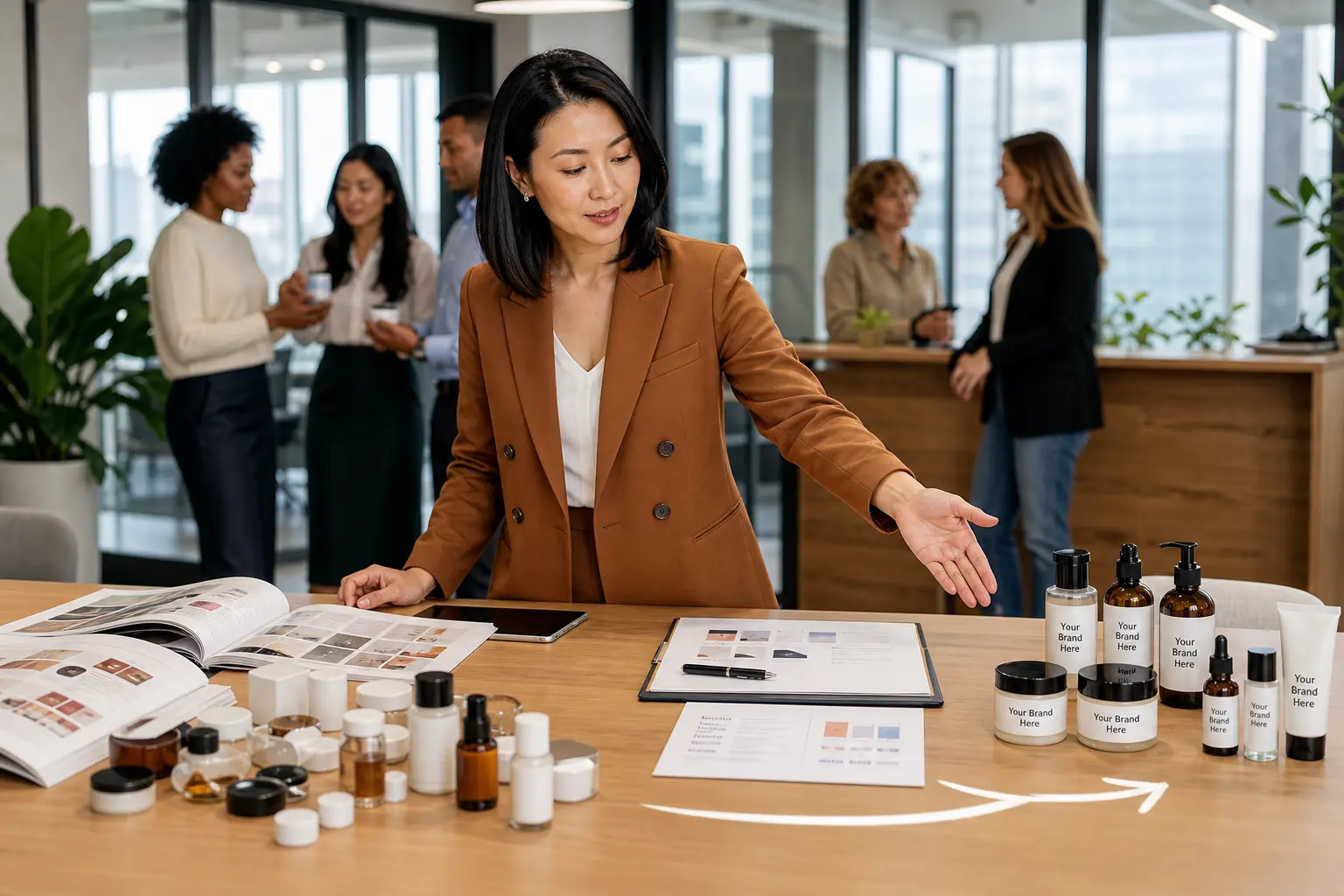
Instead of choosing from one manufacturer’s small catalog of ready-made products (white label), or creating everything from zero (full private label), you do something in between.
You access a network of manufacturers, each with their own formulation portfolio. Thousands of tested, stable formulas across all categories, textures, fragrances, and performance profiles, not 100 or 200 ready-made products.
From that enormous library, you select the formula that best matches your product brief.
Then you customize it.
A different fragrance. A specific active ingredient you want to add. A texture adjustment. A different concentration.
The formula is not created from scratch. But it is not the same thing anyone else is selling either.
And then you design the complete visual presentation: the packaging, the bottle, the applicator, the box, the label.
The result is a product that looks, feels, and performs like a private label product, developed at a speed and cost closer to white label.
The Hybrid Model gives you the differentiation of private label and the efficiency of white label, both at once.
The word "hybrid" gets confused with "semi-custom" in conversations with manufacturers. It should not.
Why this is different from "semi-custom"
Some manufacturers offer what they call "semi-custom" options. You choose a base formula and they let you change the fragrance.
The Hybrid Model is more than that.
With a typical semi-custom option, you are limited to one manufacturer’s catalog. Maybe 100 to 200 formulas.
With the Hybrid Model, the idea is to explore as many manufacturers as possible before choosing. Every extra manufacturer you contact widens the pool of formulas you can evaluate.
If you contact 3 manufacturers, you might be choosing from 500 formulas. If you contact 10, you are looking at thousands. If you work with someone who has relationships across 14+ labs, you potentially access several thousand.
The principle is the same regardless of how many manufacturers you reach: start from existing, proven formulas and customize them. Do not create from scratch. Do not accept generic off-the-shelf either.
Different manufacturers also specialize in different things (one might be exceptional at serums, another at haircare treatments, another at natural formulations), so exploring multiple labs means finding the best fit for each product in your line.
How the Hybrid Model Works in Practice
The strategic process does not change
The strategic work is the same whatever production model you pick.
Whether you choose white label, private label, or hybrid, you still follow the Reverse Engineering Approach: define your foundation, build your brand identity and naming, then approach manufacturers.
The Hybrid Model does not change WHEN you do things. It changes HOW you work with manufacturers once you get to that stage.
With white label, you arrive at the manufacturer and say: "What do you have? I will take it as-is."
With full private label, you arrive and say: "I need you to develop something entirely new from scratch."
With the Hybrid Model, you arrive and say: "Here is my product brief. Show me what you already have that comes closest to what I need. Then let us customize it."
Same strategic foundation. Same brand identity work. Different production approach.
What happens at the production stage
Once you have your brand strategy, your naming, and your product brief (all done before contacting any manufacturer), the hybrid process looks like this:
You present your brief to manufacturers.
You explain what you need: what type of product, what skin or hair concern it addresses, what texture and sensory profile, what ingredients matter, what price point you are targeting.
You evaluate existing formulas against your brief.
The manufacturer shows you what they already have. You compare it to your brief. The closer the match, the less customization needed.
You customize selectively.
This is where the hybrid part happens.
You do not accept the formula as-is (that would be white label). But you also do not start from zero (that would be full private label).
You adjust what matters. Maybe a fragrance that matches your brand identity. Maybe adding a specific active ingredient. Maybe a texture refinement.
These adjustments are small. They do not require months of R&D. But they make the product genuinely yours.
You design the complete packaging.
Your bottle. Your label. Your applicator. Your box. Your color scheme.
The visual presentation is 100% yours. Nothing shared with any other brand.
Even if someone were to Google the INCI list and find a similar base formula somewhere, your product looks different, feels different, and is experienced as something else entirely.
What you keep from white label
You get to market faster. 3 to 5 months instead of 6 to 12 for full custom.
Development costs stay low because you are not paying for R&D from scratch.
The formulas you start from are already tested and stable. That means less risk of surprises during stability testing.
And MOQs stay lower compared to full custom private label.
What you gain from private label
You can adjust the formula. A different fragrance. A specific active ingredient. A texture change.
Your packaging is completely custom, and none of it is shared with another brand.
The product is genuinely yours, not a catalog copy.
That means higher margins through premium positioning. And the ability to build a cohesive brand line over time, where every product connects to the others.
What makes the Hybrid Model powerful
You can explore multiple manufacturers to find the best formula match. The wider you search, the better your chances.
Each product in your line can come from a different lab, matched to their specific specialization.
Your product selection is driven by your brand brief, not by what one manufacturer happens to have available.
And you reduce risk because you are starting from proven, stable formulas, rather than hoping that a formula created from scratch will pass every test.
Building brand equity from day one
White label cannot give you brand equity.
When you use white label, your product is identical to other brands using the same formula. You cannot differentiate. You cannot build a unique identity around the product itself.
Your brand has no intrinsic value beyond the label.
With the Hybrid Model, the combination of formula customization and full packaging control creates a product that is genuinely different. It may have started from an existing base, but the final result is yours.
That differentiation is what allows you to build real brand value over time. The kind of value that appreciates. The kind of value that makes your brand worth 3 to 5 times its annual profit if you ever decide to sell.
White label products stay interchangeable, so none of that value accumulates. The Hybrid Model gives you a product that is yours to build on.
A practical example
Here is what this looks like in a real scenario.
A founder wants to launch a 3-product haircare line focused on damaged, color-treated hair.
She follows the Reverse Engineering Approach: defines her customer, builds her brand identity, creates her naming, and writes her product brief.
That process is the same regardless of which production model she chooses.
Now she reaches the production stage. And here is where the three paths diverge.
With white label, she contacts one manufacturer and picks a shampoo, conditioner, and mask from their catalog.
The products are decent but generic. Other brands sell the same formulas. Her packaging is limited to stock bottles with her label.
Production investment: 5,000 euros. Timeline: 3 weeks.
Fast and affordable. But the brand looks like every other brand on the market. No real differentiation. No brand equity being built.
With full private label, she works with a cosmetic chemist to develop custom formulas from scratch.
Months of sampling. Multiple rounds of stability testing. Custom packaging designed and sourced.
Production investment: 18,000 euros. Timeline: 7 months.
The products are unique. But she overspent her budget and the long timeline exhausted her momentum.
With the Hybrid Model, she contacts 3 to 5 manufacturers with her detailed brief.
She finds a shampoo formula from one lab that is 95% of what she wants. A mask formula from a different manufacturer that is even better than what she imagined.
She adjusts the fragrance on the shampoo. Adds a keratin complex to the mask. Designs custom packaging: distinctive bottle, premium label, branded box.
Production investment: 9,500 euros. Timeline: 4 months.
The products are differentiated. The brand looks professional. And she is building real brand equity from day one.
One strategic process, one brand foundation, three very different outcomes at the production stage.
When Should You Choose the Hybrid Model?
Before the decision framework, here is a side-by-side view of all three paths:
Model
Cost (3-5 products)
Timeline
Differentiation
White label
3,000 to 8,000 €
2 to 4 weeks
Low (same formula as others)
Hybrid
5,000 to 15,000 €
3 to 5 months
Medium-high (customized)
Full private label
15,000 to 30,000+ €
6 to 12 months
Full (from scratch)
The decision framework
Not every situation calls for the hybrid approach. Here is when each model makes the most sense:
Choose white label when:
You need to test a category quickly.
You have a very small budget (under 3,000 euros), which buys a single-product test rather than a line.
You want to validate demand before investing in customization.
You need to fill a gap in your existing line temporarily.
White label is a tool, and a useful one. Some of my most successful clients started with a white label product to test the market, and then moved to hybrid for their main line once they had data.
Choose full private label when:
You have a specific technical requirement (a formula that simply does not exist yet).
Your budget allows 15,000 to 30,000+ euros for development.
You are building a clinical-style professional line (dermocosmetics).
You have very specific performance claims that require custom formulation and testing.
Full private label is the premium path. It makes sense when you know exactly what you need and have the resources to invest in getting it right.
Choose the hybrid model when:
You want real differentiation without full custom costs.
Your budget is 5,000 to 15,000 euros for 3 to 5 products.
You want to launch within 3 to 5 months (not 6 to 12).
You want professional-quality products with your own visual identity.
You want to build a brand, not just sell a product.
For most first-time founders, the hybrid model is the sweet spot.
It gives you enough differentiation to build a credible brand. It keeps costs manageable. It reduces development risk. And it gets you to market faster than full custom.
The three models are not permanent decisions. Many brands start with hybrid for their first launch, then develop full custom formulas for key products in year 2 or 3. The hybrid model is often the smartest starting point, not the final destination.
White label gives you speed. Private label gives you uniqueness. The Hybrid Model gives you strategic balance. The model matters less than how clearly you understand why you are choosing it.
To make the decision concrete, here is what each path costs and how long it takes.
The Cost, Timeline, and Results You Can Expect
Investment
Hybrid Model (3 to 5 products): 5,000 to 15,000 euros
This includes formula selection and customization, first production run, packaging design and materials, and regulatory documentation.
Compare that to white label (3,000 to 8,000 euros for similar product count) and full private label (15,000 to 30,000+ euros).
The hybrid sits in the middle. More investment than white label. Less than full custom. But the differentiation and margin potential are significantly higher than white label.
Timeline
From brief to finished products: 3 to 5 months.
The breakdown:
Brand strategy and product brief: 2 to 4 weeks (if not already done)
Formula selection and customization: 4 to 8 weeks
Packaging design and production setup: 4 to 6 weeks (overlapping)
First production run: 3 to 5 weeks
Regulatory: running in parallel
Compare that to full private label (6 to 12 months) and white label (2 to 4 weeks).
The hybrid is faster than custom because you are not developing from zero. But it takes longer than pure white label because you are actually customizing and designing.
Margins
Because the hybrid model allows full packaging customization and selective formula adjustments, you can position your product as a premium or professional brand.
That means pricing at x4 to x6 margins (comparable to private label) rather than x2 to x3 margins (typical of white label).
A product that costs 4 to 5 euros to produce, positioned well, sells for 22 to 30 euros.
Over a year, the margin difference between hybrid and white label positioning can be 15,000 to 40,000 euros on the same volume of sales.
The product is slightly more expensive to produce than white label. But the revenue potential is significantly higher.
Who this approach works for
The Hybrid Model works across all three types of founders:
Salon owners and estheticians:
Professional products with your brand identity, using proven formulas customized for your specific expertise.
You already know what works because you use products on clients every day. That knowledge becomes your product brief. The hybrid model turns your professional experience into a branded product line.
Budget-friendly. Professional positioning. Margins of x5 to x6 when you sell in-salon and through your own channels.
E-commerce sellers:
Products with real differentiation for Amazon and Shopify.
Not the same generic product every other seller has. With custom packaging and formula adjustments, your listing looks premium. Your product photos stand out. Your INCI list is not identical to 20 competitors.
That differentiation means better conversion rates, higher pricing, and stronger reviews. On Amazon specifically, it means you can build A+ Content around your unique product story.
Influencers and content creators:
Products that look and feel genuinely yours.
Your audience will examine every detail. They will Google ingredients. They will compare your product to others. If it is a white label product repackaged, someone will notice.
The hybrid model gives you enough customization to be authentic. Enough quality to be credible. And enough visual distinctiveness that your audience sees YOUR brand, not a relabeled product.
How the Hybrid Model connects to everything else
If you have been reading the other articles in this series, you can see how the pieces fit together.
The 30/70 Rule tells you that product quality is 30% of success, and branding, marketing, and strategy are the rest. The Hybrid Model supports this by keeping product costs efficient, freeing budget for the 70%.
The Ecosystem Approach tells you to build a system, not just a product. The Hybrid Model enables this by giving you differentiated products within a budget that still covers branding, compliance, and marketing.
The Reverse Engineering Approach tells you to define your strategy before your product. The Hybrid Model is the most natural production method for this approach, because you match a formula to your brief rather than adapting your brief to a catalog.
These four concepts are all parts of one philosophy.
Build the strategy first. Invest across the whole ecosystem. Use the Hybrid Model to create differentiated products efficiently. And allocate your budget according to the 30/70 Rule.
What is the Hybrid Model in private label cosmetics?
The Hybrid Model combines elements of white label (using tested, existing formulas) and private label (customizing formulation and packaging). You select from a large library of formulas across multiple manufacturers, customize key elements (fragrance, active ingredients, texture), and design fully custom packaging. The result is a differentiated product without the cost and time of creating everything from scratch.
How is the Hybrid Model different from semi-custom?
A single manufacturer’s "semi-custom" option gives you their catalog (100 to 200 formulas). The Hybrid Model, working through a network of 14+ manufacturers, gives you access to thousands of formulas. The selection pool is vastly larger, and each product can be matched to the manufacturer best suited for that specific formula.
How much does the Hybrid Model cost?
For 3 to 5 products: 5,000 to 15,000 euros. This includes formula selection, customization, first production run, packaging, and regulatory. It costs more than white label but less than full custom private label. The margin potential is significantly higher than white label.
How long does the Hybrid Model take?
From product brief to finished products: 3 to 5 months. Faster than full custom private label (6 to 12 months) but longer than pure white label (2 to 4 weeks). The time is used for formula selection, customization, packaging design, and regulatory compliance.
Can I still build a real brand with the Hybrid Model?
Yes. The full packaging customization (bottle, label, applicator, box) creates a product that looks and feels like a fully custom brand. The formula adjustments make it genuinely different from catalog products. Most customers and even industry professionals cannot distinguish a well-executed hybrid product from a full private label product.
Is the Hybrid Model good for a first launch?
It is the recommended approach for most first-time founders. It provides enough differentiation to build a credible brand, keeps costs manageable, reduces development risk through pre-tested formulas, and gets you to market in 3 to 5 months. Once your brand is established, you can move to full custom formulation for future products if needed.
Most people start with the product. The cosmetiFULL method starts with YOUR brand. Learn the reverse engineering approach that saves time, money, and prevents costly mistakes.
Learn the Ecosystem Approach to cosmetic brand building. Product quality is only one pillar. Strategy, branding, compliance, and marketing complete the picture.