You spend your days analyzing skin. Reading it. Understanding it. Treating it.
You see conditions that most people do not even have names for. You know which ingredients work on which skin types. You know what the textbooks say, and you know what actually works in the real world.
And then your client goes home and uses whatever is on sale at the drugstore.
All that professional care, undone by a 6-euro moisturizer that does nothing for their specific needs.
If you are an esthetician, spa owner, or beauty professional reading this, you know this frustration.
I spent 30 years in the hair and beauty sector, starting behind the chair in Italian salons and eventually building a career as an independent private label cosmetics consultant working with 14+ manufacturers worldwide.
I’ve worked with both hairdressers and estheticians launching their own lines. The principles are the same. But the products, the positioning, and the selling approach are different.
Why Estheticians Have a Unique Advantage in Private Label Skincare
Your skin analysis is your sales tool
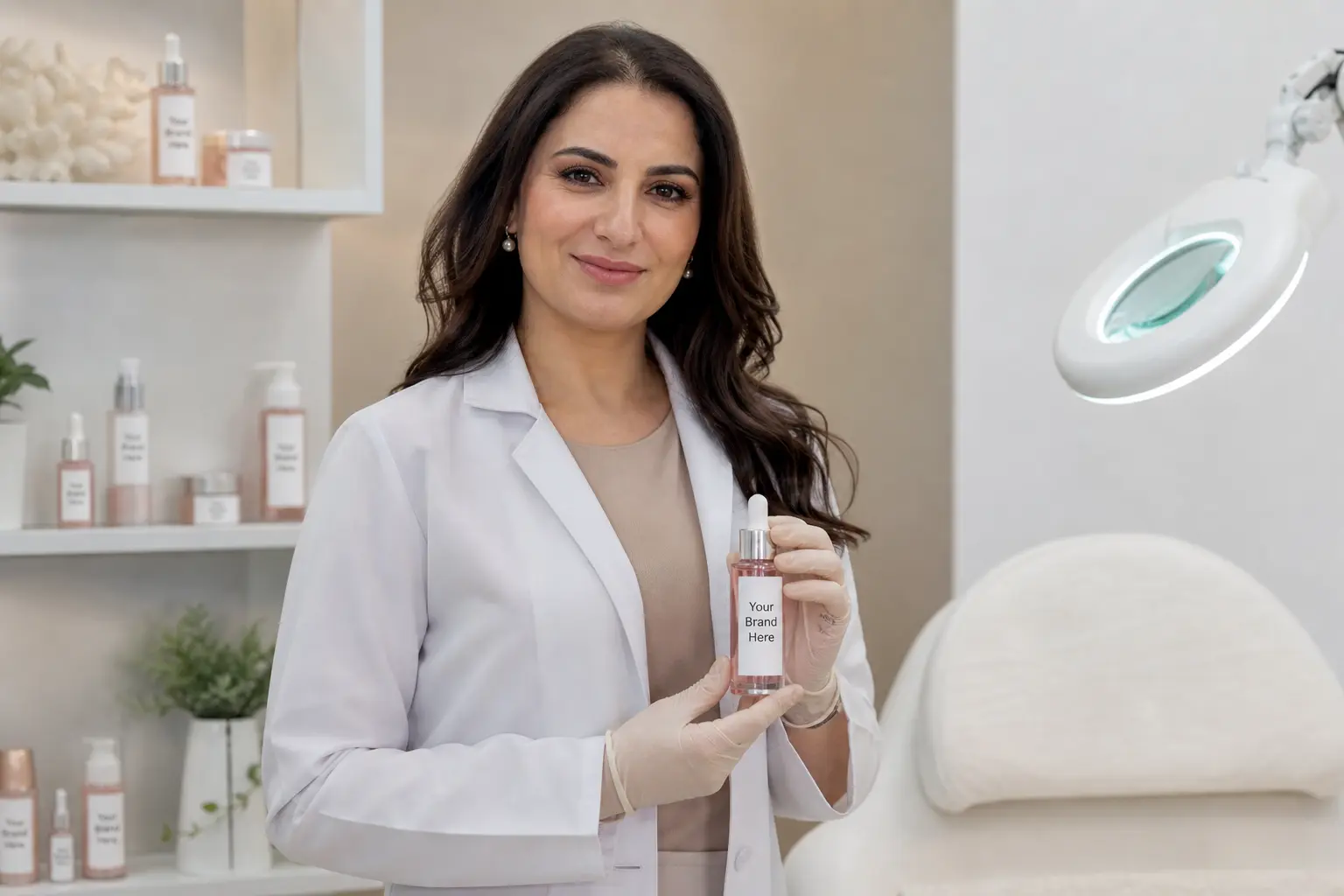
When a client sits in your treatment room, you do something no online brand and no influencer can do.
You assess hydration levels, sebum production, sensitivity, pigmentation, texture, fine lines. You look at their skin under magnification. You ask about their routine, their diet, their stress levels.
That assessment is something no e-commerce brand can replicate. No influencer reviewing products on camera can match it.
It is also the most natural starting point for recommending products.
"Based on what I see today, your skin barrier is compromised. The treatment I am going to do will repair it. And for home, I created a serum specifically for this situation."
That is professional care, not selling.
The difference between you and a random brand on Instagram: you have the diagnostic skills to match the right product to the right skin. Your recommendation is personalized, evidence-based, and backed by years of training and experience.
Your treatment room is your demonstration
Every facial treatment is a live product demo.
Your client feels the cleanser on their skin. They smell the serum. They see the difference when they look in the mirror after the treatment.
By the time you recommend the take-home version, they have already experienced the result.
That is a conversion rate no advertising campaign can match.
I’ve worked with estheticians who convert 40 to 50% of their facial clients into product buyers within the first 3 months of launching their line. Without any paid marketing. Just professional recommendations during and after treatments.
Nobody is asking you to become a salesperson. What sells here is the thing you already are: a skin expert who created something out of real professional experience, which is as credible as a skincare brand story gets.
The credibility is the foundation. The product direction comes from the same place.
Your clients tell you exactly what they need
Every client who walks into your treatment room brings you market research.
"My skin is so dry in winter, nothing works."
"I have tried everything for my dark spots."
"I react to everything. I cannot find products gentle enough."
"My skin looks dull and tired. I do not know what to do."
That is demand data. Real, specific, daily.
When you choose your first product line, you do not need to guess. You already know what your clients need. They told you.
An esthetician who hears "I react to everything" from 10 clients a month knows that a sensitive skin line will sell, not because a trend report says so but because the demand is sitting in her treatment room.
That reduces the biggest risk in private label: creating a product nobody wants.
You test products at a level no brand founder can match
This is an advantage most estheticians do not even realize they have.
Every day, you apply skincare products to different skin types. Oily skin. Dry skin. Combination. Sensitive. Mature. Acne-prone.
You have tested more serums, creams, masks, and treatments in a single year than most skincare influencers test in a decade.
You know how a formula feels on dehydrated skin versus oily skin. You know which textures absorb well and which leave residue. You know which active ingredients deliver visible results and which are just marketing claims.
When you come to select or develop your own products, that hands-on experience is priceless.
An influencer tests a product on her own face. You have tested products on hundreds of different faces, with hundreds of different conditions.
That depth of professional testing means your product selection will be more informed. Your feedback to the manufacturer will be more precise.
And your confidence when recommending the final product to clients will come from real clinical experience, not just personal preference.
What Products Should You Start With?
The 3-product system
I always recommend starting with 3 products, not 1 and not 7.
A hero product that targets a specific skin concern, plus 2 complementary products that prepare the skin for the hero and seal in its benefits.
For skincare, the most effective starting system is:
A cleanser (prepares the skin, removes barriers to absorption)
A targeted serum (your hero product, the one that delivers the visible result)
A moisturizer or finishing product (seals in the serum, protects the skin)
This gives you a complete mini-routine. Simple enough for your clients to follow at home. Effective enough to maintain the results of your professional treatments.
Your clients will buy the system as a bundle. Not just the serum. Because you will explain that the cleanser prepares and the moisturizer seals. They trust your protocol recommendation.
That bundle strategy means your average sale is 60 to 90 EUR/USD instead of 25. (Cost and revenue figures throughout this article are indicative estimates that vary by manufacturer, region, and project scope.)
Choose based on your deepest expertise
If you specialize in anti-aging treatments, your first line should be anti-aging.
If you work with acne-prone skin every day, start with a line for problematic skin.
If your clients come to you for hydration and skin barrier repair, start there.
Do not launch a "general skincare line for everyone." It has no story, no positioning, and no reason to be chosen over the thousands of brands already available.
A focused line built on your specific expertise is the only line worth launching first.
Professional cabin products vs retail products
This is where skincare is different from haircare.
In your treatment room, you use professional-strength products. Higher concentrations of active ingredients. Larger formats. Products designed to be applied by a professional.
For retail (what the client takes home), you need a separate version. Lower concentrations (safe for daily unsupervised use), smaller formats (30ml, 50ml), and packaging designed for a bathroom shelf.
Some products work in both contexts (a gentle cleanser, for example). Others need two distinct versions (a professional-grade peel in-cabin vs a mild exfoliating serum for home use).
Plan this from the beginning. Your manufacturer needs to know which products require dual formulation and which work as a single version.
Here are the ranges for an esthetician launching 3 products:
Hybrid approach (recommended for most estheticians): 5,000 to 15,000 euros
You select from tested formulas, customize key elements (active ingredient focus, fragrance, texture), and create packaging that reflects your professional positioning.
Standard private label: 8,000 to 20,000 euros
Fully customized formulation, professional packaging, complete regulatory documentation.
Where the money goes:
Formulation and sampling: 1,000 to 3,000 euros
First production run (500-1,000 units per product): 1,500 to 4,000 euros
Packaging design and materials: 1,000 to 3,000 euros
Regulatory (CPSR, PIF, CPNP): 3,000 to 5,000 euros
Branding (logo, visual identity, labels): 800 to 2,000 euros
The advantage estheticians have over online-only brands: your treatment room IS the marketing. Every facial is a product demo. That saves you 2,000 to 5,000 euros compared to someone who needs to build awareness from zero.
Those saved euros are what make the margin math work in your favor.
The margin math for skincare retail
A 30ml targeted serum costs 4 to 6 euros per unit to produce (formula, packaging, label, regulatory amortized).
You sell it in your spa or studio for 35 to 45 euros.
That is a x6 to x8 multiplier. Higher than haircare retail. Because skincare serums have higher perceived value and clients expect to pay more for clinical-grade products.
Compare that to reselling a professional brand: you buy at 18 euros, sell at 35. That is roughly x2 with 17 euros profit per unit.
With your own line: 29 to 41 euros profit per unit. On the same shelf.
The difference adds up fast. 30 to 40 units per month means 10,400 to 19,700 euros in annual product profit.
For a complete cost breakdown covering every line item, there is a dedicated guide on the site.
How Do You Sell Products When Your Hands Are on Their Face?
The consultation is the pre-sale
The selling starts before the treatment begins.
When you do your initial skin assessment, you explain what you see and what the skin needs. You describe what you are going to do during the treatment and why.
"Your skin is dehydrated and the barrier is weakened. I am going to use a deeply hydrating protocol today. The serum I will apply is the same one I developed for home use, so you will be able to continue this treatment between appointments."
Right there. Before the treatment even starts, the client knows:
What her skin needs (you diagnosed it)
What you are going to do about it (professional treatment)
That you have a product for home use (the seed is planted)
By the end of the facial, she has felt the product on her skin. She has seen the result in the mirror. The recommendation is already made.
The take-home moment
After the treatment, your client’s skin looks and feels transformed.
The next morning, she washes her face with whatever she has at home. And her skin does not look the same.
That gap between "post-treatment skin" and "morning after skin" is your biggest sales opportunity.
Your products bridge that gap. They let the client maintain the treatment results at home.
The take-home recommendation is natural: "To maintain what we did today, this is the routine I recommend for home."
And because she just experienced the products on her skin, the recommendation converts.
Once a client buys your system and sees results, she reorders. A 3-product routine at 75 euros every 2 to 3 months means 300 to 450 euros per year per client in product revenue.
Multiply that by 50 regular facial clients: 15,000 to 22,500 euros in annual product revenue. Just from your existing client base.
Now scale that.
A spa with 2 to 3 estheticians, each seeing 10 to 15 facial clients per week, can easily reach 100 to 150 active product buyers.
At 300 to 450 euros per client per year, that is 30,000 to 67,500 euros in product revenue from spa retail alone.
Add a simple website for reorders and that number grows further.
Add wholesale to 5 to 10 non-competing spas in your area, and you are looking at another 20,000 to 40,000 euros per year.
Within 2 to 3 years, a well-built esthetician skincare brand can generate 60,000 to 120,000 euros in annual product revenue.
That is a revenue stream that can match or even exceed your treatment income, not a side income.
And it is the beginning of a business that does not depend entirely on your hands being on someone’s face for every euro earned.
Your team as your sales force
If you have estheticians working for you, they need to know your products inside out.
They need the ingredients, the mechanisms, and the skin types each product works best for, not just the names.
Estheticians respond well to scientific education. Give them a proper training session with ingredient information, application protocols, and recommended pairings for different skin concerns.
Because your margins on private label are x6 to x8 instead of x2, you can offer better commissions on product sales. That motivates your team and improves their retention.
An esthetician earning good product commissions is less likely to leave for another spa. Your products become a reason to stay.
Beyond the treatment room: when to expand
Once products sell consistently in-spa, you have options:
Your own website: for clients who want to reorder without booking a treatment. Budget 500 to 1,500 euros for a simple Shopify store.
Other spas and studios: wholesale to non-competing estheticians in your area. They buy at 50% of retail. You earn margin without doing any selling.
Online presence: share your expertise through educational skincare content. Client results (with permission), ingredient explanations, skincare tips. This builds awareness beyond your local market.
Sequencing matters. Prove the products in your treatment room first. Build a base of happy, reordering clients.
Then expand one channel at a time.
Do not try to launch in-spa, online, and wholesale simultaneously. Each channel requires different effort and attention. Get one working well before adding the next.
We covered this. But it is worth repeating because it is the most common mistake.
Start with 3. Prove they sell. Then add more based on what your clients ask for.
Your second launch should be guided by the feedback from your first 100 sales, not by what you think the market needs.
Pricing too low
Clinical skincare commands clinical prices.
If your serum costs 4 euros to produce and you sell it for 12, it looks like a drugstore product. Your clients will not take it seriously.
If you sell it for 38, it looks like what it is: a professional-grade product created by a licensed skin expert.
Your clients pay 80 to 120 euros for a facial treatment. A 38-euro serum is a small addition to someone who trusts your expertise.
Ignoring the clinical positioning
You are selling skincare that comes from a licensed professional.
That is your positioning. And it should show in everything: the packaging (clean, clinical, professional), the language (ingredient-forward, not marketing-speak), and the claims (specific, evidence-based, not "miracle" promises).
Clinical positioning is about look, language and professional credibility, not medical claims: a cosmetic cannot claim to treat skin conditions, and any "clinically proven" wording on your packaging must be supported by adequate and verifiable evidence, at a level consistent with the type of claim you are making (Commission Regulation (EU) No 655/2013, Annex, common criterion 3). Proof of the effect claimed goes in your Product Information File where justified by the nature or the effect of the product (Regulation (EC) No 1223/2009, Article 11(2)(d)).
The estheticians who succeed with private label are the ones whose products look and feel like they came from a professional environment rather than a generic beauty brand.
Your first steps
Listen to your clients for 30 days. Write down every skin concern they mention. That list is your product direction.
Choose your niche. Anti-aging? Sensitive skin? Acne? Hydration? Pick the one where your expertise is deepest and client demand is highest.
Start with 3 products. One hero serum plus a cleanser and a moisturizer that support its action.
Set a realistic budget. 5,000 to 15,000 euros for a hybrid approach, 8,000 to 20,000 for full private label.
Plan both formats. Professional cabin products and retail take-home versions. Your manufacturer needs to know this from the start.
Find the right partner. Not the cheapest manufacturer. The one who understands clinical skincare and can deliver the quality your professional reputation requires.
Set up your staff commission structure. Give your team a reason to recommend your products from day one.
Launch and listen. Your first 100 sales will teach you more than any market research.
The path from esthetician to brand founder is shorter than you think.
You already have the expertise, the clients, and the trust.
The knowledge you apply every day in your treatment room is the same knowledge that makes a great skincare brand. The only difference is putting it in a bottle.
Can I create my own skincare line while still running my spa full-time?
Yes. Most estheticians who launch private label products do it alongside their practice. The development phase (formulation, sampling, branding) takes 4 to 9 months but requires only 3 to 5 hours per week. After launch, selling integrates naturally into your existing treatments and consultations.
What products should an esthetician start with?
Start with 3 products: a cleanser, a targeted serum (your hero product), and a moisturizer or finishing product. Choose a specific skin concern (anti-aging, sensitive skin, acne, hydration) rather than creating a general line. Your deepest expertise and your clients' most frequent requests should guide the choice.
How is launching skincare different from launching haircare?
The core business principles are the same (expertise, trust, in-room selling). But skincare has differences: clinical positioning is more important, active ingredient concentrations require careful formulation, you may need both professional cabin formats and retail formats, and skincare commands higher price points (35-45 euros per product vs 20-25 for haircare).
How much does it cost for an esthetician to launch a skincare line?
The hybrid approach costs 5,000 to 15,000 euros for 3 products. Standard private label costs 8,000 to 20,000 euros. This includes formulation, production, packaging, regulatory, and branding. Estheticians save on marketing costs because the treatment room serves as the primary sales channel.
What margins can I expect on private label skincare?
Skincare serums and treatments typically achieve x6 to x8 margins (production cost 4-6 euros, retail 35-45 euros). Compare that to reselling professional brands at roughly x2 margins. The difference is significant over a year of sales.
Do I need different products for professional use and retail?
It depends on the product. Some products (cleansers, moisturizers) can work in a single format. Others (concentrated serums, peels, treatment masks) may need a professional-strength cabin version and a milder retail version. Discuss this with your manufacturer during the development phase.
Most people start with the product. The cosmetiFULL method starts with YOUR brand. Learn the reverse engineering approach that saves time, money, and prevents costly mistakes.
The third option most guides skip: the hybrid model combines private label customization with white label efficiency. How to get differentiation and speed at once.
Learn the Ecosystem Approach to cosmetic brand building. Product quality is only one pillar. Strategy, branding, compliance, and marketing complete the picture.