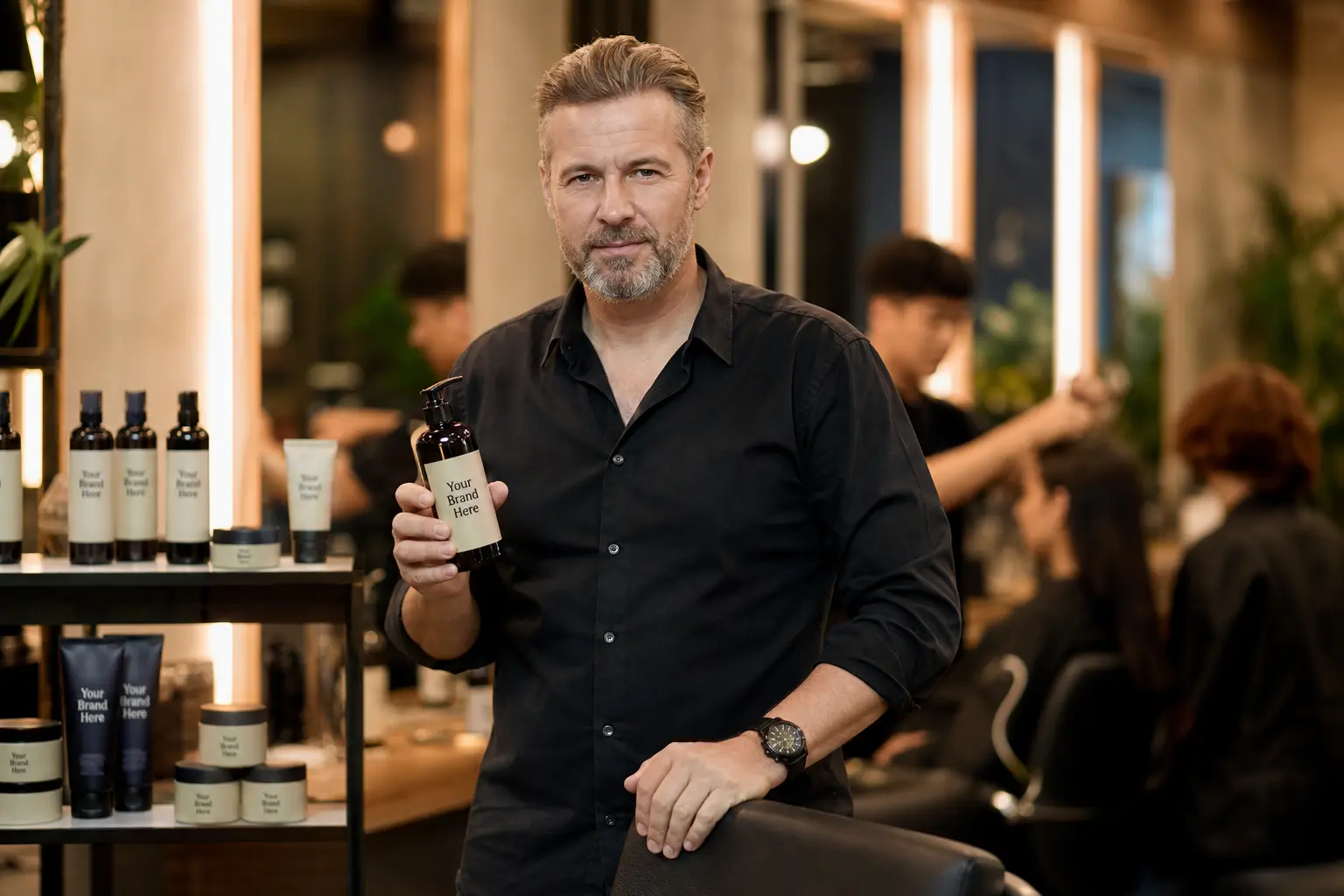
Cutting hair. Mixing color. Recommending products I did not own and earning nothing beyond my service fee when clients bought them.
If you are a hairdresser or salon owner reading this, you know the feeling.
You spend years building trust with your clients, becoming their go-to expert for everything hair and beauty. And then they walk to the shelf and buy a product that someone else created, someone else branded, and someone else profits from.
You recommend it. They buy it. The brand makes the money.
I spent 30 years in this industry, starting as a hairdresser in Italian salons and eventually building a career as an independent private label cosmetics consultant working with 14+ manufacturers worldwide. That journey taught me things that no manufacturer’s sales page will ever tell you.
This guide is written specifically for salon professionals, by one hairdresser for another, not by someone who has never held a pair of scissors.
Why Salon Professionals Have an Unfair Advantage in Private Label
You already have something most founders do not
Most people who want to launch a cosmetics brand start from zero.
No audience. No expertise. No trust.
You start with all three.
Your clients already trust you. They already come to you for advice, and they already buy products based on your recommendation.
That is an unfair advantage that most first-time founders would pay thousands of euros to have.
A random person launching a skincare brand on Instagram needs to spend months and thousands of euros building trust with strangers. Running ads. Creating content. Hoping that someone will take a chance on an unknown brand.
You have people sitting in your chair every day who already believe in your expertise.
When you launch your own product line, you are not asking strangers to trust a new brand. You are asking people who already trust you to try something you created.
The conversion rate on that is completely different from a cold audience seeing an Instagram ad.
I’ve seen salon owners convert 30 to 40% of their regular clients into product buyers within the first 3 months of launching. Try getting that conversion rate with paid advertising. It does not happen.
Your expertise is your branding
You have spent years learning what works on real hair and real skin.
From doing it every day, on real people, with real results, not from reading articles.
That knowledge is your brand. And it is the one thing no manufacturer, no marketing agency, and no competitor can replicate.
A salon owner who has spent 15 years specializing in color-treated hair can create a product line for color protection that no generic manufacturer can match in terms of credibility.
Not because the formula is necessarily different, but because the story behind the product is real.
"I formulated this because I saw what color-treated hair needs, every single day, for 15 years."
That sentence is more powerful than any marketing agency could write.
Because it is true. And your clients know it is true. They have seen you work.
Being what you already are is enough to sell your products: an expert who created something out of real experience. You will not have to turn yourself into a marketer, and there is no more authentic brand story than that.
That authenticity starts paying back the moment the product hits your shelves.
Your salon is your first store
You do not need to build an e-commerce site to make your first sale.
Your salon is your retail space. Your chair is your sampling station. Your clients are your first customers.
Every appointment is a product demonstration.
Every satisfied client is a walking testimonial.
I’ve worked with salon owners who reached 2,000 to 4,000 EUR/USD in monthly product revenue within the first 6 months, selling exclusively from their salon. (Revenue and cost figures throughout this article are indicative estimates that vary by manufacturer, region, and project scope.)
None of them had a website, an Amazon listing, or an ad budget.
They had good products on the shelf and they recommended them during appointments.
That is 24,000 to 48,000 euros per year in additional revenue. From a space you already pay rent for. With clients you already have.
And that is just the salon.
When you add a simple website for reorders, a social media presence showing real client results, and eventually a marketplace like Amazon, the numbers grow exponentially.
The salon is the foundation. Everything else multiplies it.
You test products at a level nobody else can
This is an advantage most hairdressers do not even realize they have.
Every day, multiple times a day, you use products on real hair. Different hair types. Different conditions. Different needs.
You have tested more shampoos, masks, treatments, and styling products in a single year than most beauty influencers test in a decade.
You know what a good formula feels like in your hands. You know how a product behaves on fine hair versus thick hair. You know which textures rinse clean and which leave residue.
When you come to select or develop your own products, that hands-on experience is priceless.
An influencer samples a product at home on her own hair and gives her opinion. You have tested it on hundreds of different heads.
That depth of testing means your product selection will be better. Your feedback to the manufacturer will be more precise. And your confidence when recommending the final product to clients will be genuine, not performed.
Your clients tell you what they need
This is the last piece of the puzzle. And it is the one that reduces your investment risk the most.
Every day, clients sit in your chair and tell you their problems.
"My color fades after two weeks."
"My scalp is always dry and itchy."
"I cannot get any volume no matter what I use."
"My hair breaks every time I try to grow it out."
That is market research. Real, unfiltered, daily market research.
You do not need to run surveys or study Amazon reviews. Your clients hand you the data every single day.
When you choose your first product line, you already know where the demand is. Because your clients told you.
A hairdresser who hears "my color fades" from 15 clients a month knows that a color protection line will sell, not because a trend report says so but because the demand is sitting in her chair.
That reduces the biggest risk in private label: creating a product nobody wants.
You already know they want it. They told you.
What Products Should You Start With?
The 3 to 5 product rule
The biggest mistake salon owners make is wanting to launch too many products at once.
"I need a shampoo, conditioner, mask, serum, leave-in, styling spray, and maybe a scalp treatment."
That is 7 products. The standard private label band is 8,000 to 20,000 euros, and seven products take you past the top of it before you sell a single unit.
Start with 3 to 5. Maximum.
A hero product (the one you will push hardest), and 2 to 4 supporting products that complement it and work together as a system.
For haircare, a classic starting lineup is:
A signature shampoo (your hero product)
A matching conditioner
A treatment mask or a leave-in product
Some treatments, like reconstruction protocols, naturally require 4 or 5 products to work properly. That is fine. If the system makes sense as a complete routine, 5 products is acceptable.
Every product in your starting line should serve a clear purpose and work with the others. A cohesive system, not 5 random products.
3 to 5 products give you a credible line without overwhelming your budget or your shelf space.
Choose based on what you know, not what is trending
Your first products should come from your deepest expertise.
If you specialize in curly hair, your first line should be for curly hair.
If you deal with damaged hair every day, your first line should be a repair line.
And if your clients constantly ask you about scalp issues, start there.
Do not launch a "general" line because it seems safer.
A general line has no story. It competes with every other shampoo on the shelf at half the price. There is no reason for someone to choose yours over a brand they already know.
A focused line built on your real specialization has a story your clients already believe.
When you say "I created this specifically for color-treated hair because in 15 years behind the chair I could never find exactly what I wanted," that is a positioning statement no big brand can make.
And it is the reason your clients will choose your product over the one they have been using for years.
If your salon also offers facial treatments and you are thinking about a skincare line, the approach is similar but the products and positioning are different. There is a dedicated guide for estheticians and beauty professionals that covers skincare-specific strategy.
The Real Cost for a Salon Owner
The realistic numbers
The investment ranges are the same as any private label launch. But the way you spend the money is different because you already have a distribution channel (your salon).
Here are the realistic ranges for a salon owner launching 3 products:
Hybrid approach (recommended for most salon owners): 5,000 to 15,000 euros
This uses existing tested formulas customized to your specifications. Faster, lower risk, and you still get products that are yours.
Standard private label: 8,000 to 20,000 euros
Fully customized formulation, professional packaging, complete regulatory documentation.
Where the money goes:
Formulation and sampling: 1,000 to 3,000 euros
First production run (500-1,000 units per product): 1,500 to 4,000 euros
Packaging design and materials: 1,000 to 3,000 euros
Regulatory (CPSR, PIF, CPNP): 3,000 to 5,000 euros
Branding (logo, visual identity, labels): 800 to 2,000 euros
The advantage salon owners have over online-only founders: you do not need to budget heavily for marketing at the start. Your salon IS the marketing. Every appointment is a product demo. That saves you 2,000 to 5,000 euros compared to someone who needs to build awareness from zero.
That saved marketing budget is what frees you to invest properly in the parts that matter most.
The margin math for salon retail
A concrete example.
You produce a 250ml professional shampoo. Your all-in cost per unit (formula, packaging, label, regulatory amortized): 4.50 euros.
You sell it in your salon for 22 euros.
That is roughly a x5 multiplier. And since you are selling directly (no marketplace fees, no distributor margin), your net profit per unit is 17.50 euros.
Compare that to reselling a professional brand where you buy at 11 euros and sell at 22 euros. That is an x2 multiplier with 11 euros profit per unit.
The difference: 6.50 euros more per unit on every sale. Over a year, selling 30 to 40 units per month, that is 2,340 to 3,120 euros in additional profit.
From the same shelf. The same clients. The same recommendations.
For a complete cost breakdown covering every line item in detail, there is a dedicated guide on the site.
How Do You Sell Products When You Are Busy Cutting Hair?
It starts before the chair: the hair analysis
The selling does not begin when the client is ready to leave.
It begins the moment they sit down and you do your initial assessment.
Every professional hairdresser does some form of hair analysis at the start of an appointment. You look at the condition of the hair. You check the scalp. You assess the damage, the dryness, the color fade.
That analysis is where the seed is planted.
"I can see your lengths are quite dehydrated, and the color has faded since your last visit. I am going to use a specific treatment I developed for exactly this situation."
Right there. Before you even pick up the scissors.
The client already knows you have your own products. And that you are choosing them specifically for her needs.
That is professional care, not selling. And it converts because by the time the appointment is over, she has experienced the product on her own hair.
Professional formats vs retail formats
For products you use during salon services (shampoos, masks, treatments), you will need professional-size formats. Usually 500ml or 1,000ml bottles for the back bar.
For retail (what the client takes home), smaller formats. Typically 200ml or 250ml.
Some products need both formats. Your signature shampoo will have a large bottle for salon use and a smaller bottle for the shelf.
Other products (like scalp serums, ampoules, liquid crystals, or leave-in oils) usually work in a single format for both salon and retail.
Plan your line with both uses in mind from the start. Your manufacturer needs to know which products require dual packaging.
The in-chair recommendation
This is the easiest and most natural sales method for salon professionals, because it is recommending rather than "selling."
You are already using products during the appointment. You are already explaining what you are doing and why.
The shift is simply: now the product you are using and recommending is yours.
"This is the shampoo I developed for color-treated hair. I created it because I could not find anything on the market that did exactly what I wanted for my clients."
That is a professional sharing their expertise, not a sales pitch. And it converts because the client just felt the product work on their own hair.
The take-home moment
After every appointment, your client leaves with great hair.
The next morning, they wash it with whatever they have at home.
And it does not look the same.
That gap between "salon hair" and "morning after hair" is your biggest sales opportunity.
Your products bridge that gap. They let the client maintain the results between appointments.
Keep the recommendation natural and factual, so it never sounds like a push.
"If you want this to last until your next appointment, this is what I use and this is what I would recommend for home."
Most clients will buy. Because they trust you. Because they just experienced the result.
And here is the part most salon owners do not realize at first: once a client buys your product and likes it, they reorder.
They keep reordering, for months and then for years.
A single client who buys a shampoo and conditioner two or three times a year represents 80 to 120 euros in annual product revenue.
Multiply that by 50 regular clients and you have 4,000 to 6,000 euros in recurring product income per year. Just from your existing salon base.
Now scale that.
A busy salon with 3 stylists, each seeing 15 to 20 clients per week, can easily reach 150 to 200 active product buyers.
At 80 to 120 euros per client per year, that is 12,000 to 24,000 euros in product revenue from salon retail alone.
Add a simple website for reorders (clients who want to buy without coming in), and that number grows further.
Add wholesale to 5 to 10 non-competing salons in your area, and you are looking at another 15,000 to 30,000 euros per year.
Within 2 to 3 years, a well-built salon product line can generate 30,000 to 60,000 euros in annual product revenue.
And that is with a single location as your base.
Salon owners who take the next step (wholesale to other salons, e-commerce, social media) can reach 100,000 to 200,000 euros in annual product revenue by year 3 to 4.
I’ve worked with salon owners who started with 3 products, sold from one location, and within 4 years were generating more revenue from their product line than from their salon services.
That is the inflection point. When the product business becomes the primary income and the salon becomes one of many channels.
That is a business transformation, not a side project.
Turn your team into your sales force
If you have employees, this is where it gets really interesting.
With private label, your margins are high enough that you can afford to share them.
Give your stylists a commission on every product they sell. Not the 5 to 10% you might offer on resold brands. More like 15 to 20%.
Because your margins on private label are x4 to x5 instead of x2, you can pay more and still keep more.
Everybody wins.
Your stylists earn more per sale. They are more motivated to recommend products. Your brand gets promoted by every person in your salon, not just you.
There is also a retention benefit: stylists who earn good commissions on product sales are less likely to leave for another salon. Because at the next salon, they go back to selling someone else’s brand at lower commissions.
Your products become a reason for your team to stay.
I’ve seen salon owners double their product revenue within 3 months of introducing a proper commission structure for their team. The products had not changed; the team had a reason to care.
Beyond the salon: when to expand
Once your products are selling consistently in-salon, you have options:
Your own website: for clients who want to reorder without coming in. Budget 500 to 1,500 euros for a simple Shopify store.
Other salons: wholesale to salons in your area that are not your direct competitors. They buy at 50% of retail, so half the retail price is your revenue on that unit (not your margin), and it comes without any selling effort.
Amazon or marketplace: for broader reach, once you have the inventory and the marketing to support it.
Social media: share your products through real client results, tutorials, and behind-the-scenes content. Founder-led social presence is particularly effective for salon brands.
Sequencing matters. Start in-salon. Prove the product. Then expand one channel at a time.
We covered this above. But it is worth repeating because it is the most common mistake I see.
Start with 3 to 5. Prove they sell. Then add more.
Your second batch of products should be guided by what your clients ask for, not what you think they should want.
Not integrating products into services
If your products sit on a shelf and you never mention them during appointments, they will not sell.
Every service should include your products. Every appointment should be a natural demonstration.
Train your staff too. If you have stylists working for you, they need to know the products and feel confident recommending them.
I’ve seen salon owners invest 10,000 euros in a beautiful product line and then not spend 30 minutes training their team on how to present it.
The result: the products sit on the shelf, and the staff recommends the old brand because they know it better.
Schedule a proper training session. Let them try the products. Explain the ingredients and the benefits in simple terms. Give them a recommended script for the in-chair moment.
When your team believes in the products, they sell them naturally. When they do not know the products, they avoid the conversation.
Pricing too low
This happens a lot. Salon owners feel uncomfortable charging "real" prices because they know the production cost.
"It only costs me 4 euros to make. How can I charge 22?"
You are not selling 4 euros of liquid. You are selling your expertise, your brand, and a result.
Professional positioning requires professional pricing. If your product is priced at 8 euros, it looks amateur. If it is priced at 20 to 25 euros, it looks professional.
Your clients are already paying 80 to 150 euros for a salon appointment. A 22 euro product is a small addition to someone who trusts your expertise.
Trying to do it alone
You know hair. You know your clients. You know what products should do.
You do not know manufacturing, regulatory compliance, packaging design, or brand strategy.
And you do not need to, because that is what consultants and manufacturers are for.
One part stays yours, though, and it is worth knowing before you sign anything. Under EU cosmetics law, whoever puts a product on the market under their own name or trademark is that product’s "responsible person": the one the authorities call when something is wrong. You can pass that role to your manufacturer or to a regulatory consultant, but only through a written mandate that they accept in writing. Put it in the contract. Without it, the role stays with you by default.
The salon owners who succeed fastest are the ones who recognize what they are great at (expertise, client relationships, product vision) and get help for what they are not (the business and technical side).
Your first steps
If you are a salon owner or hairdresser thinking about this, here is where to start:
Listen to your clients. For the next 30 days, write down every hair problem clients mention. That list is your product direction.
Pick your niche. What is your deepest specialization? What do your clients need most? That is your first product line.
Set a realistic budget. 5,000 to 15,000 euros for a hybrid approach, 8,000 to 20,000 for full private label. Include regulatory, branding, and packaging in your number, not just production.
Start with 3 to 5 products. One hero product and 2 to 4 supporting products that work together as a system.
Plan both formats. Professional size for back-bar use and retail size for take-home. Your in-salon experience and your shelf need to tell the same story.
Find the right manufacturing partner. Not the cheapest one. The one who understands your vision and can deliver the quality your professional reputation requires.
Set up your staff commission structure. Give your team a reason to recommend your products from day one.
Launch and listen. Your first 100 sales will teach you more than any market research. Adjust from there.
The path from salon professional to brand founder is shorter than you think.
You already have the hardest parts: the expertise, the trust, and the audience.
The rest is execution. And with the right guidance, it is very doable.
I know because I walked this path. I started behind the chair, just like you. And over 30 years, I built everything that became my career and my consulting practice on the foundation of that salon experience.
The knowledge you have is worth more than you think. It is a service, and it is also a product, a brand, an asset.
The only question is whether you are ready to turn that knowledge into something you own.
Can I create my own product line while still running my salon full-time?
Yes. Most salon owners who launch private label products do it alongside their salon work. The development phase (formulation, sampling, branding) takes 4 to 9 months but does not require full-time attention. You will need 3 to 5 hours per week during development. After launch, selling from your salon requires minimal extra time since it integrates into your existing appointments.
What products should a salon owner start with?
Start with 3 to 5 products maximum. For haircare: a signature shampoo, a matching conditioner, and a treatment mask or leave-in product. Some reconstruction treatments naturally require 4-5 products as a system. Choose based on your deepest expertise and what your clients ask for most often. Your daily client interactions are the best market research you can get.
How much does it cost for a salon owner to launch a product line?
The hybrid approach (recommended for most salon owners) costs 5,000 to 15,000 euros for 3 products. Standard private label costs 8,000 to 20,000 euros. This includes formulation, production, packaging, regulatory, and branding. Salon owners save on initial marketing costs because the salon itself serves as the primary sales and demonstration channel.
How do I sell products if I am not a salesperson?
You do not need to be a salesperson. The selling starts naturally during the hair analysis at the beginning of each appointment. You explain what the client’s hair needs, use your products during the service, and recommend the retail version for home use. It is professional expertise, not a sales pitch. Setting up a staff commission structure (15-20% per sale) turns your entire team into product advocates.
Should I start with white label or private label?
For most salon owners with budgets over 5,000 euros, the hybrid approach (selecting from tested formulas and customizing) gives the best balance of speed, cost, and differentiation. Pure white label risks clients discovering the products are not unique to your salon. Full custom private label is best for owners with larger budgets and very specific formulation needs.
Can I sell to other salons too?
Yes, but not immediately. Focus on selling through your own salon first (6 to 12 months). Once you have proven demand and client feedback, you can approach non-competing salons in your area for wholesale partnerships. Typical wholesale pricing is 50% of retail price.
Most people start with the product. The cosmetiFULL method starts with YOUR brand. Learn the reverse engineering approach that saves time, money, and prevents costly mistakes.
The third option most guides skip: the hybrid model combines private label customization with white label efficiency. How to get differentiation and speed at once.