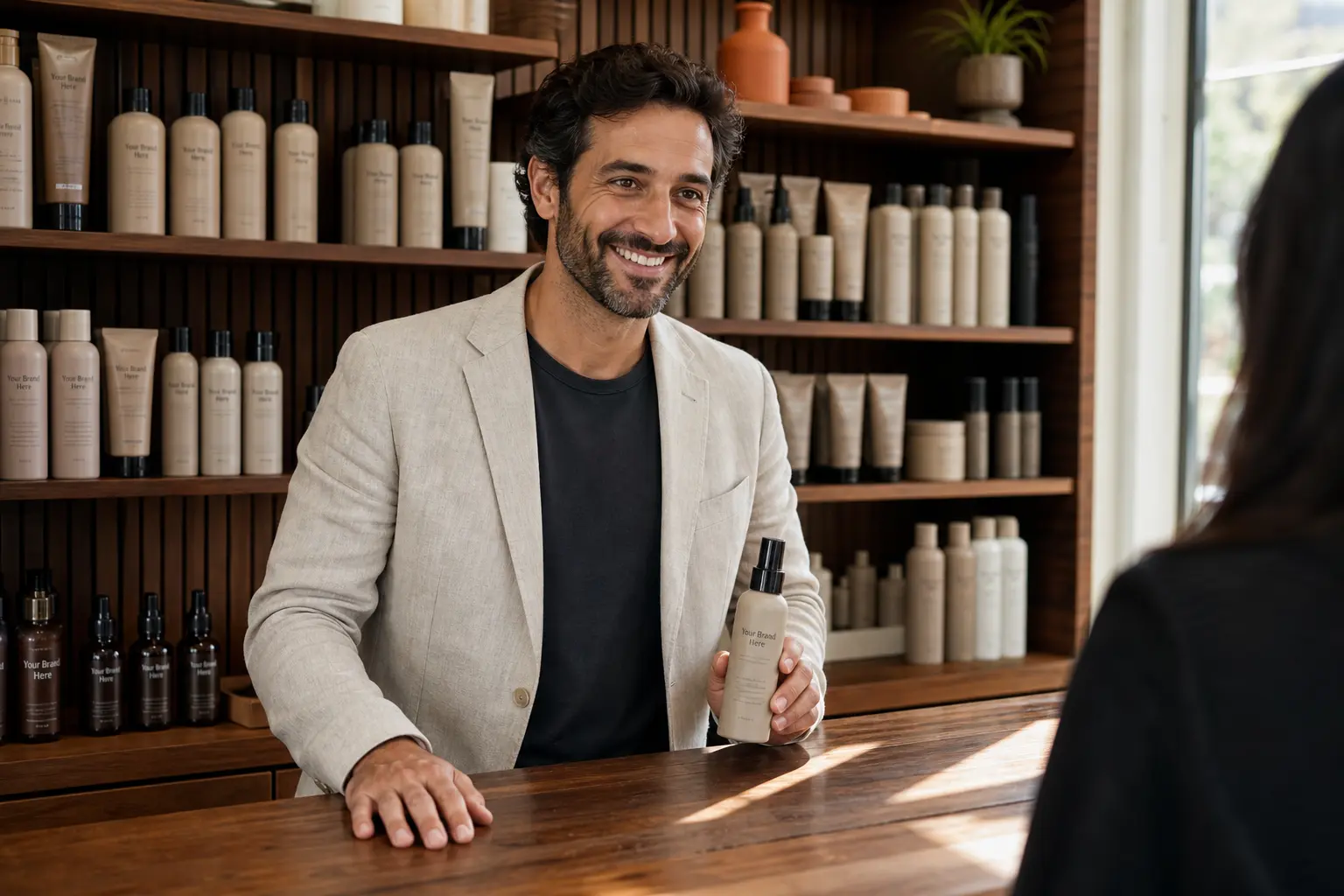
Salon distribution is the practice of placing your cosmetic brand inside professional salons, where a stylist or beauty professional uses your products on clients and resells them at the front desk.
It is one of the oldest sales channels in cosmetics. It is also the channel most commonly misunderstood by founders launching their first brand.
Most strategy guides treat it as a footnote next to DTC and Amazon. That is a mistake.
For some products and some founder profiles, salon distribution is the primary channel, not a side one.
After 30 years in the hair and beauty sector (first as a hairstylist who personally bought from distributors, then as a distributor who sold to salons, now as an independent consultant guiding private label cosmetics brands), I have watched this channel from every angle.
This guide complements the launch playbook and the DTC store guide. All EUR figures are indicative estimates, not promises.
What works in this channel and what does not is mostly unwritten, because it is learned the hard way.
It covers the two-sided dynamic of the salon channel, how to actually get your brand into salons, the pricing cascade, distributor relationships, and the mistakes that close professional doors.
The Two Sides of the Salon Distribution Game
One clarification first.
There are two completely different founder profiles operating in the salon channel.
The first is the beauty professional with their own brand. A hairdresser, an esthetician, a salon owner who creates their own private label line and sells it to their own clients at the front desk. That is technically D2C through a physical retail point, not wholesale. The path is simpler, the margins are higher, and the operational complexity is lower. The dedicated guide for this profile is the hairdresser cosmetics path, with the haircare line guide covering the haircare-specific dual-channel structure.
The second is the distributor or wholesaler with a private-label professional line. They create a brand specifically for B2B, sell to salons, and the salon resells to clients. That is real B2B wholesale. The path is more complex, the margins are tighter, and the operational discipline required is much higher.
This guide focuses on the second profile.
If you are the first (professional with your own brand for your own clients), much of this still applies, but the hybrid model in private label cosmetics for hairdressers is your better starting point.
For the deeper strategic trade-off between B2B and D2C, see the business model guide.
Why the salon channel is harder in 2026 than five years ago
The professional channel has changed in the last five years.
Salon professionals have access to information they never had before.
Five years ago, a salon owner heard about new brands from two or three reps who walked through the door each month. The comparison set was small.
Today, the same salon owner sees brand pitches every day on Instagram, in industry newsletters, on TikTok, in WhatsApp groups with other professionals.
The comparison set is hundreds of brands. Sometimes thousands.
This changes what the brand needs to deliver.
A new brand cannot win on marketing aesthetics alone. Salons have seen too many beautifully-branded products fail at the chair to be impressed by packaging design.
What wins now is technical depth.
The product has to be genuinely professional. The INCI list has to support the formula’s claims, not just decorate them. The active ingredient concentrations have to be at functional levels, not at marketing-sticker levels. The technical performance has to hold up under the scrutiny of a professional who has used 50 brands across their career.
A brand that wins at the chair in 2026 is technically credible first, beautifully branded second.
In the opposite order, the brand fails at the chair within two quarters.
Why dual perspective is the missing layer most guides skip
Most people who write about salon distribution have only seen one side of it.
Either they sold a brand into salons and learned the brand-to-distributor side. Or they ran salons and learned the distributor-to-salon side.
Almost nobody has done both.
I have. And the difference matters.
What looks easy from the brand side
When you are sitting on the brand side, salon distribution looks straightforward.
You make a good product. You set a wholesale price.
You contact distributors or salons directly. They place orders.
You ship. They sell. Recurring revenue starts.
That model is real.
It just hides 80% of what actually decides whether your brand makes it.
The brand side does not see the buyer fatigue. They do not see the pile of new brand pitches that lands on a salon owner’s desk every month, or the silent comparison the salon does between your brand and the seven other indie brands trying to get the same shelf space that quarter.
The brand side sees their own product. It is good. It deserves space.
That confidence is right. It is also not enough.
What it looks like from the salon side
When you are sitting at the front desk of a salon, the picture is different.
You already carry two or three brands you trust. Their reps visit regularly. Their products move predictably.
Your stylists know how to use them, what to recommend, what to upsell to which client. Your shelf is finite. Your client base is finite.
Adding a new brand means displacing something or expanding inventory. Either is friction.
When a new brand approaches, the question is rarely "is this product good?"
The question is: "is this brand worth the work of switching out something that already works?"
That bar is much higher than founders assume.
The salon channel is won at the relationship level, not at the product level. Founders who lead with product specs lose to founders who lead with the salon owner’s actual problem.
What it looks like from the distributor side
I spent years on the distributor side too.
A distributor sees something different again.
The distributor is the bridge between the brand and many salons, not the end user.
The distributor’s worry is not "is this product good for the client."
The distributor’s worry is: "will the salons in my network actually order this brand consistently enough to justify the inventory I have to hold?"
A distributor who stocks 100 units of a brand that sells 5 units in 6 months is not happy.
The distributor’s evaluation is volume-based, repeatability-based, and reputation-based.
Brands that look great on Instagram but fail to move at the salon level get dropped from distribution catalogs within 12-18 months. The distributor cannot afford the warehouse space for slow-movers.
This is the layer most founders never see.
Why the dual perspective changes the strategy
Knowing all three sides changes how you build the brand.
You do not start by asking "how do I sell to salons." You start by asking three questions in sequence.
What problem does my brand solve for the salon owner. Not the client, the owner. What does it solve for the distributor who has to stock and re-stock it consistently. And what does it do for the stylist who has to use it every day on real clients.
If the answer to any of these is unclear, the channel will not work.
If the answer is strong on all three, you have a salon brand.
Most indie cosmetic brands are designed only for the end client. That is why most fail in salon distribution and end up retreating to DTC or Amazon, telling themselves the channel was a bad fit.
The channel is not a bad fit. The brand was just not designed for it.
How Do You Get Your Cosmetic Brand into Salons?
There is a sequence that works and a sequence that does not.
The sequence that does not work: build the product, set a wholesale price, contact distributors, hope.
The sequence that works has more steps but actually delivers traction.
Step 1: validate the brand in your own client base first
Before approaching any external salon or distributor, the founder needs to validate the brand in a real professional context.
If you are a hairstylist, this is your own salon.
If you are not a stylist yourself, this is a small group of friendly salons (3-5) who agree to test the brand at no risk. You provide free product, gather data, iterate.
Salons that have never carried your brand are evaluating two things: does the product work, and does it move at the chair.
Without validation data, every pitch is guesswork.
Founders who skip this step end up arguing with potential distributors over claims they cannot prove. Validation in 2-5 friendly salons gives you the proof you need.
The metrics that matter: percentage of clients who buy after trial, reorder rate at 60 and 90 days, stylist enthusiasm scores, real product feedback.
Bring those numbers to the next conversation.
Step 2: choose the salon archetype that fits the brand
Not every salon is right for every brand.
The mistake is treating "salons" as one homogeneous group. Salons fragment along clear lines.
Independent owner-stylist salons (1-3 chairs). The owner is also the lead stylist. Decisions are personal. Brand fit matters more than commercial sophistication. You sell on relationship and trust.
Mid-size independent salons (4-12 chairs). Operating manager separate from owner. Decisions involve more people. Margins matter. Training matters. Brand reputation matters.
Boutique chain salons (3-8 locations). Centralized buying. Strict brand selection criteria. Volume potential is higher but onboarding takes 6-12 months.
Regional chains and franchises (10+ locations). Buying committees. Long lead times. Big-brand competition. Almost impossible to enter at indie scale without a distributor partner.
Each archetype requires a different pitch, a different price point, and a different onboarding effort. Trying to sell the same way to all of them is the most common rookie error in salon distribution.
Step 3: the sales motion that actually works
Cold-emailing salons does not work.
Cold-DM-ing them on Instagram does not work either, despite what some marketing guides suggest.
What works is closer to what works in any B2B sale: warm introductions, in-person meetings, free trial product, follow-up cadence.
The motion looks like this.
Identify 20-30 target salons that fit your brand archetype. Find a way to be introduced to the owner (mutual contact, industry event, supplier connection, training program participation).
Ask for a 20-minute meeting at the salon, not a coffee at a neutral location. You want to see the salon, see the products they currently carry, see how the front desk works.
Bring product samples generous enough for the lead stylist to actually test for 2-3 weeks: full-size or near-full-size product, not single-use sachets.
Follow up at 2 weeks, 3 weeks, 6 weeks. Not pushy. Specific. "How is the [specific product] working for you" is better than "have you decided yet."
The first salon takes 4-8 weeks of effort. The second is faster. The tenth is much faster, because by then you have referrals and credibility.
The first 10 salons are the hardest. The next 100 come from the first 10.
Step 4: training is the conversion event
Most indie founders treat training as an afterthought.
It is the conversion event.
A salon owner agrees to carry your brand. The product arrives. Now the stylists have to actually use it on clients and recommend it at the front desk.
If you do not train them, your product will sit on the shelf.
Stylists default to what they know. Without explicit training, they will not switch from the existing brand to yours, even if yours is technically better.
The training does not need to be elaborate. A 60-90 minute session at the salon. A printed protocol sheet for each product. A short video they can rewatch. Q&A.
A trained stylist sells your product. An untrained stylist forgets you are there within two weeks.
Build training delivery into your launch plan as a non-optional cost.
Pricing Structure: The Three-Level Cascade
This is where most indie cosmetic founders set themselves up for failure before they ever talk to a salon.
The pricing decision happens at the brand-design stage.
Get it wrong and no salon will carry the brand, no matter how good the product. The deeper logic on this lives in the pricing strategy guide, but the salon-specific structure deserves its own treatment here.
Why the cascade exists
Salon distribution is not a single transaction.
It is a chain. Brand sells to distributor. Distributor sells to salon. Salon sells to end client.
Each link in that chain needs a margin wide enough to make your brand worth their effort. Skip a margin and the chain breaks.
If the salon margin is too thin, stylists will not push the product at the chair.
If the distributor margin is too thin, they will not stock the brand at all.
If your own margin is too thin after both compressions, you are subsidizing the channel.
The three-level structure that works
The structure I have seen work consistently is a three-level cascade that doubles at every step.
Retail price to the end client is the anchor.
From that price, the salon buys at roughly 50% off.
From the salon price, the distributor buys at another 50% off.
That is the ideal. In practice, the numbers are tighter at one level or another, but the principle does not flex.
Concrete example. Retail price to the end client is 40 EUR/USD. Salon buys from the distributor at 20 EUR. Distributor buys from you at 10 EUR. Your landed cost is 4 EUR. (All cost and pricing examples in this article are indicative estimates that vary by region, channel, and project scope.)
You work on 60% gross margin to the distributor.
Salon works on 50% gross margin.
End client pays 40 EUR for a product whose landed cost is 4 EUR. That 90% gross margin sits at the retail moment, but it is split across three businesses.
This is why DTC margins and wholesale margins are different numbers. They describe two different business models, not the same product economics in two channels.
Building the cascade into the retail price from day one
The mistake founders make is setting retail price at DTC logic, then trying to retrofit a wholesale cascade later.
It does not work.
Set retail at 20 EUR with a 4 EUR landed cost and you have no room. The salon and the distributor still take their 50% each, so the product leaves your warehouse at 5 EUR against 4 EUR of landed cost. The margin that disappears is yours. The channel closes before it ever opens.
The fix is to work backward from the day you design the brand.
Start with the price the end client should pay. Anchor that in the brand positioning, the category, and the competitive set. Then work backward through the cascade.
If the math does not give you 60% gross margin at the wholesale level, two options exist. Either you raise the retail price, or you accept that professional channels are closed to that product.
Both are valid choices. Pretending the cascade does not apply is not a choice.
The DTC vs salon pricing tension
A real tension exists between DTC pricing and salon pricing in the same brand.
If you sell direct to consumer at 40 EUR and the salon sells the same product at 40 EUR, the salon’s client can buy it from you online tomorrow at the same price.
The salon loses the resale margin. The relationship is poisoned.
If you discount aggressively on DTC (say 25 EUR), the salon’s client will see the price difference and the salon owner will hear about it within 30 days. The brand becomes uncarryable in salons.
The fix is price parity across channels.
Your DTC price matches the salon retail price. The salon makes margin from the wholesale-to-retail spread. The DTC channel makes margin from the wholesale-to-direct spread (which is the salon’s portion in your pocket instead of theirs).
Both channels make sense. Neither undercuts the other.
This is the rule that separates brands that scale across channels from brands that have to pick one.
How Do You Find Distributors and Build the Relationship?
For most indie cosmetic brands, working with a distributor is more efficient than direct salon sales.
A distributor already has the salon relationships you would otherwise need to build from scratch.
But the distributor relationship has its own dynamics that founders often underestimate.
When does a distributor make sense
Direct salon sales work when the founder has 20-50 target salons in a specific geographic area and the operational capacity to serve them directly.
A distributor makes sense when you want to scale beyond that radius without building a regional sales team.
In the territories I have worked, a regional distributor in cosmetics covers 50-300 salons and a national distributor covers 500-2,000.
The reach is not replicable through founder-led direct sales.
The trade-off is margin. The distributor takes their cascade slice (typically 50%) and you accept the lower per-unit number in exchange for volume.
For most indie brands, this trade is worth it after the first 20-30 salons are validated through direct sales. The early validation gives you the credibility data the distributor will ask for. It also gives you a baseline reorder rate the distributor can project from.
Without that validation, the distributor is being asked to take a risk on an unproven brand. With it, the conversation becomes "here is what works, scale it."
What distributors actually evaluate
A distributor will not stock your brand because the product is good.
They evaluate four things, in order.
Marketability. Can the brand be sold? Is the positioning clear, the packaging professional, the story coherent? A great product with weak branding is hard for the distributor to push.
Margin structure. Does the cascade actually work? Will the distributor’s 50% slice still leave them profitable after warehousing, sales rep commissions, and trade marketing?
Repeatability. Will salons reorder? A brand that gets a one-time order but no reorders is more expensive to stock than a brand that moves consistently.
Brand support. What investment is the brand making in salon training, in trade marketing, in co-op advertising, in launch events? A brand that expects the distributor to do everything alone is less attractive than a brand that shows up.
If three of four are strong, the distributor will engage. If only one or two, you need to fix the gaps before approaching.
How to find the right distributors
The standard channels for finding cosmetic distributors in 2026 are not online directories.
They are trade events, industry referrals, and direct outreach to distributors who already serve your category.
Trade events that matter for indie cosmetics: Cosmoprof Bologna (Europe), Cosmoprof Las Vegas (North America), Beautyworld Middle East, Cosmoprof Hong Kong. Plus regional shows like Salon International London and Beauty Fair in Sao Paulo.
These events are where distributors discover new brands. A founder with a small booth, good product samples, and a clear pitch can connect with 10-20 distributors over a 3-day event.
Industry referrals come from manufacturers, packaging suppliers, trade press, and other founders. The cosmetic distribution world is smaller than it looks. Two warm introductions usually open the same doors that 50 cold emails do not.
Direct outreach works only when targeted carefully. Send your introduction to distributors who already carry brands in your specific category and price tier, not to random distributor lists. Reference the specific brands they carry in your message. Show that you understand their portfolio.
Alternative distribution models
Two alternative models exist for founders who want to mitigate the margin compression problem.
Shortening the chain: direct sales with internal reps.
Some distributors run their professional brand without subdistributors at all.
They build their own internal sales team (employed reps, not independent agents) who go directly from the distributor to the salon. No subdistributor in the middle, no second layer of margin.
The trade-off is operational. Internal reps need to be hired, trained, managed, and paid even when their territory has a slow month. The fixed cost is real.
But the margin saved by removing the subdistributor layer often funds the rep team and leaves more profit per unit for the brand.
This model works best for distributors with 30-100 active salons in a defined geographic area, where rep travel is efficient and territories are dense enough to support the fixed cost.
Hybrid B2B + D2C with technical/retail product split.
Some professional brands run a hybrid model.
Cabin-only technical products (color, developers, bleach, toners, perm liquids, professional treatments) are sold exclusively into salons through the wholesale channel.
Retail-format products (shampoo, conditioner, masks, styling) are sold both into salons (for in-salon retail at the front desk) AND directly to end consumers through the brand’s own e-commerce site.
The retail D2C revenue mitigates the margin compression on the wholesale side. The technical-only-in-salons rule keeps salon professionals as the gatekeepers of the technical product use.
The discipline that makes this work is price parity. The D2C price has to match the salon retail price for any product sold in both channels. The complete dual-channel structure for haircare specifically lives in create haircare line.
Done with discipline, this model is one of the most resilient structures in the professional channel.
Done without discipline (D2C undercutting salons), it destroys salon trust and closes the wholesale channel within 12 months.
The relationship is a two-way investment
Once a distributor agrees to carry your brand, the work is not done.
That is where it starts.
A distributor who feels supported pushes the brand. A distributor who feels abandoned shelves the brand within two quarters.
The investment from your side includes regular product training for the distributor’s sales reps, trade marketing materials they can give to salons, co-op advertising contributions, launch support for new salon onboardings, and clear communication on stock, lead times, and any production issues.
Brands that invest here scale through distributors over 3-5 years. Brands that do not invest cycle through distributors who all eventually drop them.
A distributor who believes in your brand will push it. A distributor who is indifferent will let it gather dust on the shelf. The difference is rarely the product. It is the relationship the brand built with the distributor’s team.
The deeper logic on B2B beauty channel selection sits in the business model guide. For founders coming from a salon background specifically, the hairdresser cosmetics path covers the parallel decision.
Critical Mistakes Cosmetic Brands Make in Salon Distribution
I have watched these patterns repeat across the launches I have guided.
Every one of them is preventable.
Caught late, each closes professional channels for years.
Designing the brand for the end client only
The first mistake happens at the brand-design stage.
Founders design the entire brand for the end consumer. The packaging speaks to the consumer. The pricing assumes DTC. The story is built for a 30-second Instagram reel.
Then they wonder why salons do not pick it up.
A salon brand has to speak to three buyers at once. The end client (or the brand will not move at retail), the stylist (or it will not be used at the chair), the salon owner (or it will not be carried at all).
If the brand only speaks to one of the three, professional channels are closed.
The fix is to design with all three buyers in the room, even mentally. Ask the salon owner question, the stylist question, and the client question for every major brand decision.
Ignoring the cascade until it is too late
The second is pricing.
Founders set retail price by DTC logic. Then approach distributors. Then discover the cascade math does not work. Then try to renegotiate retail price after the brand is already in market.
Renegotiating retail price after launch is brand suicide.
The fix is to model the cascade before locking pricing. Run the math at all three levels. If the cascade does not work at your target retail price and target landed cost, you do not have a salon brand. Either the formula needs to be reformulated for lower landed cost, or the brand needs to be repositioned at higher retail, or the channel needs to be abandoned for that product.
Skipping training and treating it as the salon’s job
Number three is training.
Founders ship product to a new salon and assume the salon will figure out how to use it.
They will not. They will use what they already know.
Untrained product sits on the shelf.
The fix is to plan training as a launch deliverable. One in-person session at the salon. A printed protocol sheet. A short video. Q&A access.
Build it into your launch budget as a non-optional cost.
Promising volume that the brand cannot deliver
Over-promising at the distributor stage is fourth.
A founder pitching to a distributor wants to get the deal. They project ambitious sales numbers. The distributor commits to inventory based on the projection.
Six months later, sales come in at 40% of the projection. The distributor is sitting on inventory that does not move. The relationship sours.
The fix is conservative projections backed by validation data. Tell the distributor what your existing 5-10 salons actually order, and project from that, not from aspiration.
A brand that delivers above projection earns trust. A brand that underdelivers loses it permanently.
Letting DTC pricing undercut the salon channel
Then the DTC versus salon pricing tension.
A founder launches DTC at full retail. Six months in, sales need a boost. They run a 30% off promotion online.
The salon’s client sees the discount, asks the salon why their price is higher, and starts buying online instead.
The salon owner notices the pattern within a quarter. Reorders slow. Then stop.
The fix is price parity discipline.
Your DTC price matches your salon retail price. Promotions on DTC have to be structured (limited time, gated to email subscribers, restricted to specific products not in the salon channel) so the salon’s clients are not undercut on the same SKU at the same time.
Brands that violate this rule lose salons faster than any product issue can.
Treating distributor relationships as transactional
Sixth on the list, the transactional mindset.
Founders treat the distributor as an order-taker. They send invoices, ship product, expect reorders. They do not invest in the relationship.
Distributors notice within the first two quarters.
A distributor who feels like a transaction stops prioritizing your brand. They have other brands in the catalog that send field reps, run training events, fund co-op advertising, and treat the partnership seriously.
Your brand drifts to the back of the catalog within 12 months.
The fix is treating the distributor like a partner from day one. Quarterly business reviews. Joint training events. Trade marketing contributions. Real communication when production issues happen.
Underinvesting in trade marketing materials
And last, the trade marketing gap.
A founder builds beautiful DTC website creative, social media assets, paid ad creative.
The trade marketing materials (the printed leaflets, the salon counter cards, the staff training guides, the client take-home flyers) get ignored or done badly.
Salons need physical materials.
A counter card that explains the brand to a client at the front desk. A protocol sheet for stylists. A leaflet the client can take home and discuss with friends. Without these, the brand is invisible inside the salon, even when it is on the shelf.
The fix is allocating budget for trade marketing as a separate line item from DTC marketing. Different format, different purpose, different design.
Brands that get this right become the ones salons recommend to other salons.
Frequently Asked Questions
How do I get my cosmetic brand into salons?
Validate first in 2-5 friendly salons or your own client base. Choose the salon archetype that fits your brand (independent owner-stylist, mid-size independent, boutique chain, or regional chain). Build a 20-30 target salon list, find warm introductions, schedule 20-minute in-person meetings at the salons. Bring generous trial product, follow up at 2-3-6 weeks. The first salon takes 4-8 weeks of effort, the second is faster, and the tenth is much faster because by then you have referrals and credibility. Training is non-optional once a salon agrees to carry the brand.
What margin do salons expect on cosmetic products?
Salons typically expect 50% gross margin on cosmetic resale. They buy from you (or from a distributor) at roughly half the retail price they sell at to the end client. If the salon margin is thinner than 40%, stylists will not push the product at the chair. The standard structure is a three-level cascade: retail to the end client at the anchor price, salon buys at 50% off retail, distributor buys at 50% off the salon price. Skip any margin in the chain and the channel breaks.
How do I find cosmetic distributors?
Three channels work. Trade events (Cosmoprof Bologna, Cosmoprof Las Vegas, Beautyworld Middle East, Cosmoprof Hong Kong, Salon International London) are where distributors discover new brands. Industry referrals from manufacturers, packaging suppliers, and other founders open warm doors. Direct outreach works only when targeted at distributors already carrying brands in your specific category and price tier. Online distributor directories produce low-quality matches and are not the standard sourcing channel for cosmetics.
Can I sell to salons directly without using a distributor?
Yes, if you have 20-50 target salons in a specific geographic area and the operational capacity to serve them directly. Direct salon sales give you full margin (no distributor cascade) and a closer relationship with each salon. The trade-off is reach. A distributor reaches 50-2,000 salons in a region. A founder doing direct sales typically reaches 20-50. Most indie brands start with direct sales, validate the brand, then add distributor partnerships when they want to scale beyond their direct-sales radius.
How long does it take to onboard a salon distributor?
Typical timeline: 6-18 months from first contact to active selling. The early phase is evaluation: the distributor reviews the brand, the cascade math, the founder, and the trade marketing setup. Then there is the contract phase with terms, exclusivity, and territorial arrangements. Then the launch phase with rep training, salon onboarding kit preparation, and initial salon selection. National-scale distributors can take 18-24 months. Regional distributors are typically 6-12 months for a well-prepared brand.
Should I sell my brand on DTC and through salons at the same time?
Yes, but with strict price parity. Your DTC price has to match the salon retail price. If you discount aggressively on DTC, the salon’s clients will see it and the salon will drop the brand within 30-90 days. Promotions on DTC need to be structured (limited time, email-gated, restricted to specific products) to avoid undercutting salons on the same SKU at the same time. Brands that maintain price parity scale across both channels successfully. Brands that violate it lose the salon channel.
How much trade marketing should I budget for the salon channel?
Realistic budget: 5-10% of wholesale revenue allocated to trade marketing in year one. This includes printed materials (counter cards, protocol sheets, client take-home flyers), training delivery (in-person sessions, video content, materials), co-op advertising contributions to distributors, launch event support, and physical sample stock for new salon onboarding. Year two and beyond, the percentage typically settles at 3-7% of wholesale revenue once the brand has established trade marketing assets and a distributor relationship cadence.
Get your first cosmetics testimonials and reviews before launch. Friends-and-family framework, influencer seeding, platform comparison (Judge.me, Loox, Junip, Yotpo), and the realistic timeline. Practical guide for indie cosmetic brands.
Customer retention strategies for indie cosmetic brands in 2026. Repeat purchase rate benchmarks, replenishment cycles, loyalty program structure, post-purchase email flows, and the unit economics that make retention non-negotiable.
Influencer marketing for indie cosmetic brands in 2026. How to find creators, what to pay, how to vet, the outreach process, and the disclosure rules. Founder perspective with practical budgets.