Cosmetics testimonials and reviews are the social proof that turns a product page visitor into a customer.
For a new brand, they are also the single hardest asset to build before launch.
The chicken-and-egg problem is real. You need reviews to convert visitors. You need sales to get reviews.
A product page with zero reviews converts at a fraction of the rate of the same page with even ten genuine reviews.
After 30 years in the hair and beauty sector, most recently guiding private label cosmetic brands, I have watched the same pattern repeat. The brands that break this cycle do it before launch day, not after.
They use the first 10-15% of their production units as a structured review-generation tool, not as samples handed out at random.
It covers the Friends-and-Close-Contacts framework, how to use influencer seeding for review collection, the four review platforms that fit different brand stages, the content rights agreement that protects you legally, and the realistic timeline from first product batch to 20+ reviews live.
How Many Reviews Do You Actually Need Before Launch?
The number is smaller than most founders think.
It is also non-negotiable.
It sits well above zero and well below 100.
The realistic minimum is somewhere between 10 and 15 genuine reviews live on the product page on launch day, with at least 3-5 of those including photos or video.
Below 10 reviews, the page reads as untested. Trust does not form.
Between 10 and 30 reviews with mixed media, the page reads as a real product with real users. Conversion catches up to category baseline.
Above 30, conversion gains plateau until you cross 100+, where the social proof effect compounds again.
The implication for a launch plan: get 10-15 authentic reviews live, ideally with media, before a single paid ad runs. The page does not need hundreds to convert.
Why review quality matters more than quantity at launch
A brand that opens its launch with 50 generic 5-star reviews ("great product, will buy again") looks fake.
A brand that opens with 12 reviews where each one mentions a specific texture, a specific use case, or a specific result looks real.
The 12-review brand converts better than the 50-review brand, despite having one quarter the reviews.
Algorithms on Amazon, Google, and most review platforms have evolved to penalize what they detect as fake or incentivized reviews.
A wave of generic 5-star reviews submitted in a 48-hour window from new accounts triggers detection systems on multiple platforms.
The Friends-and-Close-Contacts framework solves this naturally because the reviews come from real people with real accounts, real social media history, and real timing variation.
The Friends and Close Contacts Framework
This is the framework I have refined across the cosmetic brand launches I have guided.
It is the fastest and most authentic way to collect early testimonials.
The principle is simple: use the first 10-15% of your production units as a structured social proof generation system, not as random samples.
Section 1: choose the right people
The mistake most founders make is sending product to friends who do not match the target customer.
Your friend who does not use cosmetics will give you the wrong feedback.
Your aunt who only uses one drugstore brand will not articulate why your formulation is different.
And your roommate who agrees with everything you say will not be honest enough to be useful.
The selection criteria are non-negotiable.
Choose only people who match the type of customer you want to attract.
Real contacts you personally know. People who communicate naturally and are comfortable giving feedback.
Avoid people who tend to be polite at the cost of accuracy.
For a typical indie cosmetic launch, you need 20-30 people who fit the profile, knowing that 10-15 will deliver complete reviews on time.
Section 2: prepare the conversation before you send
Founders often skip this step and lose half their potential reviews.
Before sending product to anyone, write down what you want to say. Keep it simple. Explain why you are giving the product, what kind of feedback you need, and what timeline you are working on.
Practice the message until it sounds confident and clear, not apologetic.
Avoid long speeches. Keep it direct, friendly, and easy to understand.
Tell the person the product is free.
Explain that you need honest and natural feedback, not flattery.
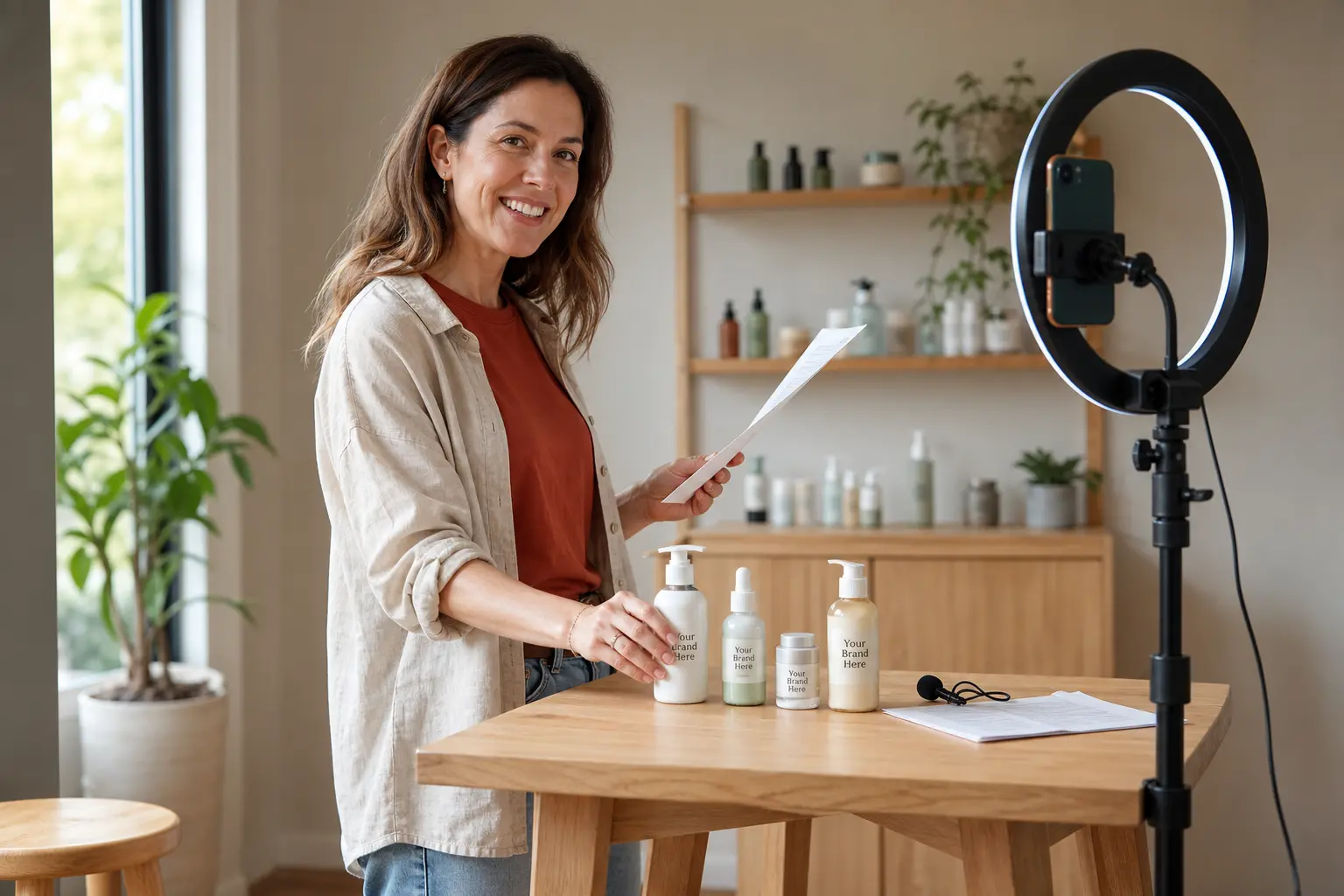
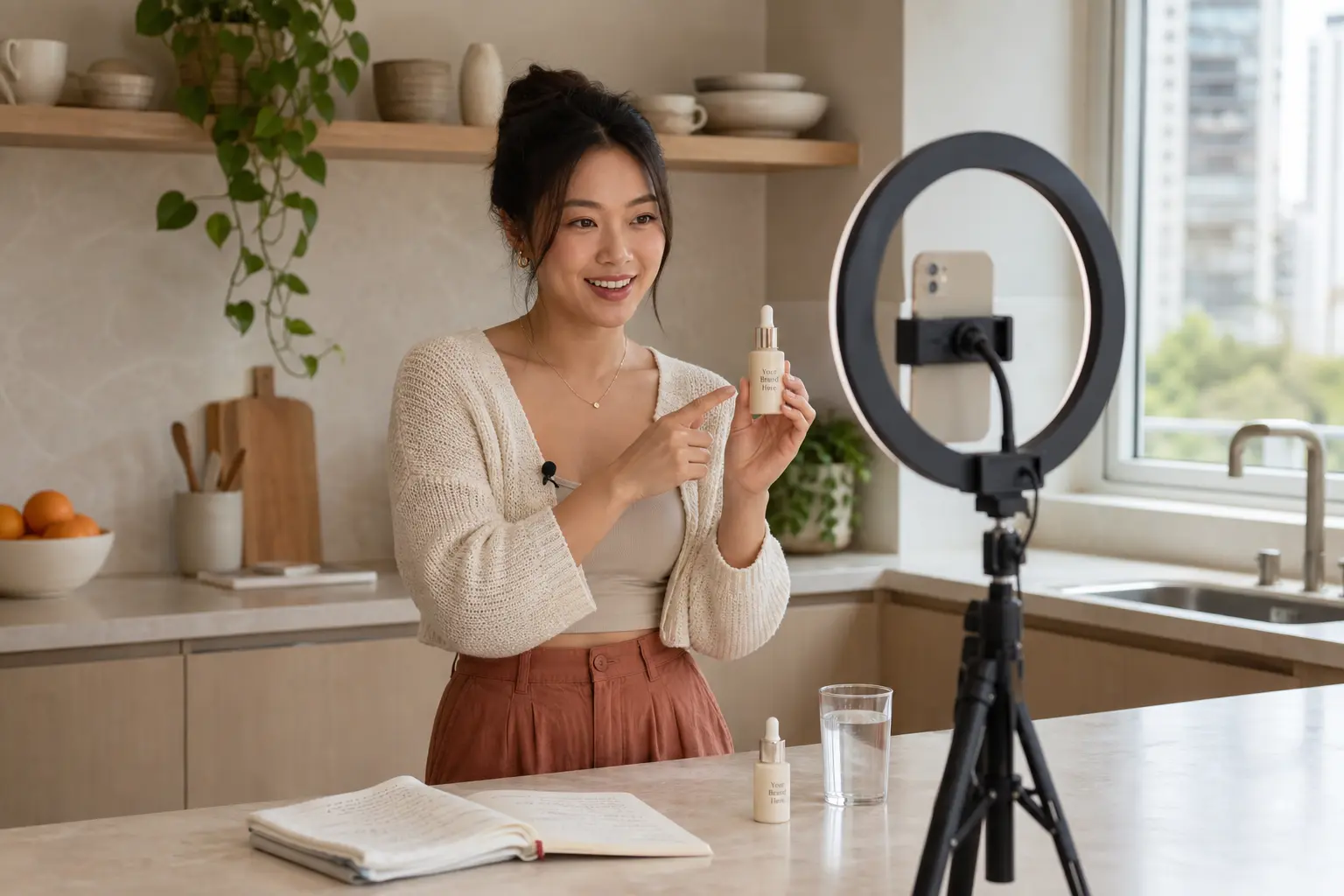
Mention that you would love a short selfie video of 10-20 seconds if possible, and that the video will help you build early social proof.
The clarity of this conversation determines whether the person treats your product as a gift to use casually or as a structured testing engagement they take seriously.
Section 3: include a "How to Test" sheet inside the package
This is the part that turns a product gift into a review-collection event.
Inside every package, include a simple printed or digital sheet that tells the tester exactly what to evaluate.
Without a How to Test sheet, the tester will use the product, like it or not, and forget. With the sheet, the tester gives you usable structured feedback in a defined timeframe.
The sheet covers six areas:
First impressions on first use. How the product feels, how it applies, the immediate sensory experience.
Fragrance evaluation. Pleasant, too strong, too light, surprising, neutral.
Texture and application. Easy, heavy, light, sticky, smooth, absorbing fast or slow.
Results after several uses, with a defined testing window of 5-7 days.
What they liked specifically.
What they did not like specifically. This part is important. Permission to give negative feedback is what makes the rest credible.
Clear instructions on how to send the feedback: WhatsApp, Instagram DM, or email, in a single message to avoid lost notes.
Make sure the tester knows you need both written feedback and a photo or short video.
Section 4: what you must collect from each tester
The deliverables list is specific.
A short written review of 1-3 lines. Honest, not polished.
A natural selfie video of 10-20 seconds in vertical format. The vertical format matters because most social proof display happens on mobile.
One or two photos with the product in natural use context. Not staged product shots. The tester holding, applying, or using the product.
Permission to use the content publicly. This is where the content rights agreement (covered below) is essential.
Section 5: analyze and select
After receiving materials from your 10-15 testers, the work is not done.
Analyze all feedback to identify patterns. Both positive and negative.
Separate personal preferences ("I do not like fragrance in skincare") from real improvement points ("the product pills under sunscreen").
The negative feedback is more valuable than the positive at this stage. Personal preferences are noise. Real improvement points are signal.
Select the best testimonials for use as social proof. Decide if the product needs adjustments before the next production batch.
The brands that scale beyond their first launch are the ones that take the negative feedback seriously and iterate before going wide.
The complete checklist version of this framework lives in the cosmetiFULL knowledge base.
The Content Rights Agreement Most Founders Skip
This is where many founders create legal problems for themselves without realizing it.
A friend gives you a video review.
You post it on your Instagram, your product page, and a Facebook ad.
Six months later, the friend changes their mind, asks you to take it down, or worse, contacts a lawyer claiming unauthorized use.
The fix is a simple written content use agreement signed before the testing starts.
Disclaimer: I am not a lawyer. The framework below is what I have used across the launches I have guided, but local laws vary by country and you should have a qualified legal professional review any agreement before using it officially.
What the agreement needs to cover. Six elements at minimum.
Identification of parties: the brand and the tester, with names, addresses, and emails.
Purpose of the agreement: the tester has received free product in exchange for providing written feedback, photos, videos, voice messages, or other materials related to their experience.
License to use the content: the tester grants the brand a non-exclusive, worldwide, royalty-free, perpetual license to use the materials. This includes the right to use, reproduce, edit, adapt, publish, display, and distribute the content in advertising, marketing, social media, the brand website, and any other commercial context.
What the agreement does not cover. A signed license settles your relationship with the tester. It does not settle your relationship with cosmetic advertising law. The moment you publish a testimonial in your own marketing, its content becomes a claim you are making about the product: Art. 20(1) of Regulation (EC) No 1223/2009 covers the advertising of cosmetic products with no exception for someone else’s words, and Regulation (EU) 655/2013 applies the common criteria to claims regardless of the medium used, with the responsible person answerable for them. Authentic is not the same as substantiated.
Authenticity statement: the tester confirms the content is authentic, reflects their real experience, and does not violate any third-party rights.
Compensation acknowledgment: the tester acknowledges that the free product is the only compensation provided, no payment is involved, and they understand the content is being used for marketing purposes.
Right of withdrawal limits: the agreement states that once content has been published in marketing materials, the tester cannot retroactively withdraw permission for materials already in use, although the brand commits to good-faith review of takedown requests for unpublished content.
This clause concerns the contractual content license. Where personal data is involved, consent under GDPR can always be withdrawn with effect for the future (Art. 7(3)); have local counsel review the clause for each market.
Why this matters more in 2026. Privacy and content rights regulations have tightened across the EU (GDPR enforcement), the UK (UK GDPR plus the Online Safety Act), and parts of the US (state-level privacy laws now active in California, Colorado, Connecticut, Virginia, Texas, and others).
A written agreement is no longer a nice-to-have. It is the document that protects the brand if a regulator or a former tester challenges content use.
Brands that skip this step often discover the problem only when something has already escalated.
The signed agreement, even in simple form, is what turns a disputed situation into a documented one.
Influencer Seeding for First Reviews
Influencer seeding is different from paid influencer marketing.
For first review collection specifically, the approach is narrower and more specific.
What seeding means in this context
Influencer seeding for reviews is the practice of sending free product to nano-creators (1,000-10,000 followers) and micro-creators (10,000-50,000 followers) in your specific category, with no payment, no posting requirement, no obligation.
You send the product. They use it. Some of them post organically. Most do not.
What share of them posts depends on the category, on how well the product fits the creator, and on how carefully you picked. No one publishes a benchmark you can plan against.
So budget a seeding wave as product given away, not as posts bought, and measure your own rate on the first hundred units. That rate is the only one that will predict your second wave.
Of those organic posts, half include something usable as social proof for your brand: a video, a photo, a written caption that can be quoted.
Why seeding works for early reviews specifically
Three reasons for it.
The reviews come from accounts with existing follower trust, not from anonymous review platform users. The trust transfer is real.
The content is authentic by definition. But note: the creator was not paid and is under no obligation to post, yet if they do post about a product received for free, that free product is still a material connection under FTC rules in the US, ASA/CMA rules in the UK, and AGCM practice in Italy. The post must disclose it (Paid partnership tools or #ad where required; in gifting-only cases some regulators accept a clear "gifted" disclosure, though for US audiences #gifted alone is not sufficient). What seeding removes is the obligation to post and the scripted message, not the disclosure duty.
The cost per review is low. A 10 EUR/USD product unit that generates one organic micro-creator post often outperforms a 200 EUR paid post in early-stage social proof value, because the seeded post reads as authentic discovery, not paid promotion. (All cost figures in this article are indicative estimates that vary by region and project scope.)
Seeding is the rare marketing tactic where the cheapest option is also the most authentic. The economics work because the creator chose to post, not because they were paid to.
How to do it without burning your inventory
Three rules keep it under control.
Target creators whose audience matches your target customer.
A creator with 50,000 followers in fitness is not relevant for a luxury skincare line, even if their numbers look good. A creator with 5,000 followers in clean beauty is highly relevant.
Never demand a post in exchange for product.
Demanding a post adds editorial control and contractual obligations on top of the material connection that the free product already creates. Disclosure is required in both cases: what changes is the level (ad vs gifted) and the loss of authenticity. Send the product with a kind note and no obligation.
Track who posts and follow up only with those who do.
The creators who post organically without obligation are the ones worth deepening relationships with. They become natural candidates for paid collaboration later, with full disclosure.
The Friends-and-Close-Contacts framework and influencer seeding work together.
Friends-and-Contacts gives you authentic reviews from real users in your network. Seeding gives you authentic content from creators with audience reach.
Both approaches need the content rights agreement covered above.
Which Review Platforms Should You Use in 2026?
Once you have testimonials and reviews collected, they need to live somewhere customers see them.
The choice of platform matters because different platforms serve different brand stages.
The four review platform tools that cover most indie cosmetic brands
The review platform category for indie cosmetics typically narrows down to four ecommerce-native tools (Judge.me, Loox, Junip, Yotpo), each fitting a different brand stage.
Judge.me is the entry-level option in this category.
The free plan includes unlimited reviews, photos, and videos, with SEO schema markup. The paid plan at 15 USD per month adds Google Shopping syndication and advanced customization.
For a new cosmetic brand launching with 10-15 reviews, Judge.me is the default starting choice. Low cost, fast setup, native Shopify and WooCommerce integration, no risk if you outgrow it later.
The limitation: the widget UX is less polished than premium options, and the email request system sends one email per product ordered, which can feel repetitive to customers who buy multiple items.
Loox is the visual-first option.
Pricing starts at 12.99 USD per month for 100 monthly orders, scaling up with volume.
Loox is built around photo and video reviews.
The widget galleries are visually polished, and the image request is built into the flow rather than bolted on: the review form asks for the photo first, and the upload prompt travels inside the request email. Every cross-platform comparison of upload rates you will find is published by one of the vendors, so measure it on your own store instead.
For visual cosmetic categories (makeup, skincare with visible results, body care with texture appeal), Loox is the standard choice once volume justifies it.
The trade-off: pricing scales with order volume, so it can become expensive quickly for high-volume stores.
Junip is the Shopify-native modern option.
Pricing starts free for up to 50 orders per month, then 29 USD per month for 500 orders.
Junip is built specifically for Shopify and Hydrogen storefronts.
Strong Klaviyo integration, attribute-based review questions, and lightweight performance impact (Core Web Vitals friendly).
For brands building on modern Shopify with a focus on attribute insights ("how does this serum perform on dry skin vs oily skin"), Junip is the cleanest option.
The limitation: smaller integration ecosystem outside Shopify.
Yotpo is the enterprise option.
Pricing is custom and typically starts at 200-400 USD per month for the integrated reviews + UGC + loyalty + SMS suite.
Yotpo is more than a review tool.
It is a full marketing platform with reviews, loyalty, SMS, and UGC capabilities integrated.
The depth of analytics, syndication to Google Shopping, and integration with email and SMS marketing tools is unmatched.
For brands above 50,000 EUR monthly revenue with a marketing team, Yotpo is the standard choice.
For indie brands launching, Yotpo is meaningfully overengineered. The pricing alone disqualifies it for most pre-launch and early-launch stages.
Which one for which stage
The pattern that works for most indie cosmetic brands:
Pre-launch and first 6 months: Judge.me free or Loox Beginner.
Months 6-18 with proven repeat purchase: Loox standard or Junip standard.
Year 2+ with marketing team and 50K+ monthly revenue: Yotpo or stay on Loox/Junip with full feature set.
The migration path matters. Both Loox and Junip allow CSV import of existing Judge.me reviews. Yotpo also supports import. Starting on the cheap option does not lock you out of the premium options later.
The Realistic Timeline From First Batch to 20+ Reviews Live
This is the part most founders underestimate.
Collecting authentic reviews takes longer than producing the product.
Week-by-week from production to launch.
Week -12 to -10 before launch: first production batch arrives. You have your first 100-300 units. Allocate 10-15% to Friends-and-Close-Contacts and seeding, which is 30-45 units on a 300-unit batch: the plan below needs a run at that end of the range.
Week -10 to -8: identify and contact 25-30 friends who match the target customer. Identify 10-20 nano/micro creators in the category. Prepare the How to Test sheet, the content rights agreement, and the seeding outreach template.
Before the first unit ships, one legal point. In the EU, giving a cosmetic away as part of a commercial activity counts the same as selling it. Regulation (EC) No 1223/2009 defines making a product available on the market as any supply "whether in return for payment or free of charge" (Art. 2(1)(g)), and the first supply of any kind is the placing on the market (Art. 2(1)(h)). Seeding units to friends and creators is that first supply.
So the product has to be compliant when the box leaves your hands, not on launch day: a responsible person designated in the EU (Art. 4), the safety assessment and safety report done (Art. 10), the CPNP notification filed (Art. 13), and the label complete under Art. 19, where free samples are exempt from one item only, the nominal content (Art. 19(1)(b)). In a normal private label setup your manufacturer has handled most of this before the batch was packed. The step founders postpone most often is the CPNP notification, so confirm it is filed before the first shipment. Outside the EU the same reasoning applies under local rules.
Week -8 to -6: ship product to 20-25 friends and 10-15 creators. Stagger the ships across 2 weeks to avoid simultaneous reviews arriving in a 48-hour window (which triggers algorithmic suspicion of inauthenticity).
Week -6 to -4: testers complete their 5-7 day testing window. Reviews and content start arriving. Follow up with non-responders at week 2 and week 3 with friendly reminders, not pressure.
Week -4 to -2: reviews compile.
You should have 10-15 friend reviews complete and 5-10 creator posts live. The review platform of choice gets installed and configured.
Reviews are loaded onto the product page using authenticated tester accounts where possible (not bulk import), which most platforms now support.
Week -2 to launch day: the product page goes live with 12-20 authentic reviews, including 5-8 with photos or video. The seeding posts continue to come in across the launch window, providing fresh content for paid amplification later.
This 12-week timeline is the floor.
Brands that try to compress it to 4 weeks end up with thin reviews, missed photos, and a launch page that looks under-tested. Brands that extend it to 16-20 weeks often see better depth and more polished content.
After Launch: the Steady-State Review Collection System
Once the brand is live, review collection shifts to a steady-state automated system.
Post-purchase email automation through Klaviyo, Yotpo, or the review platform’s native email triggers, asking for reviews 7-14 days after delivery (not at order, not at shipping).
Photo upload incentives integrated into the review request flow, since photo reviews convert visitors at meaningfully higher rates than text-only reviews.
Negative review response protocols. The brand responds to every negative review professionally, addressing the specific concern and offering remedy.
Customers reading reviews trust brands that engage with negative feedback more than brands with only 5-star reviews.
Quarterly review audits to identify product issues, formulation feedback, and content rights gaps before they become problems.
The retention engine that turns one-time buyers into review contributors and repeat customers is covered in detail in the retention guide.
Critical Mistakes Cosmetic Brands Make Collecting First Reviews
I have watched these patterns repeat across the launches I have guided.
Every one of them is preventable.
Left alone, they delay a launch by weeks or months.
Buying fake reviews to fill the page faster
The first mistake is the temptation to shortcut the timeline.
Founders see their product page sitting at zero reviews 2 weeks before launch and panic. Some buy reviews from third-party services that promise "verified-looking" 5-star reviews delivered in 48 hours.
The result: detection by Google, Amazon, or the review platform within days. Reviews removed. Account flagged. Sometimes account suspended.
Worse, the FTC in the US, the CMA in the UK, and AGCM in Italy have all increased enforcement against fake review purchasing in 2024-2026, and the law now names the practice explicitly rather than treating it as ordinary misleading advertising.
In the EU, submitting or commissioning false consumer reviews is banned in all circumstances (Annex I, points 23b and 23c of Directive 2005/29/EC, inserted by Directive (EU) 2019/2161), and in Italy AGCM applies a fine from 5,000 to 10,000,000 EUR (Article 27(9) of the Codice del Consumo). In the UK the same practices became banned practices on 6 April 2025 (Schedule 20, paragraph 13 of the DMCC Act 2024), with a CMA penalty of up to 300,000 GBP or, if higher, 10% of turnover (section 190(6)). In the US the FTC’s Rule on the Use of Consumer Reviews and Testimonials (16 CFR Part 465, in force since 21 October 2024) is backed by civil penalties of up to 53,088 USD per violation, the amount set by 16 CFR 1.98(d), and available only where the rule is broken knowingly, the condition set by 15 U.S.C. 45(m)(1)(A).
The fix is the 12-week timeline above. Authentic reviews collected from real testers cost less, perform better, and carry far lower regulatory risk, provided the free product is disclosed.
Asking only for 5-star reviews from testers
The polished-feedback request is the second.
Founders ask testers to "leave a 5-star review" or "say something nice about the product."
Testers comply, but the reviews read as performative. The specific texture descriptions, the real use cases, the honest weaknesses are all missing.
The page ends up with reviews that look fake even though they are technically real.
Ask for honest feedback explicitly. The How to Test sheet covered above, with permission to share negative feedback, produces reviews that read as authentic because they are.
Purchase likelihood peaks with an average rating between 4.0 and 4.7 stars and then falls as the average approaches 5.0, which shoppers read as too good to be true (Medill Spiegel Research Center, Northwestern University, How Online Reviews Influence Sales, 2017, on PowerReviews ecommerce data; in no product category was the optimal rating 5.0). A 4.6-star average with honest positive and negative reviews beats a wall of generic praise.
Skipping the content rights agreement
Then the legal shortcut.
A founder collects 30 testimonials, posts them on social media and the product page, and runs paid ads with the content. Six months in, two testers ask for content removal. One contacts a lawyer.
Without a written content rights agreement, the brand has no defense.
Pulling content out of live campaigns, taking down posts mid-flight, and handling the legal exposure all cost money and time a small indie brand has not budgeted, and the bill arrives while the campaign is still running.
The fix is the 1-page content rights agreement signed before product is sent. Local legal review of the template before first use.
Sending product to wrong-fit testers
The friend-network assumption is fourth.
A founder sends product to their entire friend group, including people who do not use cosmetics, do not match the target customer, or have no interest in giving structured feedback.
The result: 30 sent units, 3 reviews returned, low quality.
Target the selection instead: 20-30 people who fit the target customer profile beats 100 random friends every time.
Bulk-importing reviews on launch day
Number five, the launch-day flood.
A founder collects 25 reviews over 12 weeks. On launch day, all 25 reviews are bulk-imported to the product page in a single transaction.
Algorithmic detection on Google Shopping, Yotpo, and other platforms flags the pattern as suspicious. Reviews can be removed automatically, the page can be down-ranked, and recovery takes weeks.
The fix is staggered review uploads matching the actual collection timeline.
Reviews collected in week -8 go up in week -6. Reviews collected in week -4 go up in week -3.
The pattern looks like organic accumulation because it is organic accumulation.
Treating reviews as a one-time launch task
Then the launch-and-forget approach.
A founder collects 25 reviews for launch. Six months later, the page still has 25 reviews. Customer acquisition stalls.
Steady-state review collection requires post-purchase automation, ongoing seeding, periodic Friends-and-Contacts refreshes for new product launches, and active management of negative reviews.
Brands that run review collection as a permanent system continue to grow social proof month over month. Brands that treat reviews as a launch task watch their conversion rate stagnate as their content ages.
Ignoring negative reviews
Seventh, negative-review avoidance.
A 1-star review arrives. The founder ignores it, hopes nobody reads it, or worse, tries to remove it.
Visitors reading reviews know to look at how brands handle negative feedback. A negative review with a professional response from the brand acknowledging the concern and offering remedy converts better than no negative reviews at all.
An ignored negative review signals to visitors that the brand does not engage with customers. That signal hurts conversion more than the negative review itself.
Set a response protocol. Every negative review gets a professional, specific response within 48 hours. Acknowledge the concern. Offer specific remedy (refund, replacement, formulation feedback escalation). Thank them for honest feedback.
Frequently Asked Questions
How many cosmetics reviews do I need before launch?
The realistic minimum is 10-15 genuine reviews live on the product page on launch day, with at least 3-5 including photos or video. Below 10 reviews, the page reads as untested and trust does not form. Between 10 and 30 reviews with mixed media, the page reads as a real product with real users and conversion catches up to category baseline. Above 30, conversion gains plateau until you cross 100+ where the social proof effect compounds again. Aim for 10-15 authentic reviews before a single paid ad runs; the page does not need hundreds to convert.
Should I give products away for free to get reviews?
Yes, with structure, and only once the product is legally ready to be supplied. In the EU, supplying a cosmetic free of charge in the course of a commercial activity is making it available on the market (Regulation (EC) No 1223/2009, Art. 2(1)(g)), so the first tester box is the moment the product is placed on the market: responsible person, safety report and CPNP notification have to be done by then (Art. 4, 10 and 13), not scheduled for launch day. With that settled, use the first 10-15% of your production units as a Friends-and-Close-Contacts framework. Choose 20-30 testers who match your target customer. Send product with a How to Test sheet covering first impressions, fragrance, texture, results after 5-7 days, what they liked, what they did not like. Collect a written 1-3 line review, a 10-20 second selfie video, and 1-2 photos, with a content rights agreement signed before sending. Random product giveaways without structure produce low review return rates and inconsistent quality.
Which review platform is best for a new cosmetic brand in 2026?
For pre-launch and first 6 months: Judge.me free plan or Loox Beginner tier. Judge.me offers unlimited reviews and SEO schema for free, paid tier at 15 USD/month adds Google Shopping syndication. Loox starts at 12.99 USD/month and is built around photo and video reviews, with the image request inside the flow rather than bolted on. For months 6-18 with proven traction: Loox standard or Junip standard at 29 USD/month. For year 2+ with marketing team and 50K+ monthly revenue: Yotpo (custom enterprise pricing) or stay on Loox/Junip at higher tiers. The migration path matters: both Loox and Junip import existing Judge.me reviews by CSV, and Yotpo supports CSV import too if you upgrade later.
Can I buy reviews to launch faster?
No. Buying fake reviews triggers detection by Google, Amazon, and most review platforms within days. Reviews get removed, accounts get flagged, sometimes accounts get suspended. The FTC in the US, the CMA in the UK, and AGCM in Italy have all increased enforcement against fake review purchasing in 2024-2026, and fake reviews are now a banned practice in their own right on both sides of the Channel (Annex I, points 23b and 23c of Directive 2005/29/EC in the EU; Schedule 20, paragraph 13 of the DMCC Act 2024 in the UK). AGCM can fine from 5,000 to 10,000,000 EUR, the CMA up to 300,000 GBP or, if higher, 10% of turnover, and the FTC up to 53,088 USD per violation. Authentic reviews from the Friends-and-Close-Contacts framework and influencer seeding cost less, perform better, and carry far lower regulatory risk, provided creators disclose the free product.
What is influencer seeding and how is it different from paid influencer marketing?
Influencer seeding is sending free product to nano-creators (1,000-10,000 followers) and micro-creators (10,000-50,000 followers) in your specific category, with no payment and no posting requirement. Most seeded units never turn into a post, and no one publishes a rate you can plan against, so measure your own on the first wave. No payment is involved and no post is required, but if the creator does post, the free product is a material connection and must be disclosed under FTC, ASA/CMA, and AGCM rules (see the disclosure section of the influencer marketing guide). Paid influencer marketing involves payment, contracts, posting requirements, and mandatory #ad disclosure. Seeding is for early review collection. Paid influencer marketing is for scale amplification, covered in the influencer marketing guide.
Do I need a written agreement with people who give me reviews?
Yes. A simple content use agreement signed before testing starts protects the brand if a tester later changes their mind, asks for content removal, or contacts a lawyer about unauthorized use. The agreement covers identification of parties, purpose (free product in exchange for content), license to use materials (non-exclusive, worldwide, royalty-free, perpetual, with rights to use, reproduce, edit, adapt, publish, display, distribute in advertising and marketing), authenticity statement, compensation acknowledgment, and right of withdrawal limits. Disclaimer: this is not legal advice. Local laws vary by country and a qualified legal professional should review any agreement before official use.
How long does it take to collect 20+ reviews before launch?
The realistic timeline is 12 weeks from production batch arrival to launch day. Weeks -12 to -10: production batch arrives, 10-15% allocated to Friends-and-Contacts and seeding. Weeks -10 to -6: select testers and creators, then ship product staggered across 2 weeks. Weeks -6 to -2: testers complete the 5-7 day window, reviews compile, review platform configured. Weeks -2 to launch: product page goes live with 12-20 authentic reviews including 5-8 with media. Compressing this timeline below 8 weeks produces thin reviews, missed photos, and an under-tested launch page.
Customer retention strategies for indie cosmetic brands in 2026. Repeat purchase rate benchmarks, replenishment cycles, loyalty program structure, post-purchase email flows, and the unit economics that make retention non-negotiable.
Influencer marketing for indie cosmetic brands in 2026. How to find creators, what to pay, how to vet, the outreach process, and the disclosure rules. Founder perspective with practical budgets.
Build a loyal community around your indie cosmetics brand. Engagement strategies, platform options, advocate identification, and the realistic timeline from zero to active community.