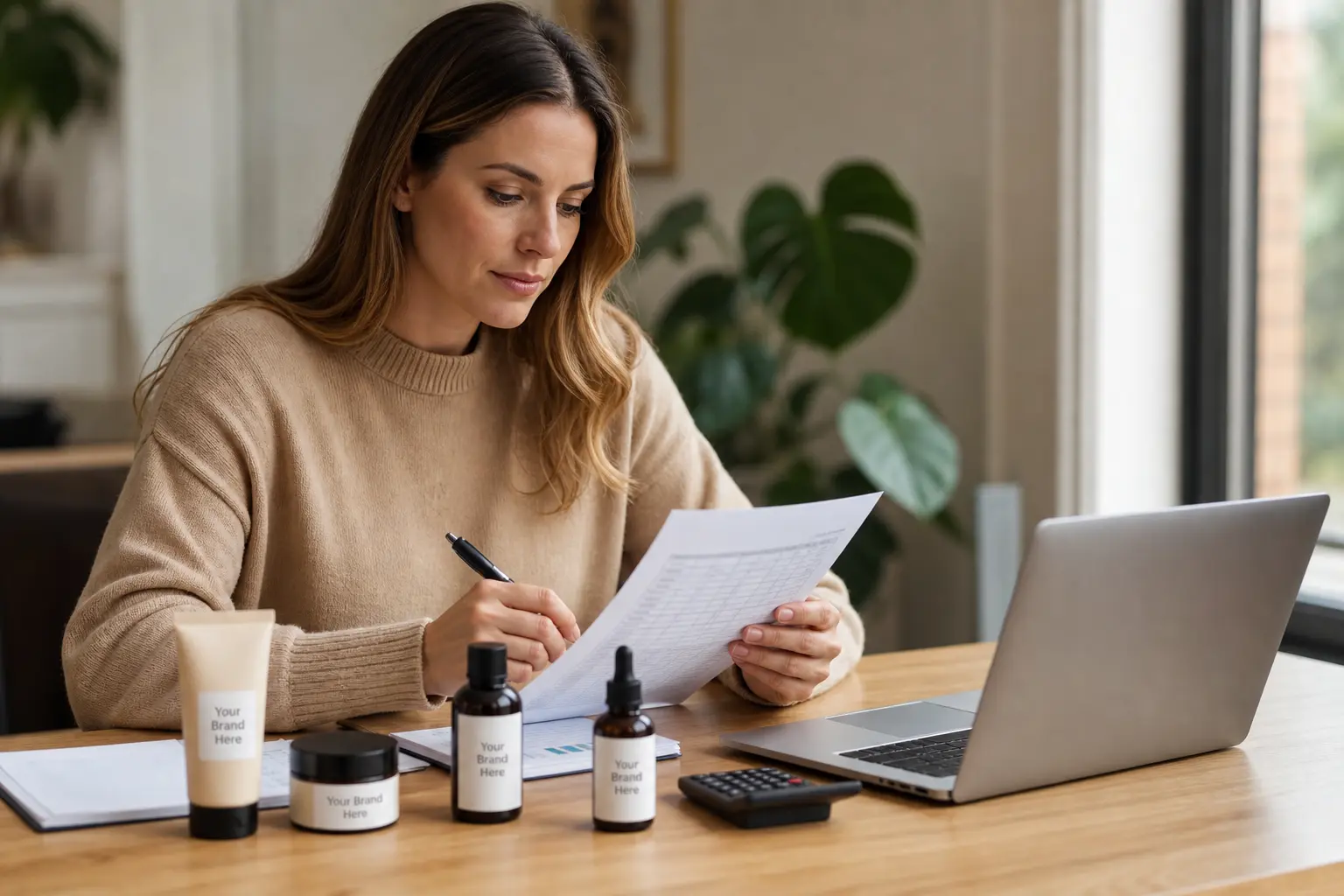
The total private label cosmetics cost for a small line of 3 to 5 products ranges from about 3,000 EUR/USD (white label, minimal customization) to 88,000 EUR/USD (fully custom formulation with premium packaging and multi-market compliance). All cost figures in this article are indicative estimates that vary by manufacturer, region, and project scope.
The most common range for a first-time founder doing standard private label is 8,000 to 20,000 euros.
That is the quick answer. But if you stop there, you will budget wrong.
Because the number you see on a manufacturer’s quote is only a fraction of the total. The rest is regulatory, branding, packaging design, marketing, and a list of expenses that nobody mentions until you are already committed.
After guiding launches across Europe, the UK, the USA, and the Middle East, I can tell you: founders fail financially when they budget on the manufacturer’s price and then discover the other half of the costs when it is too late. Spending too much is almost never what sinks them.
This guide gives you every cost line, with real ranges, so you can plan properly from the beginning.
The Three Budget Tiers (and What You Get at Each Level)
Here is how a realistic first launch (3 to 5 products) maps across the three tiers:
Tier
Investment range
What you get
Budget launch
3,000 to 8,000 euros
White label base, minimal customization
Standard private label
8,000 to 20,000 euros
Custom formulation, professional branding
Premium launch
38,000 to 88,000 euros
Fully custom, premium packaging, multi-market
Each tier is a different trade-off between cost, differentiation, and time to market. The sections below break down what each level actually covers.
Budget launch: 3,000 to 8,000 euros
This is the white label or hybrid approach with minimal customization.
At this level, you are working with an existing formula. You are not developing anything from scratch.
Marketing. Product photography. Website or marketplace setup. Shipping and logistics.
If you add those, the real number is closer to 5,000 to 10,000 euros.
This tier works for market testing. You launch a few products, see if people buy, and learn how the process works.
It does not work for building a differentiated brand. At this level, the product is not unique to you. Other brands may sell the same formula under a different name.
Standard private label: 8,000 to 20,000 euros
This is where most serious first-time founders land.
At this level, you are working with a manufacturer to customize or develop formulas that are specific to your brand. You have professional packaging design and proper regulatory documentation behind it.
What this budget typically covers:
Formulation and sampling: 1,500 to 4,000 euros (2-3 sampling rounds, formula customization)
Production (first run, 500-1,000 units of 3-5 products): 2,000 to 5,000 euros
Packaging design and materials: 1,500 to 4,000 euros
Regulatory: 800 to 2,600 euros per product (CPSR plus PIF; the CPNP notification itself is free)
Branding (logo, visual identity, label design): 1,000 to 3,000 euros
What you should also budget for (often missed):
Product photography: 500 to 1,500 euros
Website or marketplace setup: 500 to 2,000 euros
Initial marketing budget: 1,000 to 3,000 euros
This is the tier I recommend for most people who want to build a real brand. You have a product that is yours, branding that is professional, and compliance that is solid.
Premium launch: 38,000 to 88,000 euros
This is fully custom formulation, premium packaging, and multi-market compliance.
At this level, you are creating something from scratch. Custom formulas developed by a cosmetic chemist. Premium packaging with custom molds, special finishes, or unique bottle shapes. Regulatory compliance for 2 or more markets simultaneously (EU + US, for example). Full custom MOQs start at 5,000 units per SKU, which is why the first production run weighs far more here than at the tiers below.
What this budget typically covers:
Custom formulation and R&D: 15,000 to 30,000 euros for the line, sampling and stability work included
Production (first run, 5,000 units per SKU, the minimum on this path): 12,000 to 30,000 euros
Premium packaging (custom molds, special materials): 3,000 to 8,000 euros
Multi-market regulatory: 3,000 to 8,000 euros
Professional branding and design: 2,000 to 5,000 euros
Photography, content, and marketing: 3,000 to 7,000 euros
This tier makes sense for founders who already have a validated audience, a clear brand concept, and the financial runway to invest without needing immediate returns.
It does not make sense for a first launch with no proof of demand.
What Are the Real Costs Behind Each Line Item?
Formulation and sampling
This is where your product is born.
If you are working with white label, this cost is close to zero. The formula already exists.
If you are doing private label with a hybrid approach, you are selecting from existing formula bases and customizing. Budget 500 to 2,000 euros per product for that customization work.
With fully custom formulation, a cosmetic chemist develops a formula from scratch based on your brief. Full custom runs 2,000 to 8,000 euros per product in research and development work alone, before sampling, stability, and regulatory.
On a hybrid base, sampling typically involves 2 to 3 rounds. You receive small jars from the manufacturer. You test. You give feedback. They adjust. You test again.
Each of those rounds adds 3 to 4 weeks and 200 to 500 euros. Full custom runs 4 to 8 rounds per product, and each round costs 500 to 2,000 euros. Do not stack those rounds on top of the premium tier: the 15,000 to 30,000 euros listed there for the line already covers sampling and stability, while the 2,000 to 8,000 per product is the research and development on its own. Two different scopes, not two bills, and the per-product figure is not something you multiply into the line figure either.
One thing I noticed over the years: the founders who rush through sampling to save money are the same ones who end up reformulating 6 months later because the product is not right.
The sampling phase is the investment that decides whether your product is worth selling, which is exactly why it is the wrong place to save.
Take the extra round. It is cheaper than launching with the wrong formula.
Production (the manufacturer’s quote)
This is the number everyone asks about first. And it is also the most misleading one in isolation.
A manufacturer’s quote for a first production run of 500 to 1,000 units of a single product typically ranges from 700 to 2,500 euros.
For a small line of 3 to 5 products, you are looking at 2,000 to 8,000 euros in pure production costs.
That sounds reasonable. And it is.
The problem is that people treat this number as the total investment.
In my experience, the manufacturer’s production quote represents about 25 to 35% of the total project cost. The rest happens before and after their involvement.
Here is how that gap looks in practice.
A client came to me with a budget of 6,000 euros. She wanted 3 skincare products. The manufacturer quoted her 2,800 euros for production.
"Great," she thought. "I still have 3,200 euros for everything else."
Then we listed everything else:
CPSR safety assessment: 1,200 euros (3 products x 400)
PIF documentation: 1,500 euros (3 products x 500)
Packaging design: 1,500 euros
Label printing: 400 euros
Product photography: 600 euros
Shipping from manufacturer: 350 euros
Total "everything else": 5,550 euros.
Her real budget needed to be at least 8,350 euros for the same 3 products. Not 6,000.
This is why I always say: double the manufacturer’s quote, and you are getting closer to the real number.
Regulatory costs (the ones nobody budgets for)
Regulatory is legally required.
If you are selling in the EU, every product needs:
Cosmetic Product Safety Report (CPSR): 300 to 800 euros per product. A qualified safety assessor assesses the finished product, not just the formula, and signs a conclusion on its safety inside the report. It is an assessment you have to keep up to date, not a certificate you get once.
Product Information File (PIF): 500 to 1,800 euros per product. The full dossier containing the CPSR, stability data, manufacturing data, and more.
CPNP notification: free, but requires a Responsible Person established in the EU. If you do not have one, hiring a Responsible Person service costs 500 to 2,000 euros per year.
If you are also selling in Great Britain (post-Brexit), add a separate SCPN notification and a UK-based Responsible Person.
If you are selling in the US, MoCRA puts facility registration on whoever owns or operates the plant that makes the product, normally your contract manufacturer and not you. What sits on you as responsible person is the cosmetic product listing. Both are waived while your average US cosmetic sales stay under 1,000,000 dollars a year over the previous three years, adjusted for inflation, unless you make products that regularly come into contact with the mucous membrane of the eye under customary use, are injected, are for internal use, or alter appearance for more than 24 hours where consumer removal is not part of customary use. Less costly than EU, but check where you fall before you budget for it.
The EU numbers above add up to 800 to 2,600 euros per product. For a line of 3 to 5 products sold in one market (EU), that is 2,400 to 7,800 euros for three products and 4,000 to 13,000 euros for five.
For multi-market (EU + US + Great Britain), Great Britain needs its own PIF and CPSR held by a UK Responsible Person, so the EU figure applies a second time; the US side is a product listing rather than a second dossier, and costs less.
I’ve watched founders skip regulatory to save money and then get stuck with products they legally cannot sell. One Amazon seller had 5,000 units in a warehouse for 11 weeks because the regulatory documentation was not complete.
The products were fine. The formulas were tested. But without the paperwork, they could not be listed.
Packaging covers the container (bottle, tube, jar), the closure (cap, pump, dropper), the label, and any secondary packaging (box, sleeve, wrap).
Standard packaging (stock containers from the manufacturer’s catalog):
Container + closure: 0.50 to 2.00 euros per unit
Printed label: 0.05 to 0.15 per unit
Secondary packaging (folding box): 0.30 to 1.00 per unit
Custom packaging (unique shapes, custom molds, special finishes):
Container + closure: 2.00 to 5.00+ euros per unit
Custom mold costs (one-time): 3,000 to 15,000 euros
Premium label (foil, embossing, transparent): 0.30 to 0.60 per unit
For a first launch with 500 units of 3 products, packaging costs typically run 1,275 to 4,725 euros using standard containers. That is the three lines above stacked: 0.85 euros a unit taking the bottom of each range, 3.15 taking the top, across 1,500 units.
If you want custom packaging, add 3,000 to 15,000 euros on top for mold development, plus the higher per-unit cost.
My recommendation for a first launch: use standard containers with excellent label and packaging design. The visual impact comes from the design, not from a custom bottle shape. You can upgrade containers later when volumes justify the investment.
Branding and design
A logo is the smallest piece of it.
Branding includes your brand name, logo, visual identity (colors, typography, imagery style), label design for each product, and any secondary packaging design.
Budget ranges:
DIY approach (Canva, freelancer on Fiverr): 200 to 800 euros
Professional freelance designer: 1,000 to 3,000 euros
Branding agency: 3,000 to 10,000+ euros
For most first-time founders, a professional freelance designer is the right level. You get a coherent visual identity without agency prices.
Branding, though, is not a cost to cut.
Product quality is about 30% of a cosmetics brand’s success. Branding, positioning, and marketing are the other 70%. I call it the 30/70 reality. If you invest 90% of your budget in the product and 10% in branding, you have the ratio exactly backward.
A beautiful product in ugly packaging will not sell. An average product with excellent branding will outsell it every time.
These are the costs that do not appear on any manufacturer’s quote. They show up after you have committed to the project.
Stability testing: 500 to 2,000 euros per product. Annex I of Regulation (EC) No 1223/2009 requires the safety report to cover stability under reasonably foreseeable storage conditions, but prescribes no protocol and no duration: the usual 12 to 30 month accelerated plus real-time program is industry practice, not the letter of the law. The data itself is not optional.
Product photography: 500 to 2,000 euros. You cannot sell online without professional photos.
Website or marketplace setup: 500 to 3,000 euros (Shopify setup, Amazon listing setup, or basic e-commerce site).
Trademark registration: 800 to 2,000 euros. Protects your brand name legally.
Product liability insurance: 500 to 1,500 euros per year. Required by most retailers and marketplaces.
Initial marketing budget: 1,000 to 5,000 euros. Without marketing, nobody knows your product exists.
Returns and damages: budget 3 to 5% of projected revenue for defects, shipping damage, and customer returns.
Storage and logistics: 100 to 500 euros per month if you do not have your own space.
Total hidden costs: 4,000 to 15,000+ euros depending on scale and channels.
This is why a manufacturer’s "you can start for 2,000 euros" is technically true but practically dangerous. The 2,000 covers their part. Not yours.
What about ongoing costs?
Spending carries on well past your first production run, and that catches first-time founders off guard.
Ongoing costs include:
Reorders (every 3 to 6 months depending on sales velocity). Your second production run is usually cheaper per unit, but it still requires cash flow.
Marketing (continuous, not one-time). If you stop marketing, sales drop. Budget at least 15 to 20% of monthly revenue for ongoing marketing.
Amazon/marketplace fees (25-35% of revenue on Amazon, before PPC advertising costs).
Regulatory updates (if you modify formulas, change packaging, or enter new markets).
Customer service and returns: the same 3 to 5% of revenue as above, this time as a recurring line.
A client I worked with recently was surprised that her monthly operating costs after launch were 800 to 1,200 euros, even before she counted product reorders. Hosting, email marketing tools, Amazon PPC, packaging supplies, shipping labels.
Small things. But they add up fast.
The rule I give all my clients: budget for at least 6 months of operating costs on top of your launch investment. If your launch costs 12,000 euros and your monthly operating cost is 1,000 euros, you need 18,000 euros available. Not 12,000.
Running out of cash 3 months after launch, right when your brand is starting to get traction, is one of the most painful things I’ve seen. And it happens more often than it should.
How Do You Know if Your Budget Is Enough?
The budget reality check
Here is a simple test I use with clients.
Take your total available budget. Subtract 30% as a safety margin (unexpected costs always appear). The remaining 70% is your actual working budget.
Now compare:
Under 3,000 euros working budget: you can do a white label test launch. Not a brand.
3,000 to 7,000 euros: hybrid approach. Limited customization. Viable for a market test with some brand identity.
7,000 to 15,000 euros: standard private label. This is where real brand building starts.
15,000 to 35,000 euros: strong private label with professional everything. Multiple products, professional photography, solid marketing launch.
35,000+ euros: premium launch or multi-market expansion.
If your working budget is below the tier you want, do not try to squeeze into it by cutting corners. Either adjust your expectations or wait until you have enough.
I’ve seen too many brands launch underfunded and then have no money left for marketing, which is the single most important spend after the product itself.
The biggest budget mistake I see
It is always the same pattern.
Someone has 10,000 euros. They spend 8,000 on product (formula, production, packaging). They have 2,000 left.
Then they realize they need photos, a website, regulatory paperwork, and marketing. The 2,000 runs out. The products sit in boxes. Sales trickle in because nobody knows the brand exists.
This is the 30/70 problem in action. Product got 80% of the budget. Everything else got 20%.
The fix is simple but painful to hear: if you have 10,000 euros, spend 5,000 on product and 5,000 on everything else. Better a slightly smaller first production run with a real marketing push than a large inventory with no way to sell it.
How to Reduce Costs (and What You Should Never Cut)
Start smaller than you think
Most first-time founders want to launch with too many products.
5 products sounds like a small line. But at the standard private label tier, 5 products means 5 times the formulation, 5 times the regulatory, 5 times the packaging design.
Starting with 3 products instead of 5 can save you 3,000 to 5,000 euros while still giving you a credible launch.
In practice, your hero product (the one you market hardest) will drive 60 to 70% of your revenue anyway. The other products support it. You do not need 5 to start.
Some of the most successful launches I’ve been part of started with a single product. One skincare serum. One signature shampoo. That focus let the founder put more budget into branding and marketing instead of spreading thin across 5 different formulations.
Use standard packaging with great design
A custom bottle mold costs 3,000 to 15,000 euros. A standard bottle from the manufacturer’s catalog costs nothing extra (it is included in the per-unit price).
How the product looks on a shelf depends almost entirely on the label and box design, not on whether the bottle is custom.
I’ve seen brands with standard bottles and stunning label design outsell brands with expensive custom packaging and mediocre branding.
Save the custom molds for your second or third production run, when you know the product sells and volumes justify the investment.
Choose one market first
Selling in EU + US + Great Britain simultaneously means triple regulatory costs.
Launch in one market. Prove the product. Then expand.
Most of my European clients start with EU only (or EU + Great Britain if they have a UK audience). US comes later, once the revenue justifies the additional compliance investment.
The regulatory cost difference between one market and three markets can easily be 4,000 to 6,000 euros. That money is better spent on marketing for your first launch.
Never skip regulatory. Selling without a CPSR, PIF, or proper notification is illegal. You can be fined, your products can be recalled, and your Amazon or marketplace account can be suspended.
Never skip stability testing. If your product separates, changes color, or grows bacteria after 3 months on the shelf, you have a liability problem and a reputation disaster.
Never skip branding. A poorly designed label on a great product will lose every time to an average product with excellent branding. That is the 30/70 reality.
Never spend zero on marketing. Products do not sell themselves. If your entire budget goes to production and you have nothing left to tell people the product exists, you will have boxes in your garage for a long time.
Your cost planning checklist
Before you commit any money, make sure you have budgeted for every line on this list:
Formulation and sampling (how many rounds?)
Production (what MOQ? how many products?)
Packaging materials (standard or custom?)
Packaging and label design
Regulatory (CPSR, PIF, CPNP for each product)
Responsible Person (if you need one)
Branding (logo, visual identity)
Product photography
Website or marketplace setup
Initial marketing budget (at least 3 months)
Product liability insurance
Trademark registration
Storage and logistics
Safety margin (30% buffer)
If any line says "I will figure it out later," you are not ready to start production yet.
The private label cosmetics cost is real but manageable. Some manufacturers claim 2,000 euros, some people fear 100,000, and both figures are wide of the mark.
For most founders building a real brand, the answer is somewhere between 8,000 and 20,000 euros for a solid first launch. And the single best thing you can do is know every cost before you sign a single contract.
How much does it cost to start a private label cosmetics line?
The total cost ranges from 3,000 euros (white label, minimal customization) to 88,000 euros (fully custom, multi-market). The most common range for a first-time founder doing standard private label is 8,000 to 20,000 euros for 3-5 products, including formulation, regulatory, packaging, branding, and first production run.
What is the minimum budget to start?
You can technically start with 3,000 to 5,000 euros using white label or hybrid approaches. However, this does not include marketing, photography, or a proper website. A realistic minimum for a launchable brand (not just products) is about 7,000 to 8,000 euros.
Why are manufacturer quotes misleading?
Manufacturers quote their part: production, their packaging options, their minimum order. That typically represents 25 to 35% of the total cost. They are not counting regulatory, branding, design, photography, marketing, or operational costs. The total project cost is always higher than the production quote.
What are the hidden costs of private label cosmetics?
The most commonly missed costs are: stability testing (500-2,000 euros per product), safety assessment/CPSR (300-800 euros per product), PIF documentation (500-1,800 euros per product), product photography (500-2,000 euros), initial marketing (1,000-5,000 euros), and product liability insurance (500-1,500 euros per year).
Can I start with just one product to save money?
Yes. Starting with a single hero product is a valid strategy that can save you 3,000 to 5,000 euros compared to launching 3-5 products. The key is choosing a product that represents your brand positioning well and has enough market demand to generate revenue on its own.
How much should I spend on marketing vs product?
A common guideline is 50/50: half your budget on product (formulation, production, packaging, regulatory) and half on everything else (branding, photos, website, marketing). Most failed launches spent 80-90% on product and had nothing left for marketing.
Break-even analysis for cosmetic brands 2026. Formula, fixed vs variable costs, realistic timelines by channel (DTC, Amazon, salon). From 30 years in the industry. Not financial advice.
Is your cosmetic brand ready for investment? Honest readiness checklist, what investors look for in 2026, and when bootstrap is still the right answer.
Bootstrap your cosmetic brand in 2026 with realistic low-investment strategies. Learn what to cut, what you can’t, and what a lean launch really costs, from 2,900 EUR. Not financial advice.