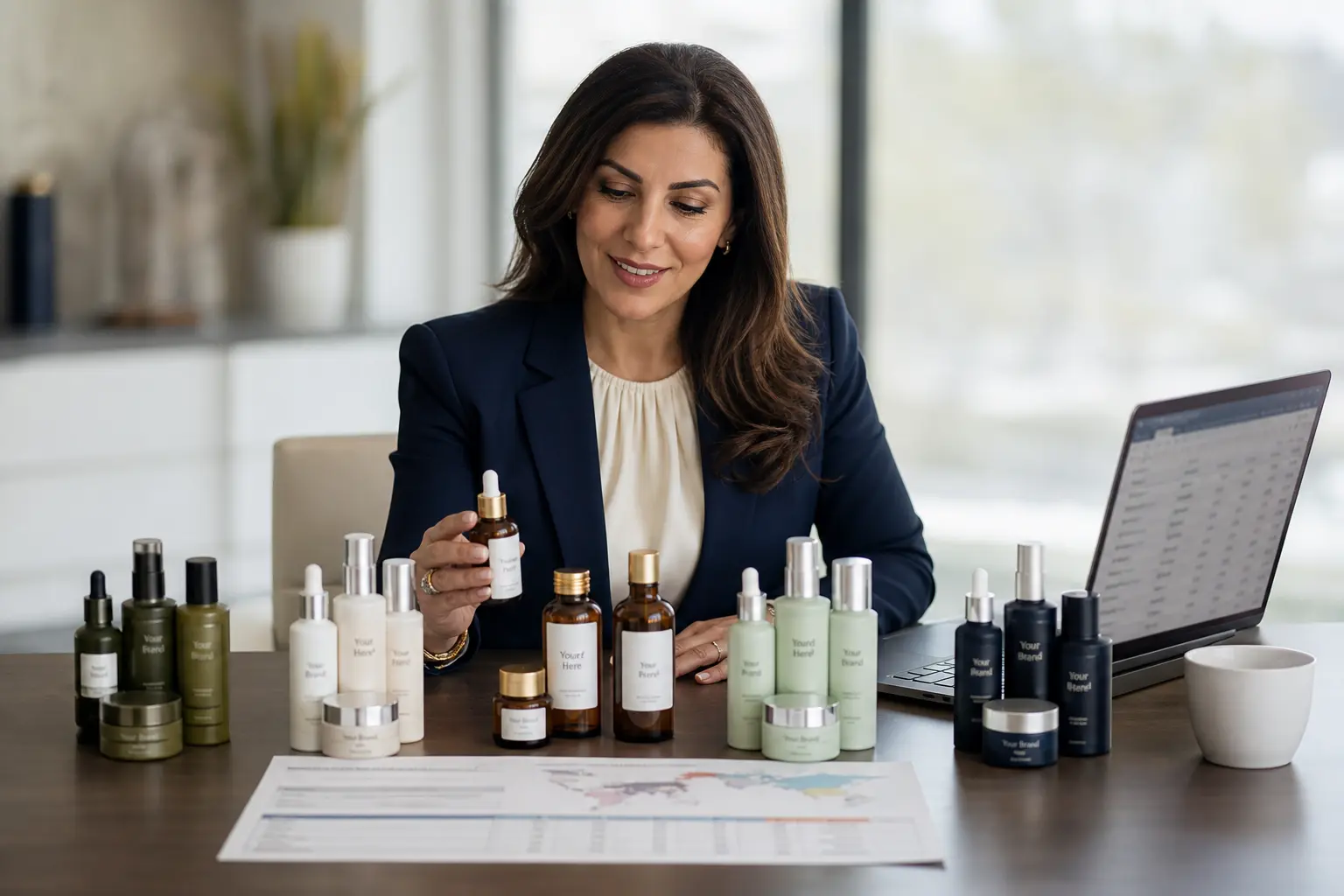
Due diligence on a cosmetics manufacturer is the structured process of asking the right questions, at the right stage, to verify that a supplier can actually deliver what they claim, under the terms they quote, with the compliance your target market requires.
That sounds simple.
In practice, most founders ask the wrong questions at the wrong time, accept vague answers, and discover the real situation only after signing.
The pattern repeats: questions about price dominate the first conversation, questions about certifications never get properly verified, and questions about what happens when something goes wrong are never asked at all.
After 30 years in the hair and beauty sector, most recently in private label cosmetics, with a network of 14+ manufacturing partners across Europe, Turkey, China, and the US, I have built and refined the question set that actually reveals useful information.
The principle is simple. Different questions belong at different stages of the conversation. Early questions filter out mismatched partners quickly. Mid-stage questions test for capability and transparency, and late-stage questions lock in commercial and legal protection.
This guide walks through all of them, organized by the four phases of the selection process. For each critical question, I note what a useful answer sounds like, and what the red flag version sounds like.
Why Do Structured Questions Matter More Than a Long Checklist?
Most manufacturer checklists online are long lists of questions with no sense of sequence, weight, or how to read the answers.
That format is easy to publish.
It is nearly useless in practice.
The problem with generic question lists
A first-time founder shows up to the first call with a 40-question list copied from a blog, reads through it in 20 minutes, and writes down whatever the manufacturer says.
The manufacturer has done this conversation a thousand times. They know how to give answers that sound complete without being specific.
An hour later, the founder has 40 notes and no usable information. Worse, they have spent the conversation checking boxes rather than actually assessing the fit.
The four-phase structure that works
Questions belong to one of four distinct phases of the selection process. Each phase has different goals and different standards of acceptable answers.
Phase 1: Capability and Identity. The first call or two. The goal is to confirm that the manufacturer can actually produce your product category, at your scale, under your target market’s regulatory framework. If they cannot, end the conversation within 15 minutes. Time is the only resource you cannot recover.
Phase 2: Commercial Terms. The quote stage. The goal is to understand what you would actually be buying, at what cost, under what conditions. Pricing, MOQ, lead times, payment terms, flexibility. Useful for negotiation, and increasingly so for verifying the manufacturer’s honesty about their own economics.
Phase 3: Quality and Verification. The technical evaluation stage. The goal is to verify independently what the manufacturer has told you, and to test capabilities you cannot assess from quotes and marketing materials. Certifications, sampling process, batch traceability, site visits or audits.
Phase 4: Contract and Relationship. The pre-signing stage. The goal is to protect against the situations where things go wrong. Contract clauses, change management, exit terms, reference checks.
The value of the structure is that each phase filters out unsuitable manufacturers before you invest further.
A manufacturer who fails Phase 1 never reaches Phase 2.
This protects your time and your judgment.
Expected answers and red flag answers
For each of the critical questions in this guide, I describe two things.
What a useful answer sounds like. Specific, verifiable, showing familiarity with the technical or regulatory detail. A manufacturer who operates professionally answers professionally.
What the red flag version sounds like. Vague, deflective, generic, or defensive. The exact wording varies. The pattern does not.
Phase 1: Capability and Identity Questions (First Call)
These go at the start of the first conversation.
If the answers are not solid, there is no point proceeding to pricing.
What product categories do you actually produce in-house, and what do you source from partners?
This is the first question because it frames everything else. The industry contains three types of companies (direct manufacturers, resellers, and hybrid producer-resellers) and knowing which one you are talking to changes the conversation.
Useful answer pattern: "We produce skincare emulsions, serums, and lotions in-house. Makeup and specialty formats like sticks we source through partner facilities we have worked with for years." Specific. Honest about sourcing boundaries.
Red flag answer pattern: "We can produce anything you need." Vague, undifferentiated, no mention of partners or categories. This is the single most consistent signal of either a reseller hiding their model or a very inexperienced sales contact.
Who is the legal entity that will appear on the contract and invoice, and is it the same entity that operates the production facility?
Identity discrepancies between the quoting entity and the producing entity are common in the industry.
Some are legitimate (holding structures).
Some are designed to complicate recourse.
Useful answer: The manufacturer can name the legal entity, state its relationship to the production facility, and offer to send the business registry entry.
Red flag answer: Confusion about which entity does what, or reluctance to clarify in writing.
How is the formula developed: in your in-house R&D, licensed from an external laboratory, or custom-developed for you by an external lab?
This question rarely gets asked because most founders do not know it matters. In practice, it determines whether a formula is exclusive or shared, whether it can be modified, and what happens if the external lab changes its terms.
Useful answer: A clear statement of which path applies to each formula they offer.
"Formulas A and B are in our R&D. Formula C is licensed from [lab X] non-exclusively. Formula D was custom-developed for us last year."
Red flag answer: "All our formulas are our own" with no detail, particularly from a manufacturer that is clearly too small to have a full R&D team.
Do you have your own brands or products sold under your own name, and do any of them compete in my target category?
Many manufacturers operate their own product lines alongside private label work. This is not a problem unless their brand directly competes with yours, or unless they prioritize their own production over client orders during peak seasons.
Useful answer: A straight yes or no, with specifics if yes.
"Yes, we have two skincare lines sold in professional distribution in Central Europe. Neither targets luxury positioning like your brief describes, so there is no direct overlap."
Red flag answer: Deflection, vague "we only do private label" claims that fall apart on 30 seconds of research, or explicit discouragement of the question.
What is your annual production volume in my specific product category?
This matters because it separates a generalist who occasionally makes your category from a specialist who runs millions of units per year. Capability at your scale is different from capability in principle.
Useful answer: A concrete number with context. "In skincare emulsions we produce approximately 3.5 million units per year across 40-50 active clients. Our capacity ceiling in that category is roughly 6 million."
Red flag answer: Evasion, very round numbers ("several million, it varies"), or refusal to share on confidentiality grounds that do not apply to aggregate category volume.
Phase 2: Commercial and Terms Questions (Quote Stage)
By this phase, the manufacturer has passed the capability filter.
Now the goal is to understand what you would actually be buying.
What is included in this price, and what is not?
The single most important commercial question, and the one most consistently skipped.
A quote that looks competitive often excludes items a market-standard quote would include: regulatory documentation preparation, stability and challenge testing, sample fees, packaging, freight, warehousing of raw materials. When those items appear as separate line items later, the real cost can be 40-60% higher than the headline quote.
Useful answer: A line-item breakdown, or an explicit statement of what is inclusive and what is separate. The manufacturer can say which items are excluded and give indicative ranges for each.
Red flag answer: "This is our standard price for the product" with no breakdown, or refusal to clarify until you have committed to proceed.
Is your stated MOQ a technical minimum from the production line, or a business rule minimum?
Most founders accept stated MOQs as fixed.
In practice, MOQs come from two different sources with very different flexibility.
A technical minimum is the smallest batch size the production line can run efficiently without waste.
Below that threshold, the manufacturer loses money on every unit. This is almost never negotiable.
A business rule minimum is a threshold the manufacturer sets above the technical minimum because changeover, cleaning, and calibration between formulas cost time and money. This is sometimes negotiable, particularly for a committed multi-batch relationship, or at a higher unit cost that compensates for the setup inefficiency.
Useful answer: The manufacturer can distinguish between the two, typically explaining that the technical minimum is around X kilograms of bulk (often equivalent to 500-2000 finished units depending on product), and that the business minimum they quote is above that for setup-cost reasons.
Red flag answer: The stated MOQ is presented as absolute with no explanation of why.
What are your payment terms for a first-time client?
Industry-standard terms for new clients cluster around 30% on order, 30-40% on batch approval, 30-40% on delivery. Variations exist.
Useful answer: Terms within or close to industry standard, with clear milestone definitions ("batch approval means your sign-off on the control sample from the production run before shipping"). Flexibility possible for repeat business.
Red flag answer: 100% payment before any production begins, or heavily front-loaded terms (70%+ upfront with no release milestones). These terms remove any practical recourse if quality problems appear.
What is your realistic lead time, including typical delays?
Published lead times tend to be optimistic. Realistic lead times include the raw material sourcing window, packaging arrival, regulatory testing cycles, and the time between pilot batch and final production.
Useful answer: A range rather than a single number, with honest mention of the most common causes of delay ("raw material lead time can add 2-3 weeks if we do not have the actives in stock; custom packaging usually pushes us another 4-6 weeks").
Red flag answer: A single aggressive number with no discussion of dependencies, or a history of late deliveries that they deflect rather than discuss.
How do you handle mid-development formula changes requested by the client?
Projects evolve.
A texture does not land right on the first sample. A fragrance direction shifts, or regulatory feedback requires a change.
The manufacturer’s flexibility on reasonable adjustments is a real predictor of relationship quality.
Useful answer: A specific process with a defined cost framework. "Minor adjustments within a defined scope are included in the development fee. Major reformulations are quoted separately based on lab hours and raw material changes. We typically accommodate three rounds of iteration before additional fees apply."
Red flag answer: "We do not change the formula once development starts," or the opposite extreme ("we can change anything anytime"), both of which indicate no actual process.
The best commercial conversations I have ever had with manufacturers were the ones where both sides said, early, what they could not do. The worst were the ones where both sides said yes to everything.
The first conversation sets the pattern for the whole relationship.
Phase 3: Quality, Compliance, and Verification Questions
This phase tests whether the claims made in earlier conversations hold up under verification.
Can I see your current ISO 22716 certificate, and verify it directly with the certifying body?
ISO 22716 is the international standard for cosmetics Good Manufacturing Practice.
In the EU, GMP compliance is required under Regulation (EC) No 1223/2009; ISO 22716 is the harmonised standard that gives a presumption of compliance, and the third-party certificate is voluntary but is the standard commercial proof, so asking for it remains best practice. In the US it is the de facto standard because the FDA has never published the GMP rule MoCRA ordered: both dates the Act set have passed, nothing has appeared under the rule’s RIN, and no new date has been announced.
Useful answer: The certificate is provided promptly with certifying body and validity date. The manufacturer actively offers a verification path ("you can check this directly on the SGS registry using certificate number X"). Major bodies (SGS, Intertek, TÜV SÜD, DQS, Bureau Veritas, Kiwa) maintain public registries for this purpose.
Red flag answer: The certificate takes weeks to produce, is issued by a body you cannot find or verify, or the manufacturer actively discourages direct verification with the certifying body.
The certificate itself is paper. The registry confirmation is a fact. A manufacturer who welcomes the verification is one that has nothing to hide. A manufacturer who discourages it is telling you something important without saying it.
The ISO 22716 verification is the EU baseline. For US-facing production, a separate registration system applies under MoCRA.
For US market production, what is your FDA FEI number, and is the facility actively registered and current on biennial renewal?
Under MoCRA, facilities producing cosmetics sold in the US must register with the FDA using Form FDA 5066, with biennial renewal. Section 612 of the FD&C Act exempts small businesses, meaning under 1,000,000 USD of average annual US cosmetic sales over the previous three years, unless they make products that contact the mucous membrane of the eye, are injected, are for internal use, or alter appearance for more than 24 hours.
Every facility has a unique FEI number (FDA Establishment Identifier). Biennial renewal is active in 2026.
Useful answer: The manufacturer provides the FEI number, which you can check in the FDA’s FEI Search Portal to confirm that it resolves to the same firm name and address. Registration status is not publicly searchable, so ask as well for the facility’s registration confirmation from Cosmetics Direct, which carries the status and the renewal date.
Red flag answer: Claims of US market capability without being able to produce an FEI number, or an FEI that does not match on verification.
Can you walk me through your sampling process, including how many iterations are typically needed and what each iteration costs?
Sampling reality is often invisible to first-time founders. Samples are produced at laboratory scale (mini-emulsifiers with 50-500 ml batch capacity), and each iteration costs real lab time and materials.
Useful answer: The manufacturer describes their sampling workflow clearly. "First sample is based on your brief and our closest reference formula. Typical development cycle is 2 to 5 iterations for base-derived formulas. Each iteration costs 200 to 800 EUR/USD for most product categories. We recommend a structured brief at the start to minimize iterations." (Cost figures in this article are indicative estimates that vary by manufacturer, region, and project scope.)
Red flag answer: Vague "we’ll send you samples until you’re happy" responses, which usually mean unlimited free samples for low-commitment clients and escalating costs for anyone who actually plans to produce.
How do you trace a finished product batch back to the source raw materials?
Tracing every finished unit back to the production batch, the intermediate batches, the raw material lots and the suppliers of those lots is an ISO 22716 requirement. Regulation 1223/2009 asks for less: the batch number of manufacture, or the reference identifying the product, on the container and packaging (Article 19(1)(e)) and, at the request of a competent authority, identification of who supplied the product and who it was supplied to, for three years from the date the batch was made available to the distributor (Article 7).
Useful answer: The manufacturer walks through an example trace fluently, ideally using a recent real batch with proprietary details redacted. They can name the QC software or paper system they use, the typical retention period for records (usually 5-10 years depending on jurisdiction), and the time required to produce a full trace on request (normally same-day or next-day for any batch from the past 3 years).
Note that in the EU the Responsible Person must keep the Product Information File for ten years following the date the last batch was placed on the market (Article 11(1), Regulation 1223/2009), so aligning the manufacturer’s record retention to that horizon is prudent.
Red flag answer: General statements about "full traceability" without being able to demonstrate the actual process, or long delays when asked to produce a trace on an example batch.
Can I arrange a site visit, or will you support an independent third-party audit?
For production runs above a few thousand units, verification beyond documentation is not optional.
Useful answer: "Yes, site visits are welcome with 2-3 weeks scheduling notice for logistics. We have supported independent audits by SGS, Intertek, TÜV SÜD, and Bureau Veritas for other clients. We can provide reference audit reports from the past 12 months." Third-party audits typically cost 1,500 to 4,000 euros and deliver a written report against ISO 22716.
Red flag answer: Refusal of both site visits and third-party audits. This single signal justifies walking away regardless of how good the other answers have been.
Phase 4: Contract and Relationship Questions (Before Signing)
By the time you reach this phase, the manufacturer has passed capability, commercial, and verification filters. The final questions protect against what happens over the duration of the relationship.
Can I see a sample of your standard supply contract before committing to sign?
Every serious manufacturer has a standard supply contract template. Reviewing it before negotiation is the only way to understand what protection the default contract actually provides (and what it does not).
Useful answer: The manufacturer provides a redacted or template version of their standard contract promptly for your legal review. A manufacturer who has been through many client relationships has a mature contract and is not defensive about sharing it.
Red flag answer: The manufacturer only produces the contract at signing, refuses to share it in advance, or does not have a standard template at all. Each of these indicates either inexperience or a deliberate tactic to block informed negotiation.
Who owns the formula, and what are the exclusivity terms?
Formula ownership determines whether you can take the product to another manufacturer if the relationship ends, and whether the manufacturer can sell the same formula to a competitor.
Useful answer: Clear language on ownership depending on the production path. In base-derived private label, the manufacturer typically retains ownership but grants exclusivity on a specific customization. In full custom, the brand typically owns the formula with some form of exclusivity clause. Terms are negotiable and should be explicit in the contract.
Red flag answer: "We’ll work it out later" or ambiguous answers. Formula ownership that is not explicit in the contract is ownership the manufacturer can claim in a dispute.
How are formula changes, raw material changes, and supplier changes communicated and approved?
A manufacturer who can unilaterally change suppliers or substitute ingredients without notification is a manufacturer whose product will drift over time.
Useful answer: A clear change-control protocol. Material changes to the formula, the raw material supply chain, or the packaging require written notification and client approval before implementation. The contract spells this out.
Red flag answer: Vague answers, or contract language that allows the manufacturer to change suppliers "for equivalent materials" at their own discretion.
What happens if there is a quality issue with a production batch?
Quality issues will happen over time in any long-term relationship. The manufacturer’s standard response framework predicts whether these moments strengthen the relationship or destroy it.
Useful answer: A specific process with a defined role. "Within 10 business days of a written quality complaint with batch number, we provide a root cause analysis and corrective action plan. Out-of-spec batches are either reworked at no charge, replaced, or credited to the next order, depending on severity and agreement."
Red flag answer: Generic "we stand behind our quality" responses without any described procedure, or language that shifts the burden of proof onto the brand for any quality dispute.
Can you provide two client references we could contact?
A manufacturer with a healthy business has clients willing to speak to prospects. A manufacturer with a problematic history does not.
Useful answer: Two or more specific names provided within a few days, with the manufacturer having pre-asked the referees for willingness to speak. The references are meaningful (recognizable brands, professional operations), not tiny test accounts.
Red flag answer: Delays, excuses, or references that turn out to be either non-existent or very small accounts whose endorsement does not validate the manufacturer’s capabilities at your scale.
What are the termination terms of the contract, and what happens to inventory, tooling, and specifications if we end the relationship?
Every relationship eventually ends. The terms governing what happens at that point should be clear from the start.
Useful answer: Termination clauses that define notice periods, handling of work-in-progress and finished inventory, ownership and return of tooling, and a clear transition process that does not leave the brand stranded.
Red flag answer: Termination terms heavily weighted toward the manufacturer, with forfeiture of tooling, unclear inventory handling, or no defined transition obligations.
Frequently Asked Questions
What is the single most important question to ask a cosmetics manufacturer?
"What product categories do you actually produce in-house, and what do you source from partners?" This single question reveals more about the structure of the manufacturer than any other. It distinguishes direct manufacturers from resellers and hybrid producer-resellers, exposes the industry’s most common opacity, and sets the tone for the transparency of the rest of the conversation. A manufacturer who answers it specifically and honestly is one you can continue to evaluate. A manufacturer who deflects or gives a vague "we can produce anything" answer is one to be cautious with from the start.
How do I know if a manufacturer’s answer is reliable?
Two patterns separate reliable answers from unreliable ones. Reliable answers are specific, verifiable against external sources, and include boundaries or trade-offs the manufacturer acknowledges. Unreliable answers are general, hard to verify, and describe the manufacturer as capable of everything with no trade-offs. A useful test is to ask a follow-up question that requires detail. A reliable manufacturer goes deeper. An unreliable one pivots to a different topic or repeats the original vague claim in different words.
How many questions should I ask in the first call with a cosmetics manufacturer?
Fewer than you think. The first call should cover the 5 Phase 1 questions from this guide (category capability, legal entity, formula origin, own brands, annual category volume) and leave time for the manufacturer’s own questions about your project. A first call dominated by a 40-question checklist is less productive than a focused conversation on capability fit. The remaining questions belong to later phases, once the manufacturer has passed the initial filter.
What should I do if a manufacturer refuses to answer a specific question?
A refusal to answer is itself an answer. The appropriate response depends on which category of question they refused. Refusal on confidential information about other clients is reasonable. Refusal on their own certifications, FEI number, ISO 22716 status, or supply contract template is not. In those cases, name the refusal explicitly in writing, ask for clarification with a deadline, and treat continued evasion as grounds to end the engagement. The red flags guide covers the specific patterns.
Do I need different questions for white label versus private label manufacturers?
The core capability, identity, commercial, and compliance questions apply to both. Some questions shift weight. In white label, formula ownership and exclusivity matter less because you are buying from a shared catalog. Sampling process matters less because finished samples are typically paid and sent anonymously with no iteration cycle. In private label, those questions become central, and development process questions carry the weight that catalog selection questions carry in white label.
How long should the full due diligence process take?
From first contact to signed contract, five to eight weeks for an experienced founder working with a prepared brief. First calls each take 45-60 minutes, and quote evaluation and comparison take one to two weeks. Certification verification, sample requests, and initial technical evaluation add two to three weeks. Site visit or third-party audit adds another week, including scheduling. Contract negotiation and legal review take one to two weeks. First-time founders without a pre-prepared brief typically add three to six additional weeks as they clarify their own requirements through the conversations.
Can I use this checklist if I am already in a relationship with a manufacturer?
Yes, and it is often more valuable at that stage than at selection. If you are already producing with a manufacturer, running the questions from Phase 3 and Phase 4 is a quick health check on the relationship. Many of the signals that predict future problems (quality drift, delivery inconsistency, unresponsiveness) show up on these questions before they show up in the production runs. If the answers now are worse than the answers were when you first engaged, that drift is the signal worth acting on.
Independent cosmetics consultant or manufacturer "free advice": what each actually covers, the structural limits of each, and how to decide which role you need at each phase. From 30 years in the industry, the honest framework.
The contract clauses that protect a cosmetics brand: formula ownership, IP, exclusivity, quality standards, termination. From 30 years of contracts reviewed and disputes seen, the practical guidance founders need before signing.
An honest comparison of cosmetics manufacturing regions (EU, Turkey, Korea, China, and the US), covering quality, compliance, MOQ, pricing, and when each region is the right choice. From 30 years working across four continents.