Product Development
Prototyping and Sampling Your Cosmetic Products: Complete Guide
How to request, evaluate, and give feedback on cosmetic product samples. A practical guide to the sampling process that prevents expensive production mistakes.
Product Development
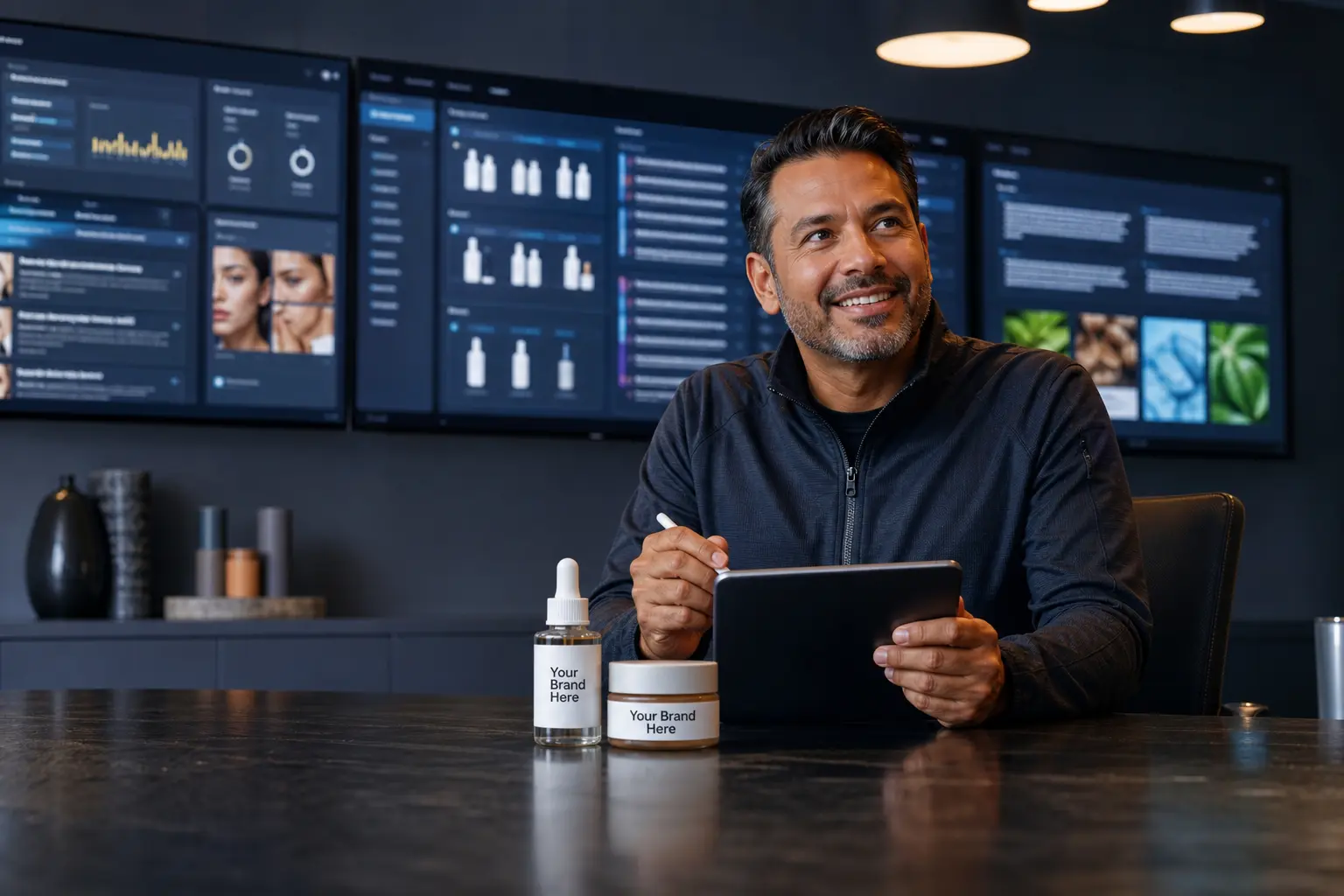
AI in cosmetics development is the use of artificial intelligence (large language models, specialized analysis systems, and machine learning tools) to accelerate parts of the brand-building process: market research, ingredient analysis, claims compliance, content generation, regulatory documentation, and customer communication.
It amplifies human expertise instead of replacing it.
Most articles about AI in cosmetics fall into one of two camps. The first is hype from AI companies selling their own tools. The second is fear from people who do not use AI every day and do not really understand what it does.
This article is neither.
After 30 years in the hair and beauty sector, most recently in private label cosmetics, I use AI daily in my own practice. It has multiplied what that expertise lets me do.
Research that took me days now takes hours. I like to say it makes me ten times more effective as a consultant: same judgment, same experience, same network, only faster and more consistent.
This guide is an honest view from someone sitting at the intersection of the traditional industry and the new tools: what AI genuinely does well, what it cannot do, and how to use it without getting burned or left behind.

AI capabilities in cosmetics fall into five distinct areas. Each one has real use cases and real limits.
| Area | AI does well | AI does not replace |
|---|---|---|
| Market research | Scanning reviews, prices, claims | Industry contacts, unpublished signals |
| Ingredient research | Explaining function and alternatives | Designing stable formulations |
| Claims and compliance | Drafting PIF sections, cross-checking rules | Legal sign-off by qualified professional |
| Content generation | Producing launch-scale copy fast | Brand voice without a strong brief |
| Customer support | Automating first-level queries | Emotionally sensitive conversations |
Each area is explained below with the specific trade-offs a founder should know.
Market and competitor research.
AI systems can scan hundreds of product listings, customer reviews, and industry articles in minutes, and surface patterns a human researcher would take days to find.
What used to take a founder a full week (competitor price points, claim patterns, ingredient trends, review sentiment) can now be done in an afternoon with the right workflow.
The limit: AI only sees what is public. It does not know what is happening inside manufacturers, what new ingredients are being tested but not yet launched, or what a specific regulatory authority is currently flagging behind the scenes. That still requires industry contacts.
Ingredient and formulation research.
AI is good at explaining what ingredients do, what claims they can support, what alternatives exist, and how different ingredients interact at a surface level.
Ask AI to explain the difference between hyaluronic acid and sodium hyaluronate, or to list alternatives to parabens with similar efficacy. You get a useful answer in seconds.
The limit: AI cannot design a stable formulation.
Telling AI to "create a vitamin C serum formula" produces something that looks like a formula but almost certainly does not work. Real formulation requires a chemist who understands how ingredients behave together at real concentrations, in specific packaging, over time.
Claims compliance and regulatory support.
This is one of the areas where AI adds the most value.
AI can read regulatory documents (EU 1223/2009, FDA guidance, Commission Regulation 655/2013) and answer specific questions: "Can I say hypoallergenic in the EU?", "Is this claim compatible with FDA rules for cosmetics?", "What evidence supports this claim under the common criteria?"
The documentation burden of cosmetic compliance is significant: PIF drafting, CPNP notifications, claim substantiation files.
All of it can be accelerated with AI assistance.
The limit: AI is not a regulator. Every output needs to be reviewed by a qualified professional before it becomes the basis for a commercial decision.
Content and marketing generation.
Product descriptions, social captions, email sequences, blog articles, ad copy. All of this can be drafted by AI in a fraction of the time a human writer takes.
For a founder launching with a small budget, this levels the playing field. Content that a well-funded brand would pay an agency to produce can be generated in-house at a fraction of the cost.
The limit: AI writes what is statistically likely based on its training.
Without clear brand positioning, customer avatar, and voice guidelines, AI-generated content reads generic. The quality depends entirely on the quality of the brief you give it.
Customer communication and support.
AI assistants and automated email systems can handle first-level questions, order support, and product recommendations around the clock, freeing the founder for higher-value work.
The limit: customers can tell when they are talking to AI.
Using it for low-stakes queries is fine. Using it for anything emotionally sensitive (complaints, product issues, adverse reactions) is not.

The limits above are category-specific. Deeper limits apply across every AI tool on the market.
It cannot replace manufacturer relationships. The trust, communication, and problem-solving between a brand and a manufacturer cannot be automated. When something goes wrong in production (and it will), no AI tool calls the manufacturer for you.
It cannot make strategic decisions for you. "Should I launch with 3 products or 5?" "Should I go retail or professional?" "Should I price at 45 EUR/USD or 65 EUR/USD?" These are judgment calls that depend on context AI does not have: your risk tolerance, your capital, your network, your timeline. (Pricing examples in this article are indicative estimates that vary by manufacturer, region, and project scope.)
It cannot stand behind a product in a salon chair or in a customer’s home. The moment a product touches real hair or skin, human experience matters more than any AI output.
AI is powerful where the work is data-heavy, pattern-driven, or repetitive. It is weak where the work requires judgment, relationships, or physical sensation.
That split between what AI handles well and where humans stay irreplaceable shapes every practical decision a founder makes about which tools to use. Understanding it before you buy the first tool saves money and time.

Not every AI application is equally valuable. Some deliver real time and cost savings. Others are overhyped and underperform.
Based on daily use across the brand projects I work on, here is where AI actually pays off for a first-time founder.
This is probably the highest ROI use of AI for a new brand.
Give it a product category (for example, "natural adult acne treatments") and ask it to analyze the top 20 products on Amazon, Sephora, or your target channel. Ask for price ranges, common claims, ingredient patterns, packaging formats, review themes.
What used to be a week of manual research becomes a useful synthesis in an hour.
Use this as the starting point for your own positioning, not as the final word.
AI analysis is always a draft that your industry knowledge improves.
AI is excellent at turning a rough idea into a structured brief.
Describe your concept in one paragraph, and ask AI to convert it into a formal brief with sections for target customer, positioning, claims, technical parameters, reference products.
What comes back is not final, but it gives you something to iterate on.
This shortens the gap between "I have an idea" and "I have something a manufacturer can quote against" from weeks to days.
AI handles documentation volume better than any human can.
Draft PIF sections, cross-reference claims against regulations, generate ingredient declarations, prepare CPNP notification text. None of this replaces the two roles the law assigns to people: the Responsible Person, who stays legally accountable for the product’s compliance, and the qualified safety assessor, who has to write and sign the safety report. All of it shortens the time to get there.
For founders working across multiple markets (EU + Great Britain + US), parallel regulatory preparation becomes manageable with AI support.
Without it, most first-time founders underestimate this work.
The content needed for a launch is enormous: website copy, product descriptions, email sequences, social content, blog articles, ad variations, press materials.
AI lets a small team produce launch-level content volume without hiring an agency.
The key is the brief, the voice guidelines, and the editorial review on the way out. Without those, the output reads like everyone else’s.
After launch, AI helps analyze reviews, support tickets, and social mentions to surface patterns that inform product iteration and marketing refinement.
What customers praise, what they complain about, what they wish existed.
All of this used to require expensive market research. Now a structured AI workflow can produce useful insights weekly.
The highest ROI use of AI for a first-time brand is compressing the research and documentation work from weeks into days, not generating content.
That compression is what lets a small team operate at the scale of a well-funded one, as long as the judgment on top of the AI output is still human and still sharp.

Every industry has areas where the AI marketing gets ahead of the reality. Cosmetics has several.
"AI-generated formulas." These exist as tools but almost never produce commercially viable formulations. The output looks like a formula.
When a chemist reviews it, the issues become visible: stability problems, unrealistic active concentrations, combinations that do not work together, missing preservation systems.
Treat AI-formula tools as brainstorming inputs, not as production-ready outputs.
"AI-powered personalization." Widely promoted, rarely delivered well. Most AI personalization in cosmetics is a quiz that maps answers to existing products. Useful, but not the deep personalization the marketing suggests.
"AI replacement of cosmetic consultants." Tools that promise to replace an experienced consultant typically deliver generic strategy that any experienced consultant would reject.
They work for founders who have never worked with a real consultant. They disappoint the ones who have.
For a deeper view of what independent expertise actually delivers, see the independent consultant vs manufacturer guide.
"AI-driven regulatory automation." Automated compliance tools exist and are useful, but they still require a qualified human to validate outputs. Anyone promising full regulatory automation is overselling.
A simple filter that has served me well.
First question: who built this tool, and do they know cosmetics? Tools built by AI engineers with no industry knowledge often produce output that sounds right on the surface but falls apart when a cosmetics professional reviews it. Tools built by (or with) cosmetics experts tend to catch the details that matter (regulatory nuance, ingredient behavior, real manufacturer dynamics) and get the small things right.
Second question: what does the tool actually do? Specific, verifiable functions ("generate a first draft of a PIF section," "analyze reviews for sentiment patterns") deliver real value. Vague promises ("AI-powered brand intelligence," "revolutionary beauty innovation") usually do not.
Third question: does it require expert review after use? An honest tool is clear that its output is a draft that needs human review. A dishonest one promises production-ready deliverables with no oversight.
If the tool passes all three filters, it is worth testing on a specific, defined task. If it fails any of them, save your money.

Looking 2 to 3 years out, the most interesting direction for brand founders is a change in how the work is organized, not a new tool.
It is the emergence of integrated service ecosystems where AI runs in the background and a hand-picked network of human specialists delivers the work that actually needs human hands.
Today, most first-time founders spend enormous energy stitching together their own version of this: a consultant for strategy, a chemist for formulation, a regulatory professional for compliance, a designer for packaging, an agency for content, a lawyer for contracts, a manufacturer for production.
Each one found separately, evaluated separately, briefed separately, coordinated by the founder.
It is expensive and slow, and it goes wrong often. Every handoff between specialists is a place where the brand loses coherence.
The direction the industry is moving in: service hubs where all of this is coordinated under one roof, with AI doing the connective work (research, documentation, content preparation, communication) and human professionals handling the parts that only humans can do.
The value sits in what the AI makes possible: faster, cheaper, clearer service delivery without losing the quality of real human expertise at the decision points that matter.
This is exactly the direction I am building with cosmetiFULL: a service ecosystem where 30 years of experience in the hair and beauty sector combines with a trusted network of legal, formulation, packaging, and development specialists.
AI works quietly behind the scenes to speed up research, documentation, content generation, and coordination.
The service is the product, and the AI just makes it better, faster and more accessible than what a single consultant or a traditional agency could deliver alone.
If this direction interests you, cosmetiFULL is launching soon. You can follow the blog for updates as the launch approaches.
Three practical implications.
Start using AI now, even in limited ways. Founders who build AI fluency early are more effective at managing the research, content, and documentation load of a launch. Those who avoid AI will be at a cost and speed disadvantage within 18 months.
Do not rely on AI alone for decisions that affect safety, compliance, or brand identity. These require human professionals. Use AI to prepare the inputs they work with, and keep the professional in the loop.
Build relationships with real humans in parallel. The chemist you trust, the manufacturer you can call, the consultant who knows your products. AI amplifies these relationships. It cannot build them for you.
The brand founders who succeed in the next 5 years will be the ones who use AI as a tool, backed by human expertise where the decisions actually matter.
For how to think about choosing a manufacturer in this context, where AI helps with preparation but the relationship itself stays human, see the manufacturer selection guide.
For the broader context of what private label cosmetics is and how the model works today, see the complete guide to private label cosmetics.
Can AI create cosmetic formulas?
Not production-ready ones. AI can generate text that describes formulations, list plausible ingredient combinations, and suggest starting points for a chemist. But real cosmetic formulation requires chemistry (stability, compatibility, preservation, texture, performance over time) that AI cannot validate without lab testing. Treat AI formula outputs as brainstorming material for a human chemist, not as formulas ready to manufacture.
Will AI replace cosmetics consultants?
Not for experienced founders, and not for strategic decisions. AI replaces parts of a consultant’s work (research synthesis, document drafting, content generation) but not the core value (judgment, strategy, manufacturer relationships, accountability for outcomes). What AI does replace is generic entry-level consulting that mostly aggregated public information. If your consultant’s value is 20+ years of specialized experience and a real network, AI amplifies them rather than replacing them.
How is AI used in the beauty industry today?
Major brands use AI for trend and customer behavior analysis, personalized recommendations, virtual try-on technology, customer service automation, and supply chain planning. Smaller brands use AI mostly for content generation, market research, and customer communication. The gap between what large brands do with AI and what small brands can do is narrowing rapidly thanks to affordable LLM-based tools.
What AI tools exist for cosmetics brands today?
Tools exist for claims compliance checking, ingredient database research, INCI analysis, content generation, customer sentiment analysis, and regulatory documentation support. Most are sold as specialized SaaS. Many of the best results come from using general-purpose LLMs (ChatGPT, Gemini, Perplexity) inside carefully designed workflows, rather than from single-purpose beauty-tech tools. The right approach depends on budget, use case, and technical comfort level.
Is it ethical to use AI in cosmetics brand development?
Yes, when used responsibly. AI applied to research, content preparation, and documentation is efficient and uncontroversial. Ethical concerns arise mainly when AI is used to fabricate claims, simulate reviews, or replace safety assessments that require qualified professionals. The rule: use AI to amplify honest work, not to disguise low-quality work as high-quality.
Can AI help me choose a manufacturer?
Partially. AI can help you research manufacturers, compare public capabilities, analyze their client portfolios, and prepare the questions you should ask. But the actual decision still requires human conversations, factory visits (or video tours), sample evaluation, and contract review. AI accelerates the preparation for manufacturer selection. It does not replace the selection itself.
How should a small brand start using AI?
Start with one high-value use case. Pick the area where you are spending the most time on research or documentation, and build a simple AI workflow for it. Do not try to automate everything at once. Master one workflow, learn what AI does well and badly for your specific business, then expand. Most first-time founders get more value from using one LLM well than from subscribing to 5 specialized tools.
Keep reading
How to request, evaluate, and give feedback on cosmetic product samples. A practical guide to the sampling process that prevents expensive production mistakes.
How to create a haircare product line that actually sells. From hairdresser-turned-consultant: product selection, professional vs retail, and launch strategy.
How to create a skincare product line that actually sells. Strategic guide to product selection, positioning, and sequencing your launch for founders.