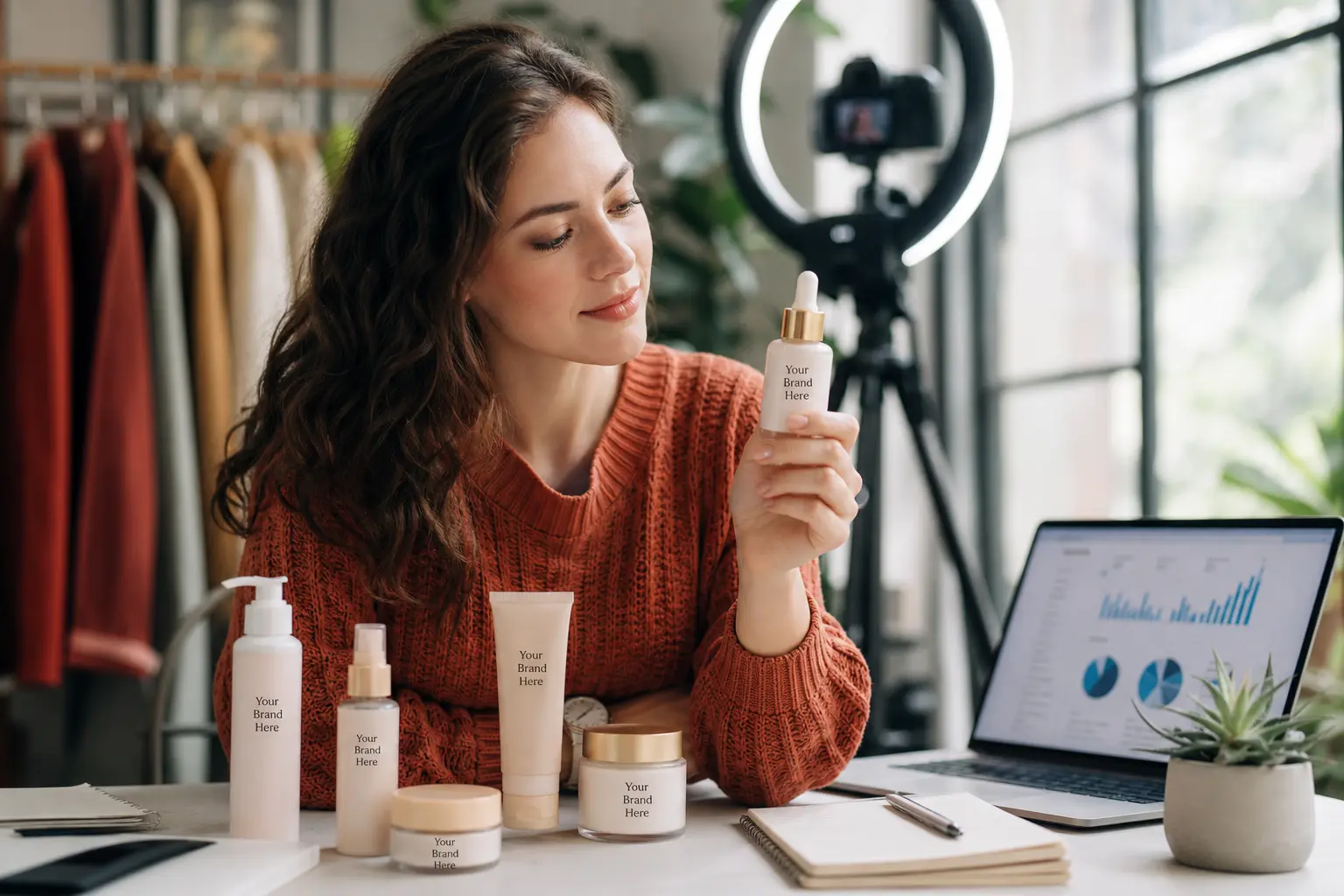
Every influencer with a decent following gets the same DMs.
"We can make your dream products!"
"Launch your own line in 30 days!"
"Low MOQ, fast delivery, your logo on our products!"
Five, ten, sometimes fifteen messages a week from manufacturers promising to turn your audience into a cosmetics brand.
Most of those messages lead to products that look generic, feel generic, and risk making you look generic too.
This guide comes from an independent consultant who has guided influencer launches and seen both the wins and the very public failures, not from a manufacturer trying to sell you production.
With your audience, you can absolutely launch a private label cosmetics brand.
The real question is whether you can do it without destroying what took you years to build: your credibility.
Your Biggest Advantage (and the Risk You Need to Understand)
The audience advantage nobody else has
Start with what you already own.
As an influencer, you have the single most valuable asset in the cosmetics industry: an audience that trusts you.
That is worth more than any formula, any packaging, any marketing budget.
When you recommend a product, people buy it. When you launch your own product, those same people will at least try it.
I’ve seen influencers generate 2,000 to 3,000 pre-orders before the product even shipped. From a single Instagram Story.
Try doing that with paid ads as an unknown brand. It would cost 50,000 to 100,000 EUR/USD and you would not get close. (Cost and revenue figures throughout this article are indicative estimates that vary by manufacturer, region, and project scope.)
That is your advantage. And it is enormous.
But it also means the stakes are higher than for any other type of founder.
The reputation risk that comes with it
Every product you put your name on is a public bet.
If the product is good, your audience loves you more. Their trust deepens. Your brand grows.
If the product is mediocre, generic, or (worst case) causes a bad reaction, the damage is public, immediate, and permanent.
The career damage from a failed or fake product launch can take years to recover from.
If you recover at all.
Your audience gave you something that cannot be bought: their trust. A product launch either deepens that trust or destroys it. There is no middle ground.
This is why the way you launch matters as much as what you launch.
Why white label is riskier for influencers than for anyone else
White label is not a bad model in every situation. For a salon owner testing a new category or a retailer filling a gap, it can work.
But for influencers, the risk is much higher.
Your followers are people who follow beauty content, not casual consumers. They know products, they compare, and they research.
A white label manufacturer might have 100 to 200 ready-made formulas in their catalog. Those same products can be sold to anyone: other influencers, Amazon sellers, random brands.
When a follower notices that your 35-euro serum looks suspiciously similar to a 12-euro product on Amazon, the conversation shifts from your product to your authenticity.
That is a conversation you do not want to have publicly.
Why the hybrid approach works better for creators
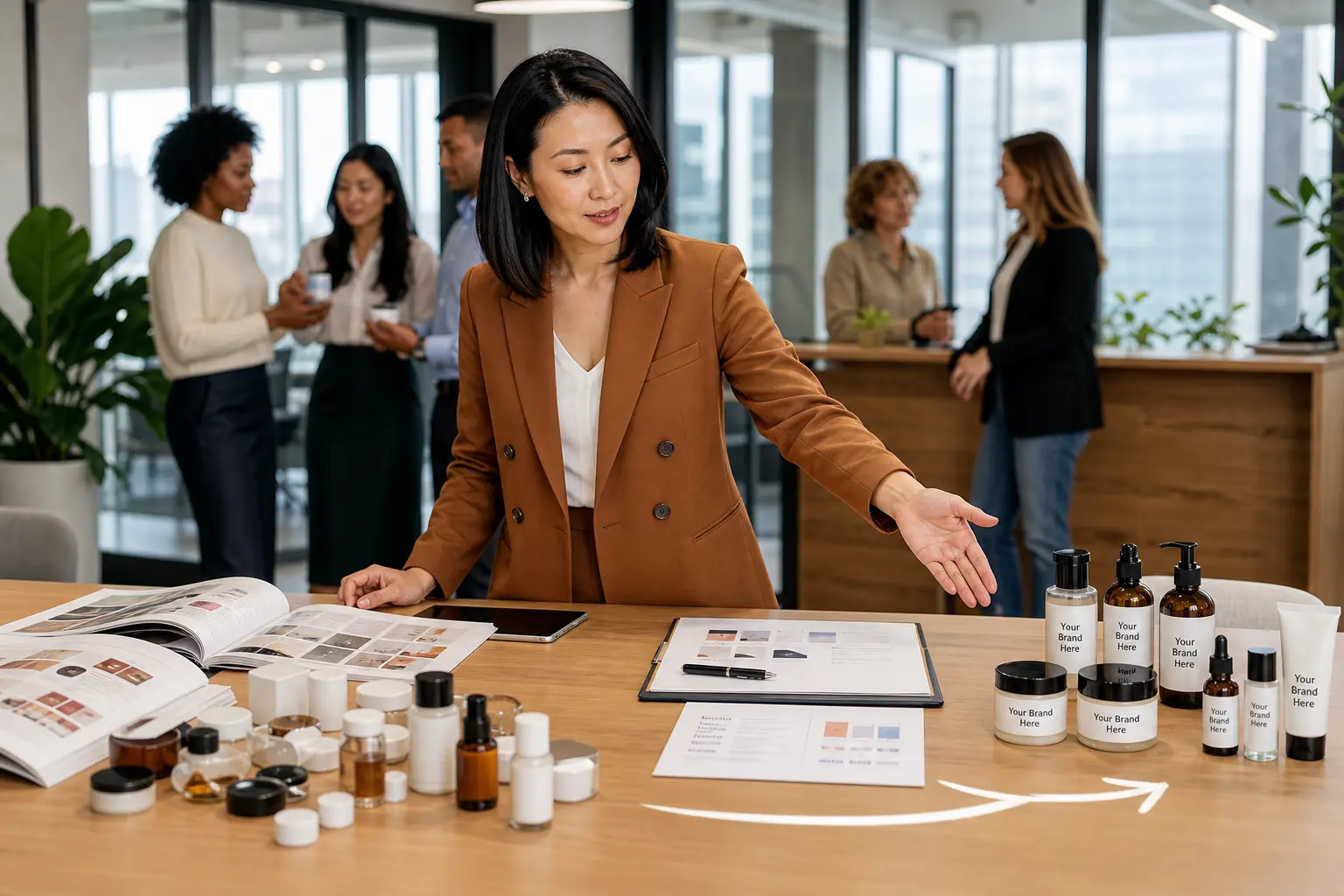
The hybrid approach sits between white label and full custom private label.
Instead of choosing from one manufacturer’s limited catalog, you access a network of manufacturers with hundreds of thousands of formulas in their archives. Not 100 or 200 ready-made products. Hundreds of thousands of formulations that exist in their development portfolio.
Then you customize selectively. A different fragrance. A specific active ingredient. A different texture.
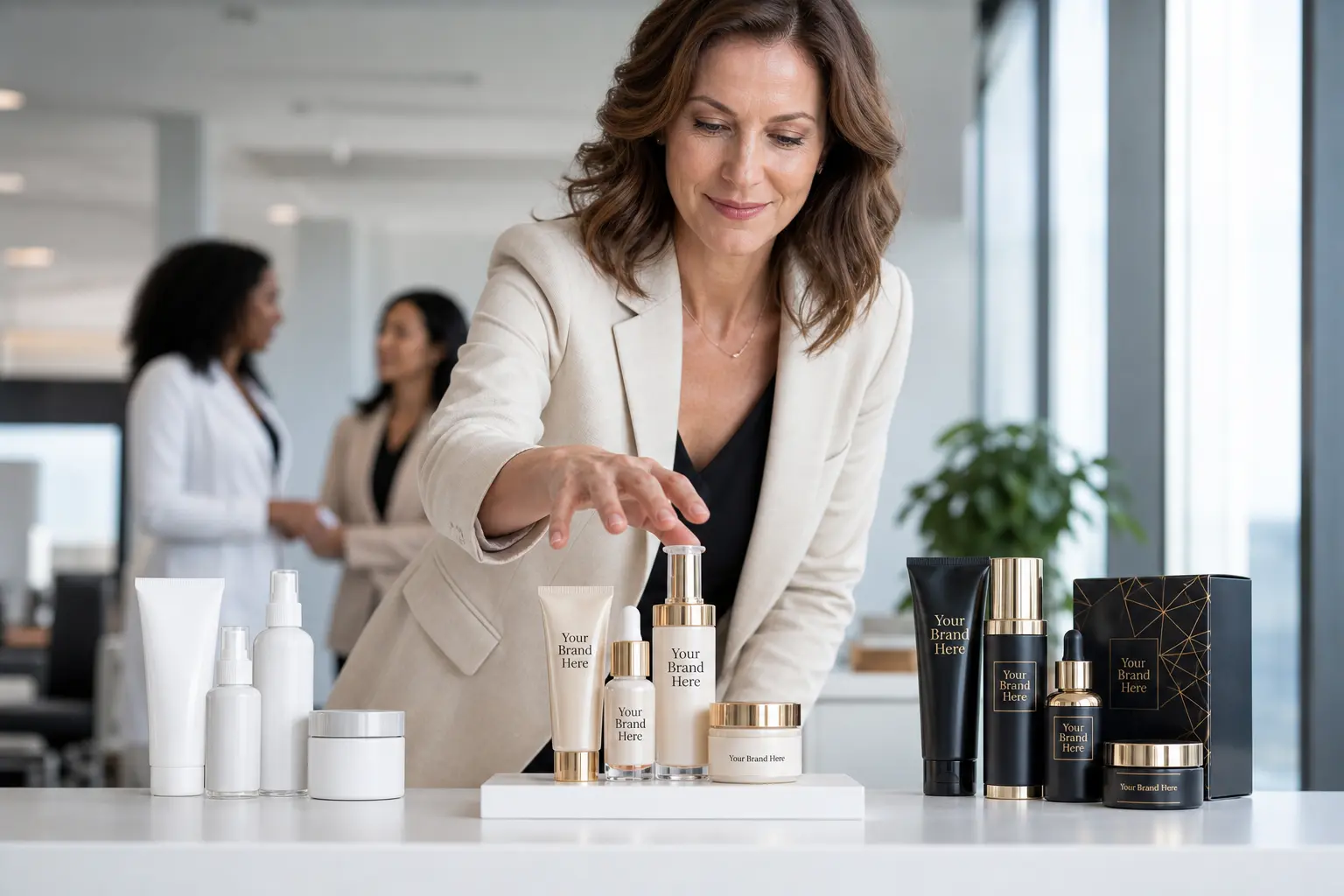
And here is the key differentiator for influencers: you choose completely different packaging. A different bottle, a different applicator, a different box, a different color scheme.
Could a very determined follower Google the INCI list and find a similar formula somewhere? Theoretically, yes. That is true for any product that is not 100% custom.
But with hybrid, the visual product is completely different from anything else on the market. The packaging is yours. The presentation is yours. The experience is yours.
With white label, the product looks the same as the ones on Amazon because it IS the same.
That visual and experiential difference is what protects your credibility.
Start with what your audience already trusts you for
If your content is about skincare, launch skincare.
If your content is about haircare, launch haircare.
If your content is about makeup, launch makeup.
Do not launch a skincare line if your audience knows you for makeup tutorials. The credibility does not transfer automatically.
Your first product should sit in the exact center of your expertise and your audience’s expectation.
A hero product with 2 to 4 complementary products
I never recommend launching a single product alone.
And I never recommend launching an entire routine either.
The sweet spot for influencers is 3 to 5 products. One hero product that solves a specific problem, plus 2 to 4 complementary products that speed up, strengthen, or extend the action of the hero.
This matters strategically.
If you sell one product, you acquire a customer for one purchase. If you sell a system of 3 products, you acquire the same customer but for a bundle worth 3 times as much.
The cost of acquiring that customer is the same. You already have their attention. They already trust you.
A well-designed bundle (hero + complementary products) converts at a much higher rate than a single product. Because the customer sees a complete solution, not just a product.
But do not go beyond 4 to 5 products. For a wide audience (not professionals who are used to multi-step protocols), routines longer than 4 steps feel like too much commitment.
3 products is the minimum. 5 is the maximum for a first launch.
Build on your content, but keep an eye on trends
Your audience follows you for a reason. They relate to your perspective, your recommendations, your approach.
Your product should be an extension of that. Not a random launch that feels disconnected from everything you have talked about.
You are also an influencer. Part of what your audience values is that you are aware of what is happening in the beauty world.
The foundation of your product line should come from your content and your expertise. That does not change.
But the specific direction (which ingredient, which texture, which format) can absolutely be informed by trends that are relevant to your audience.
The key word is relevant. Following a trend because it is popular on TikTok this week is a mistake. Incorporating a trending ingredient that your audience has been asking about is smart product development.
Choose products with visible, immediate results
This is a practical tip that most guides miss.
For your first launch, pick a product category where the customer sees results from the first application.
Something that shows an immediate, visible difference, rather than a product that needs 3 months to work.
For haircare: restructuring treatments, shine serums, plumping masks, liquid crystals. Products that change how the hair looks and feels from the first use.
For skincare: hydrating serums, glow-boosting treatments, instant-effect masks. Products where the "before and after" is visible immediately.
This matters more for influencers than for other founders.
Your content is visual. You need to show the result.
A product that "works after 90 days of consistent use" is hard to demonstrate on camera. A product that makes hair visibly shinier after one application creates content that sells itself.
The immediate result builds trust fast. The customer sees it, believes it, and comes back.
Products that work slowly (like hair loss prevention or long-term anti-aging) can come later, once your audience already trusts your brand. But they are harder to launch with.
Here are the realistic ranges for an influencer launching 3 to 5 products:
Hybrid approach: 5,000 to 15,000 euros. Existing tested formulas customized for your brand. The recommended path for most influencer first launches.
Standard private label: 8,000 to 20,000 euros. More customization, premium packaging, more development work behind the formula.
One item is not a tier, and it is worth saying plainly: the regulatory dossier. Every cosmetic sold in the EU needs its safety assessment, its product information file and its notification before the first unit reaches anyone, hybrid or standard, three products or thirty. Ask each quote whether that work is inside the price. A number that leaves it out is not the real number.
Where influencer budgets differ from other founders:
You will likely spend less on initial marketing. Your audience is your marketing channel.
But you should spend more on product photography and video content. Your audience expects high visual quality.
And you should absolutely invest in proper packaging design. Your followers will judge the product by how it looks in your content before they ever try it.
A strong unboxing experience matters. Premium packaging, thoughtful details, visual consistency with your personal brand. This is where part of your budget should go.
For a complete cost breakdown covering every line item, there is a dedicated guide on the site.
The margin opportunity
A typical skincare product costs 3 to 5 euros per unit to produce.
An influencer with strong positioning can sell it for 25 to 40 euros.
That is a x5 to x8 multiplier, higher than salon retail and higher than Amazon.
Because your audience pays for the trust and the brand, not just the formula.
DTC margins (selling through your own website) can reach 50 to 60% net after all costs.
Sponsored content rents your audience to other brands and pays once. Your own product line owns the relationship and keeps paying.
Those margins only hold up if the launch itself does not damage what made them possible.
How to Launch Without Destroying Your Credibility
Involve your audience from the beginning (but you make the decisions)
This is the single most important piece of advice in this article.
Do not disappear for 6 months and then surprise your audience with a product.
Bring them into the process.
Share the development journey. Show the samples. Let them vote on fragrances. Ask for input on packaging.
Show the real process, including the iterations and the challenges. Not just the final result.
In practice:
Month 1: "I have been thinking about creating my own serum. What is the one skin concern you wish I could solve?" (Instagram Story poll)
Month 3: "I have been working on something. Here are the first samples." (Behind-the-scenes content)
Month 5: "I narrowed it down to two fragrances. Which one do you prefer?" (Vote in Stories)
Month 7: "The packaging is almost final. Here is a sneak peek." (Teaser content)
Month 8: "It is ready. And you helped create it. Pre-orders start next week."
When your audience feels like they were part of creating the product, they are emotionally invested in its success.
They buy it, and then they promote it and defend it.
One important note: your audience will give you a wide range of suggestions, some brilliant, some contradictory, some impractical.
The final decisions are yours. Your job is to listen to the signals, understand what your audience actually needs (not just what they say they want), and make the product decisions based on that understanding plus your expertise.
Co-creation does not mean design-by-committee. It means involving your audience in the journey while you steer the direction.
Be transparent about how the product is made
Your audience will respect honesty more than perfection.
"I did not create this formula in a lab myself. I worked with a professional manufacturer, selected a base formula that matched what I wanted, and customized it specifically for this brand."
That is a real sentence you can say. And it is the truth.
Nobody expects you to be a cosmetic chemist. They expect you to be honest.
The influencers who get in trouble are the ones who imply they personally formulated everything.
When the audience discovers that is not true (and they will), the backlash is about the lie, not the product.
Integrate products naturally into your content
Your product should not feel like an interruption. It should feel like a natural part of your content.
If you do skincare routines, use your product in the routine. Show it alongside other products you genuinely use.
The ratio that works: 80% of your content stays the same as before (education, reviews, entertainment). 20% features your product.
If every post suddenly becomes a sales pitch for your brand, your audience will feel the shift. And they will disengage.
The best influencer brands are the ones where the product feels like it has always been part of the creator’s life.
Test with a small group before committing
Before you place a full production order, get honest feedback from a small group of your most engaged followers. One thing to settle first: in the EU, putting a cosmetic product in a consumer’s hands counts as putting it on the market, even when you give it away for free. So whatever you send has to be the finished, compliant product: safety assessment done, product notified, full label on the container. Until that point, keep the trials in-house with your manufacturer.
Not "do you like it?" but "what would you change?"
That feedback will save you from launching a product that does not match your audience’s expectations.
It also creates your first wave of real reviews. People who actually used the product and can talk about it authentically when you launch.
The pre-sale advantage (use it)
Most influencers do not realize they have this.
You have an audience. You have trust. You can sell products before they are produced.
A well-executed pre-launch campaign (teasing, behind-the-scenes content, early access for followers) can generate enough pre-orders to cover a significant portion of your production investment.
I’ve seen influencers recover their entire initial investment through pre-sales alone. Before the first box was shipped.
That is something no salon owner, no Amazon seller, no first-time founder without an audience can do.
Use it.
The logistics gap (the one thing you need help with)
Now the practical part.
You know content. You know your audience. You know how to sell through a camera.
You probably do not know fulfillment, shipping, inventory management, or customer service at scale.
And this is the part that kills influencer brands quietly.
Bad logistics, not a bad product and not a bad launch.
Orders that take 2 weeks to ship. Packages that arrive damaged. No system for handling returns. Stock that runs out with no reorder plan.
In 2026, customer expectations for e-commerce are very high. People expect fast shipping, professional packaging, and a smooth experience from purchase to delivery.
You have two options: build the logistics infrastructure yourself (warehouse, shipping partners, customer service) or use a fulfillment partner (3PL) who handles it for you.
Either way, plan this before you launch. Not after.
This is one of the areas where working with an experienced consultant or partner pays for itself. Because the logistics mistakes are the ones that damage your reputation silently, through negative reviews and customers who simply never buy again.
A realistic first year for an influencer launching 3 to 5 products:
3,000 to 8,000 units sold (depending on audience size and engagement)
Revenue: 75,000 to 200,000 euros
Net profit: 25,000 to 80,000 euros
That is from a single launch cycle, promoted through content you would be creating anyway.
Compare that to sponsored content. Most mid-tier influencers (50,000 to 200,000 followers) earn 500 to 2,000 euros per sponsored post.
You would need 40 to 80 sponsored posts to match the profit from one product launch.
And here is the critical difference: a sponsored post generates income once. Your product generates income every time someone reorders.
A customer who buys a serum and loves it will buy it again in 2 to 3 months.
That is recurring revenue. Something sponsored content can never give you.
Years 2 to 4: the compounding effect
Sponsored content income is linear. You post, you get paid, it is over.
Product income compounds.
Every new piece of content about your product drives more sales. Every satisfied customer reorders. Every review attracts new buyers who found you through search, not through your feed.
By year 2, with 5 to 8 products and an established audience, an influencer brand can reach 200,000 to 500,000 euros in annual revenue.
By year 3 to 4, with expanded product lines, multiple channels (DTC, Amazon, retail), and a brand that has its own momentum beyond your personal content, 500,000 to 1,000,000+ euros is realistic for creators with engaged audiences.
And at that point, the brand itself has value. It can be sold. It can attract investment.
It is an asset that exists independently of your daily content.
The mistakes that kill influencer brands
Launching too fast. A manufacturer promises 4-week delivery. You skip brand strategy, regulatory, and testing because you want to ride momentum. Then: stability issues, regulatory problems, customer complaints. 4 to 9 months of proper development is protection, not a delay.
Launching into a saturated category without differentiation. "I want to launch an eyeshadow palette." Great. There are 10,000 on the market. What makes yours different? If the answer is "my name on it," that is not enough.
Ignoring logistics. Your content skills are your superpower. But content does not handle shipping, returns, or inventory. Get help for the parts you do not know.
Launching a single product. One product alone limits your revenue per customer. Launch 3 to 5 products that work as a system. The cross-sell opportunity is too valuable to miss.
Not planning for reorders. Your first production run sells out. Great. But if you do not have a reorder plan, you go out of stock for 6 to 8 weeks. Momentum dies. Customers move on.
Your first steps
Validate with your audience. Before you spend anything, ask your followers: what would they want from you? What problem should it solve? Use polls, questions, DMs.
Choose 3 to 5 products. One hero product plus 2 to 4 complementary products that work together as a system. Pick a category with immediate visible results.
Set a realistic budget. 5,000 to 15,000 euros for a hybrid approach, 8,000 to 20,000 for standard private label. Invest extra in packaging design and photography.
Find the right partner, and put one thing in writing. Not the manufacturer who DMed you. An independent consultant or a vetted manufacturer who understands your brand and the stakes of a public launch. Before anything else, settle who is the responsible person for the product in the EU: it is a named role, the product cannot legally be sold without it, and if you sell under your own brand and nobody has signed for it, it is you by default. Ask, get the answer on paper, and know which of the two of you is holding it.
Plan your logistics. Fulfillment, shipping, returns. Set this up before launch, not after.
Build anticipation over 4 to 9 months. Use the development time to create content around the journey. Your audience will follow the story.
Pre-sell. Use your audience advantage. Early access, exclusive pricing, limited first batch. Cover as much of your investment as possible before the official launch.
Launch and listen. Your first 100 sales will teach you everything. Adjust from there.
The path from content creator to brand founder is natural. You already have the audience, the content skills, and the trust.
The only question is whether you protect that trust by doing it right, or risk it by taking shortcuts.
Will my audience buy products from me?
If they trust your recommendations and the product is relevant to your content, yes. The key is launching a product that fits naturally within your existing content and offers visible results.
How do I avoid looking like I just slapped my logo on a generic product?
Use the hybrid approach: select from tested formulas and customize (fragrance, key ingredients, texture). Most importantly, invest in completely different packaging (bottle, applicator, box, design). White label products look the same because they ARE the same. Hybrid products look different because the entire visual and experiential presentation is yours.
How many products should I launch with?
Launch with 3 to 5 products. One hero product plus 2 to 4 complementary products that speed up or strengthen the hero’s action. This gives you a system to sell as a bundle, which significantly increases your revenue per customer. Do not launch a single product alone, and do not launch more than 5.
How much does it cost for an influencer to launch a beauty brand?
The hybrid approach costs 5,000 to 15,000 euros for 3 to 5 products. Standard private label costs 8,000 to 20,000 euros. Influencers save on marketing but should invest more in packaging design, product photography, and potentially a fulfillment partner for logistics.
What if the launch fails publicly?
The best protection is proper preparation: validated demand (audience polling), quality product (tested and sampled), correct regulatory compliance, and transparent communication. Most influencer failures come from rushing the process or using white label products that get exposed, not from the audience rejecting the concept.
Should I work with the manufacturers who DM me?
Be very cautious. Most manufacturers who cold-DM influencers offer white label (stock products with your logo). That is the approach most likely to get exposed by your audience. Work with an independent consultant or a vetted manufacturer who provides genuine customization and different packaging, not just a label change.
Can I make more money with my own products than with sponsorships?
Yes. A single product launch can generate more profit than 40 to 80 sponsored posts. And unlike sponsorships, product revenue recurs: every reorder is income. By year 2 to 3, a well-run influencer brand can generate 200,000 to 500,000+ euros in annual revenue.
Most people start with the product. The cosmetiFULL method starts with YOUR brand. Learn the reverse engineering approach that saves time, money, and prevents costly mistakes.
The third option most guides skip: the hybrid model combines private label customization with white label efficiency. How to get differentiation and speed at once.