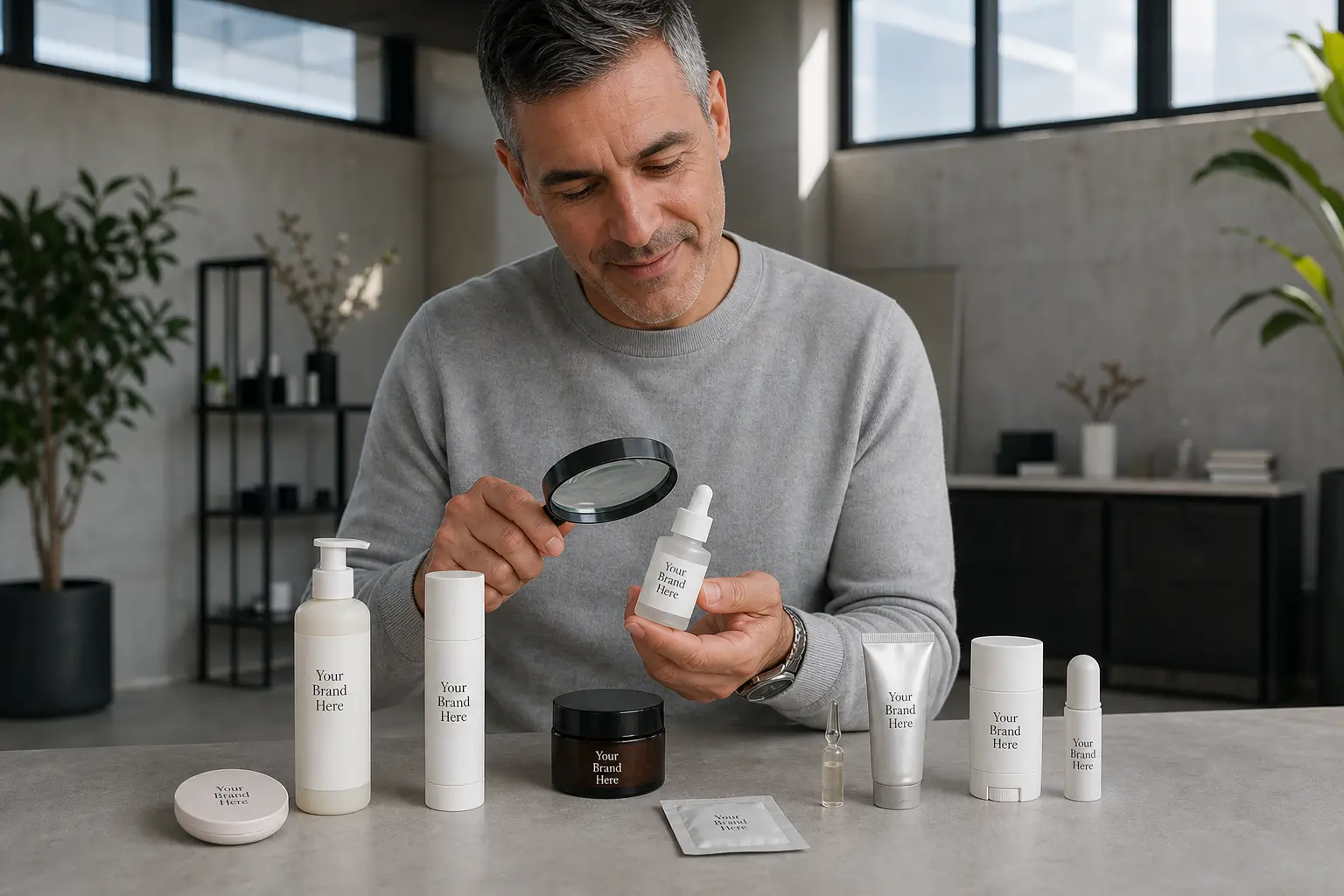
Primary packaging is the container that is in direct contact with the cosmetic product inside: the bottle, jar, tube, pump, dropper, compact, stick, roll-on, sachet, or ampoule.
It is the first thing the customer touches.
It protects the formula from air, light, and contamination.
And it decides how the product is dispensed and used, and what it looks like to someone standing in front of a shelf.
Most guides list the options. Few explain which formula fits which container, and why the wrong pairing wastes months and thousands of euros.
After 30 years in the hair and beauty sector, most recently in private label cosmetics, I can tell you the same failure repeats. A beautiful container is chosen first, and then the formula is forced to fit it.
The result is almost always the same: reorders, delays, customer returns, and a relaunch that costs two or three times the original packaging budget.
This guide walks in the opposite direction. Formula first, container second.
It covers every major primary packaging option, what it is technically compatible with, what it is not, and the specific mistakes that keep showing up in the industry.
Why Packaging Compatibility Is a Technical Decision Before It Is an Aesthetic One
What a primary container actually has to do
A primary container has three jobs.
One, hold the product without contaminating it or being contaminated by it.
Some plastics react with essential oils, some metals corrode in acid formulas, and some glass transmits UV light that degrades sensitive actives.
Two, dispense the product in a way that works for how it is used.
A thick balm needs a wide mouth or a jar. A fluid serum needs a dropper or a pump. A shampoo needs a flip-top that opens with wet hands.
Three, preserve the formula over its stated shelf life.
A preservative-light formula in a clear glass bottle exposed to light does not behave the same way as the same formula in an opaque airless pump.
The container is part of the stability equation.
A container that fails any one of these three jobs is the wrong container, no matter how good it looks on a shelf.
The compatibility questions to ask before anything else
Before you fall in love with a shape, a color, or a finish, the formula has a list of questions that have to be answered.
Is the formula sensitive to air?
If yes, go airless or use a tube, not an open jar.
Is the formula sensitive to light?
If yes, use opaque or amber, not clear.
Is the formula high viscosity?
If yes, use a jar or a wide-neck bottle, not a thin pump.
Is the formula acidic, alkaline, or rich in essential oils?
If yes, material compatibility has to be tested, because some plastics and some metals will react.
Is the product applied by hand or by applicator?
That changes everything about the closure.
Is the container going to be used in the shower, at the vanity, or on the go?
That changes the opening mechanism and the material durability.
Only once those answers are on the table can you actually start choosing between options.
The full logic of building the formula before the container is covered in the product development guide.
The Full Range of Primary Packaging Options
Bottles
Bottles are the default for liquid and semi-liquid products: serums, toners, lotions, shampoos, conditioners, oils, mists.
Glass bottles.
Glass is the oldest cosmetic packaging material for a reason.
It is chemically inert, fully recyclable, and carries a premium signal no plastic can replicate.
A 30 ml serum in a heavy glass bottle feels like a serious product in the hand. The same serum in a PET bottle at the same fill volume feels like a different product entirely, even if the formula is identical. That perception gap is real, and brands aiming at premium positioning use it.
Trade-offs are obvious: heavier shipping, breakage risk, higher carbon footprint unless the supplier uses recycled glass.
One detail worth catching early: clear glass lets UV light through. Vitamin C, retinol, and any light-sensitive actives oxidize in clear bottles within weeks. For light-sensitive formulas, specify amber, frosted, or fully opaque glass from the start.
Typical sizes: 15, 30, 50, 100 ml for skincare. 150 to 300 ml for haircare retail.
Plastic bottles (PET, PP, HDPE).
Plastic is the workhorse of the industry. Cheap, unbreakable, light for shipping, available in hundreds of stock shapes. Shampoos, conditioners, body washes, and any high-volume product almost always land on plastic.
PET is clear and widely recyclable, the most common choice.
PP and HDPE come in for squeeze-bottle applications and specific formulas.
The perception problem with plastic is real. Stock PET signals mass market unless you compensate with weight, finish, or shape. PCR PET with heavier wall thickness and a soft-touch coating can carry premium positioning, but it costs more and still does not match glass for sensorial feel.
Airless bottles.
Airless systems dispense the product without letting air back into the container, through a vacuum piston or a collapsible bag.
This is the right call for any formula where oxidation matters. Vitamin C, peptides, retinol, growth factors, any preservative-light natural formula. If the active ingredient is what you are selling, airless protects the investment.
Cost per unit runs 1.50 to 5 EUR/USD depending on format. MOQs start around 5,000 to 10,000 units for custom shapes, lower for stock. Worth it for formulas where the alternative is a product that slowly loses efficacy on the shelf. (All cost figures in this article are indicative estimates that vary by manufacturer, region, and project scope.)
The category has variations. Piston-based airless is the most common. Bag-in-bottle (often called BIB) handles viscous formulas better. Airless compacts exist for creams and gels that would otherwise need a jar.
Jars
Jars are the default for rich creams, balms, body butters, masks, scrubs, and anything solid or semi-solid that the user applies with their fingers.
Glass jars.
The premium default. Every serious night-cream brand has one.
The hygiene problem is well known and still ignored across the industry. Customers dip fingers in, bacteria go with them, the formula contaminates over time. For preservative-heavy formulas this is tolerable. For preservative-light or natural formulas, it is a product that will fail within months.
Fix one of two ways: include a spatula with the product, or switch to an airless jar. Brands that position "natural" or "clean" and then deliver an open jar are delivering a product that will not survive the user’s routine.
One practical point: wide-mouth glass jars work well for whipped textures and balms. Narrow-mouth does not.
Plastic jars.
Lower cost, lighter, harder to break. Acceptable for travel sizes, budget lines, or body care at volume.
Plastic jars feel cheaper in the hand, which is a problem for premium positioning.
Some brands compensate with heavier wall thickness, soft-touch coating, or matte finishes. Even at that level, glass wins on signal.
Airless jars.
The clean answer when you want the jar format without the contamination risk. A pump or piston system keeps the product sealed until the customer presses the top.
More expensive and higher MOQ than either glass or plastic, but the right call for premium anti-aging creams, eye creams with actives, or any formula where open-jar exposure would damage stability.
Tubes
Tubes are hygienic, flexible, and lightweight. The user squeezes instead of dipping, which keeps the product and the hands clean.
Used for creams, gels, masks, cleansers, toothpaste, and anything used more for function than for ritual.
Plastic tubes.
Standard cost, widely available. PE (polyethylene) and PBL (plastic-barrier-laminate) are the two most common constructions.
Plastic tubes work for most cream and gel formulas. They are not the right choice for formulas sensitive to air exposure (all plastic tubes breathe slightly) or for aggressive essential oil blends that can degrade the plastic over time.
Metal (aluminum) tubes.
Premium, fully recyclable, excellent barrier properties. Pharmaceutical skincare, specialty retinoids, and any formula that needs maximum protection land here.
More expensive per unit than plastic. Lithography is the standard decoration method, which adds setup cost but produces a printed-on-metal finish that no label can replicate.
Eco-materials (sugarcane, PCR, bio-based).
Rising fast for brands with sustainability positioning. PCR plastic tubes, sugarcane bioplastic, and paper-based tubes are all real options now, all slightly more expensive than conventional.
One caveat worth knowing: some eco-materials interact differently with preservatives, so compatibility testing is essential. A formula that ran clean in standard PE can behave unpredictably in a sugarcane blend.
The right container is the one that works for the formula in the customer’s hand three months after opening, not the one that looks good on the first Instagram post.
Packaging is a three-month and twelve-month test, not a launch-day statement. Get the compatibility right and the brand has room to grow. When it is wrong, the next reorder cycle brings either reformulation or repackaging, both of which are expensive.
Specialty containers
Droppers.
Glass bottle with a pipette. The classic signal for face oils, essences, and high-active serums.
The pipette meters the dose and slows the customer down, which matters for expensive products. Two things to watch: rubber bulbs can react with essential oils or aggressive actives over time, and poorly sealed droppers leak in transit. Both problems are caught by sampling with the final formula in the final container, not before.
Common sizes: 10, 15, 30, 50 ml.
Sticks.
Twist-up format for lipsticks, lip balms, deodorants, solid perfumes, sunscreen sticks, concealer sticks.
The formulation challenge is narrow. The stick has to stay solid at summer transport temperatures without warping, and soft enough to glide on skin at body temperature. The gap between those two specs is about 10 degrees Celsius, which is why stick formulation is more technical than most people assume.
Compacts.
For pressed powders, foundations, cushions, blushes, eyeshadows. Usually include a mirror, a puff, and a hinged closure.
This is where the heaviest decoration work happens in makeup. Hot stamping, spray coating, metallization, embossing all live here. The shell carries most of the premium signal, often more than the formula inside.
Roll-ons.
Small bottle with a ball applicator. Used for deodorants, eye serums, perfume oils, essential oil blends, and spot treatments.
The ball material matters more than the bottle. Steel rolls are cold to the skin, which is excellent for eye serums. Plastic rolls are cheaper and warmer, more common in budget deodorants and oil blends.
Sprays and aerosols.
For hairsprays, mists, toners, setting sprays, sunscreen sprays, deodorant sprays. Fine, even dispensing.
Pressurized aerosols use aluminum or tinplate cans and need dedicated filling lines, so the manufacturer choice narrows. Non-pressurized pump sprays use standard cosmetic bottles with a fine-mist pump, which keeps options open.
Ampoules.
Single-dose glass vials. The signal for high-active treatments: vitamin C shots, peptide boosters, pre-event radiance courses, serum cures.
Premium positioning, strong protection for sensitive actives, higher unit cost. Almost always sold in multi-packs of 7, 14, or 28, which supports a treatment-course narrative that a single bottle cannot.
Sachets and monodoses.
Flexible single-use packaging. Low cost, ideal for sampling, travel, and subscription-box sampling kits.
Low perceived value for standalone retail. High perceived value inside a gift set or a sampling campaign.
Neck Finishes and Closures: The Decision That Quietly Shapes Your Packaging Budget
What a neck finish actually is
The neck finish is the section at the top of the bottle or tube where the closure screws on. It is defined by two measurements: the outer diameter in millimeters and the thread profile code.
Standard cosmetic neck finishes include:
20/410. 20 mm diameter. Common for small bottles (toners, mists, concentrated serums). Pairs with fine-mist sprayers, small pumps, and essential-oil droppers.
24/410. 24 mm diameter. The most widely used size for personal-care products: lotions, shampoos, conditioners, hand soaps. Pairs with most standard pumps and disc caps.
28/410. 28 mm diameter. For larger bottles: big body washes, conditioners, household-volume cosmetics. Pairs with larger pumps and trigger sprayers.
18/415, 18/410. Smaller diameters for serums, essential oils, and specialty droppers.
38/400, 33/400, 28/400. Different thread profile (400 vs 410), used on specific bottle and jar formats.
The numbers look arbitrary but they are a universal language across bottle and closure manufacturers worldwide. A 24/410 bottle in Italy fits a 24/410 pump made in China or Germany.
Why closures force you toward standards
Closures (pumps, sprayers, dispensers, dropper assemblies) have much higher customization MOQs than bottles. Often 20,000 to 50,000 units or more for anything custom.
This matters because it reshapes the whole packaging strategy.
If you design a custom bottle with a non-standard neck, you also have to commission a custom closure. The closure MOQ usually exceeds the bottle MOQ, which means you end up with tens of thousands of extra closures sitting in inventory, or you pay a premium for a short-run custom pump.
This is why even brands that go fully custom on the bottle shape tend to keep a standard neck finish. The bottle is the brand statement. The closure is the functional part, and keeping it standard gives you access to thousands of off-the-shelf options.
If a supplier tries to sell you a custom bottle with a proprietary neck, ask specifically: what closure options exist for this neck, and what are their MOQs. If the answer is vague, the closure will become a hidden cost later.
These are the mistakes I see repeat across brands, year after year. Each one is preventable with the right test at the sample stage.
Essential oils in the wrong plastic. Some plastics (especially soft PE and low-grade PET) react with citrus, mint, and eucalyptus oils over time.
The plastic cracks, leaches, or develops a smell.
Fix: test the final formula in the final container for at least 8 weeks before committing to production volumes.
Thick formulas in thin pumps. A rich cream in a standard lotion pump clogs or dispenses unevenly.
Customers assume the product is broken.
Fix: match pump dosage and tube diameter to formula viscosity. Thicker formulas need wider-mouth pumps or treatment pumps with larger orifices.
Clear glass for light-sensitive actives. Vitamin C, retinol, and some plant extracts degrade under UV light.
A clear glass dropper looks beautiful and destroys the product.
Fix: use amber, cobalt, opaque, or airless packaging for any UV-sensitive formula.
Open jars for preservative-light formulas. A natural or preservative-minimized cream in an open jar exposed to fingers repeatedly becomes a contamination risk within weeks.
Fix: choose an airless jar, a pump container, or include a spatula with the product.
Wrong neck for the closure. Ordering a 24/410 bottle and a 24/400 pump because "they look the same."
They are not interchangeable. The pump will leak or not seat properly.
Fix: always confirm the exact neck finish code before ordering closures, and test a sample assembly before committing.
Metallic or coated caps with reactive formulas. Certain acid formulas (AHA, BHA, vitamin C) can corrode uncoated metal parts of a cap over time.
Fix: confirm with the supplier that all formula-contact surfaces are coated or compatible with the specific pH range.
Packaging ordered before the stability test finishes. The formula passes stability in a generic beaker. The final container is ordered. Then the formula behaves differently in the actual packaging (temperature, material interaction, headspace). Fix: run at least the final stage of stability testing in the final primary packaging, not in a surrogate. The full stability testing protocol is covered in the stability testing guide.
The cheapest packaging test is the one you run at sample stage. The most expensive packaging test is the one the customer runs for you after purchase.
All of these mistakes are avoidable. They are all caught by a single thing: testing the final formula in the final container, at production-like conditions, for enough time to see real-world behavior. Thirty days is the minimum. Ninety days is safer.
How Do You Choose the Right Primary Packaging?
Choosing primary packaging is a three-layer decision.
Layer 1: the formula layer. The formula tells you what the container has to do technically. Air sensitivity, light sensitivity, viscosity, pH, essential oil content, preservative system. These are not negotiable.
Once you have the formula spec, you narrow the list of compatible containers from 12+ options down to 3 or 4 real candidates.
Layer 2: the use-case layer. How and where is the product used?
In the shower, the closure has to open with wet hands and not slip.
At the vanity, aesthetics and a clean dispensing system matter more.
On the go, size and leak resistance matter. In a salon, what counts is bulk formats, easy refills, and durability.
For travel, you need smaller sizes, secure closures, and transport compliance.
This narrows your 3 or 4 candidates to 2 or 3.
Layer 3: the brand and cost layer. Within the remaining compatible options, you pick the one that matches the brand signal (premium vs mass, clean vs expressive, modern vs classic) and fits the target unit cost.
This is where design, color, and finish come in. And this is where most first-time founders mistakenly start. Starting here without the formula and use-case layers is how you end up reordering packaging four months later.
A dedicated manufacturer with in-house packaging expertise can help you shortcut this process by flagging compatibility issues at sample stage, not at production stage. The cosmetics manufacturer guide covers how to select one.
Frequently Asked Questions
What is the most common type of cosmetic primary packaging?
Plastic bottles with standard pumps are the highest-volume format in cosmetics, mainly for haircare and body care. PET plastic dominates by unit count because of its cost, clarity, and recyclability. For skincare specifically, glass jars and airless pumps are the most-used formats in mid-to-premium positioning, while plastic tubes dominate the mass-market cleanser and cream category.
How do I know which packaging is compatible with my formula?
The formula has to be tested in the final container for compatibility and stability before any production volume is committed. Key variables: is the formula sensitive to air, light, or temperature; is the pH outside neutral range; does it contain essential oils or solvents that can react with plastics. A reputable manufacturer or packaging supplier will run compatibility testing as part of the development phase. Never assume a container works just because it looks right.
What is the difference between a pump, an airless pump, and a standard pump?
A standard pump uses a dip tube that reaches into the bottle. It is cheap, flexible, and works for most low-to-medium viscosity products but allows air back into the container. An airless pump uses a piston or a flexible bag that vacuum-seals the product from air. It costs more and has higher MOQs, but it protects active ingredients from oxidation. For products with sensitive actives (vitamin C, peptides, retinol), airless is almost always the correct choice.
What is a neck finish, and why does it matter?
The neck finish is the diameter and thread profile of the bottle opening where the closure attaches. It is expressed as two numbers, like 24/410: 24 mm diameter and 410 thread profile. Closures are designed around these standards, so choosing a non-standard neck on a custom bottle often forces a custom closure, which has a much higher MOQ. Standard neck finishes in cosmetics include 20/410, 24/410, and 28/410.
How do I choose between glass and plastic for my packaging?
Glass signals premium, is infinitely recyclable, and offers better barrier properties for sensitive formulas. It is heavier, more fragile, and more expensive to ship. Plastic (especially PET and PCR PET) is light, cost-efficient, and has a lower shipping footprint per unit but carries a less premium perception unless the design compensates. The right choice depends on positioning, target price, channel, and formula compatibility.
Can I mix different packaging suppliers for the same product line?
Yes, and most mid-size brands do. The bottle may come from one supplier, the pump from another, the cap from a third, the secondary box from a fourth. What matters is that the manufacturer responsible for filling and assembly can coordinate all components. A good manufacturer will also flag compatibility issues across components before filling starts. For more on the packaging-manufacturer interface, see the cosmetic packaging and branding guide.
What are the most sustainable primary packaging options?
PCR (post-consumer recycled) plastic, aluminum, glass with recycled content, bio-based plastics, and refillable systems are all credible options. "Most sustainable" depends on the full lifecycle: shipping weight, recycling infrastructure in the target market, refill behavior, and end-of-life recovery. Sustainable packaging is most credible when it is specific (exact PCR percentage, named certification, verified refill system) rather than vague (labels that just say "eco-friendly").
Cosmetic packaging MOQ guide: real minimums by type, insider negotiation strategies, three customization levels, and cost optimization tactics that don’t compromise quality.
Cosmetic brand naming guide: legal entity vs brand vs trademark, brand architecture, product naming approaches, Nice Class 3 clearance, and the step-by-step process to name a brand properly.
Cosmetic label design guide: EU and US regulatory requirements, INCI order, decoration methods with real costs, and the label mistakes that trigger recalls or rebranding.