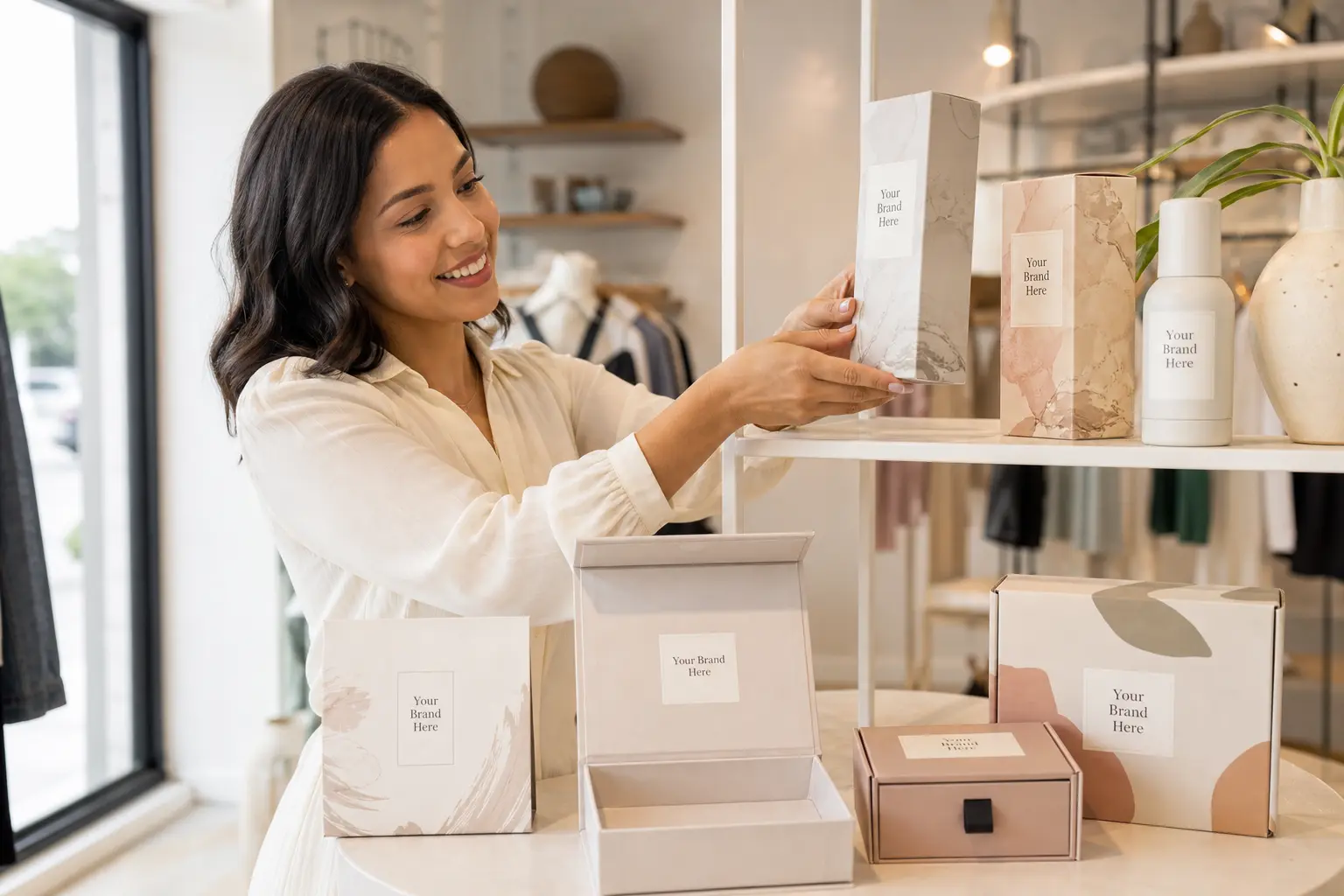
Secondary packaging is the outer container that holds and presents the primary packaging of a cosmetic product: the folding carton, rigid box, sleeve, or gift set that surrounds the bottle, jar, or tube inside.
It is optional from a technical standpoint.
The product can ship and sell without it.
But it is the first thing the customer sees on a shelf. Most brand storytelling happens on that surface. And it drives the unboxing experience that decides how the product feels before the customer ever opens the lid.
A brand can make more money on a well-conceived box than on a beautiful primary container.
It can also waste its entire packaging budget on boxes that nobody sees or cares about.
After 30 years in the hair and beauty sector, most recently in private label cosmetics, I can tell you the secondary packaging decision is more nuanced than either "always invest for premium" or "skip to save money."
The right call depends on channel, positioning, and, in some cases, rules that narrow how the mandatory text can be carried.
This guide is the full framework.
What Secondary Packaging Is and the Jobs It Does
The technical definition
Secondary packaging sits outside the primary container.
If the primary is what touches the formula (bottle, jar, tube), the secondary is what holds the primary: the printed folding carton, the rigid gift box, the outer sleeve, or the kit that groups several products together.
Tertiary packaging is the layer above that: the shipping carton, the pallet wrap, the logistics-level protection that the customer never sees.
This article is about secondary.
The five jobs of secondary packaging
A well-designed box does more than protect the product. It solves five different problems at once.
Protection. The box stops scratches, pump-head damage, and label scuffing during transit. For glass primary containers, it adds a meaningful layer against breakage.
Shelf communication. On a crowded retail shelf, the secondary is what the customer sees first. Brand recognition, category signals, key claims, and product name all have to land in the three seconds before the customer decides whether to pick it up.
Regulatory compliance. The ingredient list can legally live on the box alone, and so can the batch number when the primary is too small. More on this below.
Unboxing experience. For e-commerce and DTC brands, the box is the first physical interaction. Instagram, TikTok, and YouTube unboxings decide whether the brand looks premium or cheap, long before the product is used.
Gifting and presentation. Cosmetics are one of the most-gifted consumer categories in the world. A box that looks good wrapped under a tree or inside a gift bag earns revenue that an unboxed product cannot capture.
A secondary packaging decision that ignores any one of these five jobs leaves money on the table, or worse, creates a problem the brand only discovers after production.
The Main Types of Secondary Packaging
Secondary packaging is a family of formats, each with its own cost profile, MOQ, and use case.
Folding cartons.
The default secondary for most cosmetic products.
A folding carton is a thin paperboard box that ships flat and is glued or tuck-closed at filling. Low cost, low MOQ, fast to produce.
Cost per unit: 0.20 to 0.80 EUR/USD for basic printed cartons. Mid-tier cartons with heavier paperboard or more print colors run 0.80 to 1.30 EUR/USD. Premium finishes (foil stamping, soft-touch lamination, embossing) add 0.15 to 0.60 EUR/USD each. (All cost figures in this article are indicative estimates that vary by manufacturer, region, and project scope.)
MOQs typically start at 1,000 to 3,000 units for printed cartons. Lead times run 3 to 5 weeks from artwork approval.
Folding cartons are the right call for retail skincare, single-product SKUs, and most e-commerce DTC launches. They are the workhorse.
Rigid boxes.
The premium answer. Thicker, heavier, wrapped in specialty paper, with a manual-assembly production process.
Rigid boxes are the format for luxury fragrances, high-end skincare sets, and any product where the box is part of the brand statement.
Cost per unit: 2.50 to 7.50 euros for standard rigid boxes. Luxury variants with magnetic closures, drawer mechanisms, or specialty materials can run 10 to 22 euros each.
Tooling is a separate cost: 2,500 to 7,000 euros for custom rigid box dies, which amortizes over the production volume.
MOQs can go as low as 500 to 1,000 units for boutique runs, but the unit price at those volumes is high. Lead times run 4 to 8 weeks.
Drawer and magnetic closure boxes.
Variants of the rigid box format, built around a specific unboxing moment.
A drawer box has an outer sleeve and an inner tray that slides out horizontally. The reveal is deliberate and theatrical. It works well for gift-focused fragrances and premium gift sets.
A magnetic closure box has concealed magnets in the lid and base that snap shut with a satisfying feel.
Customers keep these boxes long after the product is gone, which extends brand impressions well beyond first use.
Both formats sit at the upper end of the cost ladder. They are the right call only when the retail price and margin support the investment, usually 80 euros per unit and above.
Gift sets and kits.
A gift set is secondary packaging that contains multiple products, often designed around a seasonal moment or a brand theme.
Cosmetic gift sets typically include a hero product plus two or three complementary items in a shared presentation box. Mother’s Day, Christmas, Valentine’s Day, and brand-anniversary moments are the classic revenue windows.
The economics of a gift set are different from a single product.
The set itself becomes a SKU with its own packaging investment, its own MOQ, and its own margin structure.
Done well, gift sets raise average order value during the relevant seasons.
Sleeves and belly bands.
A lighter-weight alternative to a full secondary box.
A sleeve is a printed paper or cardboard band that wraps around the primary container. A belly band is a narrower version, usually positioned across the middle of the primary.
Cost per unit: 0.10 to 0.50 euros. Much lower investment than a full box, and often more sustainable because it uses less material.
Sleeves work well for brands that want visible primary packaging but still need a surface for branding, claims, or regulatory text.
They also work as an add-on to a primary container that already looks good on its own.
Mailer boxes.
The e-commerce format. Designed to serve as both secondary packaging and shipping container.
A mailer box is a corrugated or folded-cardboard outer that protects the product in transit and doubles as the first surface the customer sees when the delivery arrives.
Cost per unit: 1 to 4 euros depending on size, printing, and corrugated thickness. They eliminate the separate shipping carton, which saves cost for DTC brands that do not sell through physical retail.
Inserts and trays.
Not a box by themselves, but the internal structure that holds the primary container inside the outer.
Foam inserts give the most protection for fragile items like glass bottles. Molded paper inserts are more sustainable and cheaper at volume. Cardboard inserts are the budget option and work for most folding carton setups.
Inserts are often underrated. A premium rigid box with a loose, shifting primary inside feels cheap. The same box with a precisely cut molded insert feels intentional.
When Secondary Packaging Is Worth It (and When It’s Not)
When the box earns its place
Secondary packaging is worth the cost when it does something that moves the business forward.
Retail shelves. A brand selling in physical stores almost always needs a box.
The secondary is what the customer picks up, turns over, reads. Without it, the product is a lonely bottle next to twelve competitors that all have boxes. Conversion at shelf drops visibly.
Premium or luxury positioning. A cream priced at 80 euros and above in a 0.30-euro pump bottle without any outer box signals "cheap."
The math is counterintuitive but customers read the packaging-to-price ratio instinctively. Premium pricing almost always requires premium secondary.
E-commerce with unboxing content. Instagram Reels, TikTok unboxings, YouTube reviews.
The brands that invest in the unboxing experience get free distribution from content creators and customers who post about it. Folding cartons with a printed interior or a matte-laminated finish often pay for themselves in user-generated content.
Gifting-driven brands. If your target customer buys the product as a gift (perfumes, high-end skincare sets, seasonal launches), the box is the entire sale.
Gift buyers rarely see the primary before purchase. They see the box.
Products that need protection in transit. Glass droppers, rigid pump bottles with painted finishes, products that scratch easily, any primary that ships directly to consumers.
A 0.40-euro folding carton saves on returns from transit damage, which can be 3 to 8 percent without proper secondary.
When the box is a waste of money
Skipping secondary is the right call more often than founders expect.
Professional products sold directly to salons. Stylists open the box once, extract the product, throw the box out.
Money spent on a beautiful carton for salon products is money not spent on the stylist education, the technical support, or the formula quality that actually wins professional loyalty.
Refill and sustainability-positioned brands. Less packaging is part of the brand promise. Adding a box contradicts the positioning and confuses the customer. Refill brands usually use a primary-plus-sleeve setup, or no secondary at all.
Very early-stage DTC launches. A brand with a tight budget can launch with a strong primary container and a well-designed label, then add the secondary in the next production run once cash flow supports it.
The first hundred customers rarely decide based on the outer box. They decide based on the product and the brand voice.
Low-margin products. A 5-euro body lotion with a 2-euro box has eaten its entire margin.
Some categories (basic body care, hair care at volume, low-price-point toiletries) cannot absorb the secondary packaging cost without compromising the economics.
For these, a printed shrink sleeve or a primary-only approach often wins.
Subscription box inserts. If your product is included in someone else’s themed box, your own secondary packaging becomes redundant.
The subscription box is itself the presentation layer. Your primary and label carry the brand, and the box from the service carries everything else.
The most expensive secondary packaging is the one that looks good but nobody ever sees. Before you invest, make sure the customer will actually encounter the box in the journey.
The packaging investment has to be read against total landed cost, not against unit price alone.
A 2-euro rigid box on a 3-euro formula in a 1-euro primary looks fine until you add shipping, duties, warehousing, and the fact that half the time the customer never sees it.
When a Small Primary Makes Secondary Packaging the Answer
There is a scenario where compliance sets the baseline before marketing gets a say. The law does not order a box: it narrows the ways of carrying the mandatory text, and the box is usually the cheapest of them.
The compliance path: small primary, mandatory information
In the EU, Article 19 of Regulation 1223/2009 requires a set of mandatory information on the container and the packaging, with exemptions written into the article itself rather than into practice: nominal content is not required on packaging below five grams or five millilitres, on free samples or on single-application packs, and the batch number may appear on the packaging alone where the product is too small to carry it. The US (MoCRA) and Great Britain have their own, different labeling regimes: each market must be checked separately, they are not interchangeable. The list below is the EU one.
The ingredient list in the common ingredient names of the Article 33 glossary. The Period After Opening (PAO) or date of minimum durability. The Responsible Person name and address. The particular precautions for use. The nominal content at the time of packaging, by weight or by volume, subject to the exemptions in Article 19(1)(b). The function of the cosmetic product, unless it is clear from its presentation, which is the act’s word and is a lower bar than obvious. Country of origin where required. Batch code.
This information has to be legible on the product as delivered to the customer. Not on a sticker that falls off. Not in small print that disappears at arm’s length.
When the primary container is physically too small or too curved to carry all of it, the secondary packaging is what takes the overflow. The relief is narrow, though. Two particulars may sit on the packaging alone: the ingredient list under Article 19(1)(g), and the batch number under Article 19(1)(e) where the products are too small. The Responsible Person block, the durability date or PAO, and the function stay on the container and the packaging both.
Which products typically need a compliance-driven box
The trigger is size.
A 5 ml roll-on for an essential oil blend. A 10 ml perfume vial. A lipstick bullet. A tiny mascara tube. A 15 ml ampoule. A 3 ml dropper sample.
All of these have surface area too small to carry the full regulatory text at readable font size. The box takes the two particulars named above, and no more: everything else still has to appear on the container itself.
The leaflet alternative
The leaflet route is narrower than most founders assume. Under Article 19(2), only two elements can move to an enclosed or attached leaflet, label, tape, tag or card: the precautions for use and the INCI list. And only where it is impossible for practical reasons to print them on the pack. Unless that too is impracticable, the pack must then refer to them, either with abbreviated information or with the hand-in-book symbol of Annex VII, point 1: the symbol is one of two options, not the only one. For soap, bath balls and other small products, Article 19(3) sends the INCI list to a notice in immediate proximity to the container where the product is displayed for sale, but only where a label, tag, tape, card or enclosed leaflet is itself impossible for practical reasons.
One thing the leaflet does NOT solve: multi-language labels. The Court of Justice (C-667/19) has clarified that the cost or bulk of fitting the required translations is not "practical impossibility". Article 19(5) leaves the language to the law of each member state where the product is made available, and the requirement follows the information onto the leaflet: the paragraph names points (b), (c), (d) and (f) of paragraph 1 together with paragraphs 2, 3 and 4, so moving the precautions or the INCI list onto an enclosed leaflet or a proximity notice does not move them out of the language obligation.
The leaflet has to be enclosed with the product or attached to it. It has to be printed in legible font size. And it has to be in the language(s) required for each target market.
Detailed label layout rules and the full regulatory checklist are covered in the cosmetic label design guide.
The retailer-rejection risk
Missing or incomplete regulatory information is the single most common cause of retailer rejections in cosmetics.
A brand can produce 5,000 beautiful units and watch them sit in a warehouse because the label is missing the PAO icon or the Responsible Person address.
A retailer review that flags a compliance gap can force a full repackaging run, which costs thousands of euros and weeks of lost shelf time.
If your primary is small, get the regulatory review done before the secondary is even specified. The outer box is part of the compliance system, not an afterthought.
How Do You Make the Right Call for Your Brand?
The framework I use with every client. Four questions, in order.
Question 1: What channel is the product sold through?
Retail shelves? You need a box. Almost always.
Salon-direct professional? Usually no box. The cost belongs in education and service.
DTC website with heavy unboxing content? Invest in the secondary. The content value compounds.
Amazon marketplace? A simple folding carton or Frustration-Free Packaging compliant solution. Amazon’s own rules shape the decision.
Subscription box inclusion? Minimal secondary. The service’s box is the presentation layer.
Wholesale to multi-brand stores? A mid-tier folding carton that works across retail contexts.
Question 2: What does the positioning require?
A 20-euro face cream can sell without a box.
An 80-euro serum cannot. The price-to-packaging ratio has to match. Customers read this at the shelf and on the product page, even if they cannot articulate why.
If the price is premium, the secondary signal has to match. Where the positioning is "clean, minimal, sustainable," the secondary may be a thin recycled-paper sleeve rather than a full box.
Question 3: Is the primary physically big enough to carry the compliance information?
If yes, the box is a business decision.
If no, the text has to be carried some other way: a box, or, for the precautions and the ingredient list, an enclosed or attached leaflet, label, tape, tag or card under Article 19(2). The box is the usual answer, and the leaflet route is worth pricing before you assume it.
Question 4: Can the budget absorb the secondary at the target unit cost?
Secondary packaging adds 10 to 30 percent to total packaging cost for most cosmetic products. On a premium line it can go higher.
If the unit economics cannot absorb the full secondary system at the chosen sophistication level, there are three options.
One: simplify the secondary. A printed folding carton with a single color and no finishes instead of a foil-stamped premium carton.
Two: phase it in. Launch with primary-plus-label, add the full secondary in the second production run once the brand has revenue.
Three: shift the budget. If the box is non-negotiable for the positioning, find cost savings in the primary (stock container instead of custom), the fragrance, or the initial marketing spend.
The full framework for packaging cost control, including MOQ negotiation tactics, is covered in the packaging MOQ and costs guide.
The phased approach for first-time brands
For most first-launch brands, the right move is to start with a simple folding carton, get the product selling, then reinvest into premium secondary once the brand has traction.
Not every brand has to launch at the luxury packaging tier. Plenty of successful brands started with 0.40-euro printed cartons and upgraded as the revenue justified it.
The worst outcome is a brand that blows 40 percent of the launch budget on rigid boxes that sit in a warehouse for eighteen months because the product never found its customer.
Packaging should match the stage of the business, not the founder’s aspiration. A brand that grows into premium packaging beats a brand that launches premium and runs out of money.
Primary and secondary decisions should be made together, not sequentially. What the primary container looks like, how it ships, and whether it carries compliance info all shape the secondary choice. See the primary packaging guide for the pairing logic.
Frequently Asked Questions
Do I really need secondary packaging for my cosmetic product?
Not always. Retail-shelf products, premium-positioned brands, and e-commerce with unboxing-driven content almost always benefit from secondary packaging. Professional salon products, refill brands, very early-stage DTC launches, and low-margin products often do better without it. And when the primary container is too small to carry all the mandatory information, the box is the practical answer rather than a legal duty: Regulation 1223/2009 never orders you to add one. It lets the ingredient list sit on the packaging alone under Article 19(1)(g), and the batch number do the same under Article 19(1)(e) where the products are too small. Where labeling them on the pack is impossible for practical reasons, the precautions for use and the ingredient list can move onto an enclosed or attached leaflet, label, tape, tag or card under Article 19(2). Everything else stays on the container either way.
How much does cosmetic secondary packaging cost per unit?
Folding cartons range from 0.20 to 0.80 euros for basic printed versions, and up to 1.30 euros for mid-to-premium paperboard. Specialty finishes (foil, embossing, soft-touch) add 0.15 to 0.60 euros per unit. Rigid boxes run 2.50 to 7.50 euros for standard designs, and 10 to 22 euros for luxury variants with magnetic closures or drawer mechanisms. Sleeves and belly bands are cheaper at 0.10 to 0.50 euros. Mailer boxes for e-commerce direct run 1 to 4 euros depending on size and print.
What is the difference between a folding carton and a rigid box?
A folding carton is a thin paperboard box that ships flat and is assembled at filling. Low cost, fast production, MOQs starting around 1,000 units. A rigid box is thicker, wrapped in specialty paper, with manual assembly. Higher cost per unit, higher MOQs, longer lead times, but a significantly more premium feel. Folding cartons are the default for most retail cosmetics. Rigid boxes are the standard for luxury fragrance, high-end skincare, and gift sets.
What is the MOQ for custom cosmetic boxes?
Folding carton MOQs typically start at 1,000 to 3,000 units for printed versions, sometimes lower with digital short-run printing. Rigid boxes can start at 500 to 1,000 units for boutique clients, though the unit price at those volumes is high. Sleeves and belly bands often have lower MOQs because the production process is simpler. Custom tooling for rigid boxes adds 2,500 to 7,000 euros in separate dies.
Does a small primary container force me into secondary packaging?
The Regulation leaves the choice open, and in practice the box usually wins it. The trigger is a primary container too small to carry all the mandatory information legibly. The Regulation sets no size threshold for this: Article 19(1)(e) says only "where this is impossible for practical reasons because the cosmetic products are too small", and the single figure in Article 19, five grams or five millilitres, governs a different exemption. As a rule of thumb from practice rather than from the act, containers under roughly 15 to 20 ml tend to fall here: perfume vials, roll-ons, small ampoules, lipstick bullets, tiny mascara tubes. In those cases the outer box carries what the container cannot: the INCI list, which Article 19(1)(g) allows on the packaging alone, and the batch number, which Article 19(1)(e) allows on the packaging only where the products are too small. Only two particulars can move further, onto an enclosed or attached leaflet under Article 19(2), and only where it is impossible for practical reasons to label them on the pack: the precautions for use and the INCI list. The PAO symbol and the Responsible Person’s name and address stay on the container and the packaging both. Missing this is one of the most common causes of retailer rejections.
What is the best secondary packaging for e-commerce DTC brands?
A printed folding carton inside a custom mailer box is the most common DTC setup. The folding carton handles shelf presentation and brand signal. The mailer box handles transit protection and the unboxing moment. Some DTC brands consolidate into a single "premium mailer" that serves both functions, which reduces total packaging cost and is more sustainable. For high-priced premium products, a rigid box inside a simple outer shipper delivers the best unboxing experience.
How do I choose between sustainable and premium secondary packaging?
The two are not always opposed. Rigid boxes can use FSC-certified paperboard, recyclable wraps, and soy-based inks. Folding cartons are usually single-material and easier to recycle by default. The honest sustainability choice is often "less packaging" rather than "more expensive eco-packaging": thinner wall paper, no plastic window, no unnecessary inserts, printed directly on uncoated board instead of adding a laminate. For a full treatment, see the sustainable packaging guide.
Cosmetic packaging MOQ guide: real minimums by type, insider negotiation strategies, three customization levels, and cost optimization tactics that don’t compromise quality.
Cosmetic brand naming guide: legal entity vs brand vs trademark, brand architecture, product naming approaches, Nice Class 3 clearance, and the step-by-step process to name a brand properly.
Cosmetic label design guide: EU and US regulatory requirements, INCI order, decoration methods with real costs, and the label mistakes that trigger recalls or rebranding.