Introduction
The idea was never the problem.
Have you ever thought about creating your own cosmetic product? Seeing it in your customers’ hands, sold online, or on the shelf of a good salon?
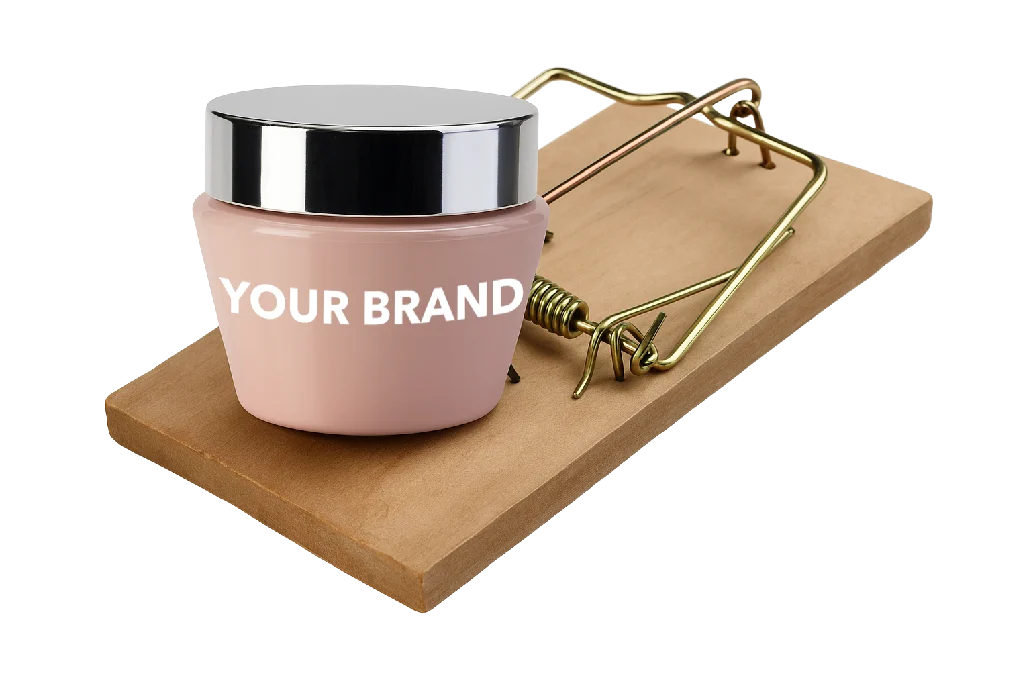
Many people start that journey full of enthusiasm, and then meet unexpected costs, delays, decisions taken in the wrong order, and often the hard version of failure: the one that arrives before the launch. Not because the idea was bad. Because they walked into traps they could not see.
This book walks you through the five most common and most expensive of them, in private label cosmetics. How to recognise each one, and what to do instead. It is not theory. It is the method built over 30 years of work, watching projects on three continents get born and, often, die.
It works even if you are starting from zero, even if you are not a technician, and even if the budget is small. None of those is the reason projects fail.
This is not a book to read once. It is a book to open again every time you are about to take a decision that costs money.
Before you start
Which side of the table you are on.
This book was written from one side of the table: the side of the person who owns the brand, decides what to launch, and pays for the mistake. If that is you, read it as it is and skip the rest of this page.
But the same five traps look different from the other two seats at that table, and they cost money there too. So before you start, find yourself here.
- You own the brand. The traps are yours and so is the bill. Read straight through.
- You manufacture for other people. You are not going to fall into these five. You are going to watch your customers fall into them, and it will cost you: small repeat orders, stock that stops moving, projects that go quiet around month eight and never come back. What you get out of these pages is the ability to see it coming before they do.
- You sign for safety. Trap one is your subject. The costs everybody underestimates are precisely the ones that land on your desk, and the person underestimating them has usually already committed to a price.
Three seats, one table, the same five traps. The reason this is not three different books is that the traps do not care where you sit. They only send the bill to a different address.
How to use it
Five traps, and the same six steps for each.
Every trap in these pages comes from a real situation, not from a manual: real projects, real mistakes, the kind that are common and underestimated at the same time. Every solution has been used in the field, with entrepreneurs in different markets.
So each of the five chapters is built the same way, on purpose. Once you have read the first, you know where to find things in the other four.
What you will find in every chapter
- What you told yourself. The sentence that opens the trap, in the words people actually use.
- Where the trap is. The mechanism underneath, and what it costs.
- The strategy that works. What to do instead, and a real case.
- What the research says. The number underneath the mechanism, where it comes from, and where it stops being evidence.
- The checklist. The uncomfortable questions, the ones worth not skipping.
- The exercise. Something to do, not something to agree with.
Read it with a pen. The chapters you skim are the ones you will pay for later.
Before you start
What this book asks of you.
Building a brand that works takes more than a good product. It needs vision. It needs method. It needs consistency. Above all it needs awareness, and that is the one thing you can start with today, for free, before spending anything.
And this material is worth nothing if it stays in your head or on your computer. It has to end up in your notes, in the conversations with the people who work with you, in what you write down, in the decisions you take on an ordinary Tuesday. Pass it on to whoever works with you and argue about it with them: that is when it starts being useful.
Private label cosmetics can be a fascinating sector, and it is a complicated one. It does not forgive improvisation, and it rewards the people who work with a method.
Use these pages as a compass. Not as a shortcut, but as a direction. Not to avoid the hard work, but to do it with your eyes open. Something good can start here, and whether it does is up to you.
Where this comes from
It started in a small salon in Italy.

I was fifteen and I had chosen a practical trade: hairdressing. I could not have imagined that it would lead to working across three continents, between labs, international backstages, and the strategy of new brands.
After years on the technical side I became a trainer for large brands, running courses across Europe. That is where the first real change of perspective happened: a cosmetic is not just a formula. It is perception. It is positioning. It is experience.
The turning point came when I moved abroad to work as an international distributor. It was like walking behind the curtain: I saw how a product is really born, what it really costs in time and money, and which decisions separate a shelf that sells from one that does not.
Since then I have studied hundreds of projects as a private label consultant: new brands, influencers, pharmacists, salons. And the same pattern repeats at every level. The same traps. The same mistakes.
Where this comes from
The two gardeners.
The same thing happens in cosmetics as in the garden: excellent products launched without a vision, and much simpler ones with a system behind them, that end up leading their category. What separates them is a plan, and a plan does more than avoid mistakes. It builds a line that is consistent, that can be sustained, and that can be repeated.
Imagine you hold rare, high quality seeds. You plant them with enthusiasm, you look after them for a few days, then you get distracted. When you go back to look, many have not come up, and the ones that did are choked. Meanwhile your neighbour, with much simpler seeds, followed a plan: he read the soil, planned the watering, chose what to plant. His garden is flourishing, tidy, ready to sell from. Yours is not. This book is about being the second gardener.
The five traps
Each chapter is built the same way. Once you have read the first, you know your way around the other four.
Trap 1
The illusion of huge margins
What you told yourself
“I make a 500% profit on every product. With a hundred customers a month I will be rich within a year.”

Where the trap is
It is easy to get carried away when you discover that a product costing 5 euros can sell for 25. You have probably heard the same calculation from a colleague, from a creator, or from a supplier who was enthusiastic about your project. The trap hides in the space between gross margin and net margin. Most new entrepreneurs stop at the difference between the selling price and the production cost, and forget everything that sits in between. You planned a garden in bloom, and what grows is weeds you never budgeted for.
- Mandatory regulatory costs: the Product Information File, the CPNP notification, stability tests, challenge tests
- Secondary packaging, labels, boxes, tags, leaflets
- Logistics: storage, shipping, returns, damaged or unsold stock
- Customer acquisition: advertising, social ads, influencer campaigns, events
- Fixed operating costs: accounting, legal, servers, digital tools
- Marketplace commissions, promotions, discounts, bonuses
The strategy that works
What is left after all of that is a fraction of the number you started from, and it is the only number that pays anybody. So the point is not to chase a high margin on paper. It is to build a model that is sustainable, measurable and able to grow, from the first day.
- Work out the real net margin, with every cost attached to the product inside it
- Look at the lifetime value of a customer, not only at the first order
- Price the opportunity cost: what are you giving up in time and energy for each euro earned?
- Plan for volume: what happens to logistics, production and promotion when the numbers go up?
From the field
Mary, a beautician with a following, and a skincare line
She invested in a personalised skincare line, confident about what she called a 500% margin. What she had not put in the calculation: the mandatory tests and the regulatory file, the promotional material and the packaging, the advertising spent without a strategy, and the monthly cost of logistics and warehousing. Eight months later most of the stock was still there, the capital was tied up in it, the products were moving towards their expiry date, and the fixed costs kept running.
Look at where the money actually went, because the order surprises people: the tests and the regulatory file, plus the packaging and the promotional material, came to more than everything she spent on advertising. Almost half the budget was gone before the first jar was ready to sell. She had planned for the advertising. She had not planned for the two lines above it.
She had not lost money on the product. She had lost it on everything around the product.
What the research says
In 2013 a merchant lost, on average, nine dollars on every new customer acquired. By 2022 that loss had grown to twenty-nine dollars: a rise of 222% in eight years. Acquiring a customer is the line most people leave out of the margin calculation, and it is the line that has moved the most while they were not looking.
Source: SimplicityDX, press release, 19 July 2022.
Disclosure: SimplicityDX sells software that addresses this problem. The figure is their own analysis, published by them. That makes it a primary source with an interest, which is not the same thing as an independent one.
The checklist
- Have I included every regulatory cost: tests, the PIF, the CPNP notification?
- Have I costed logistics, packaging, returns and stock?
- Do I have a marketing budget for the first months, not just for the launch?
- Have I left a margin for error on top of all of it?
- Do I have a plan B if sales are slower than I expect?
The exercise
Open a spreadsheet and build your real net margin, line by line.
- Direct cost per unit: production plus packaging
- Every fixed cost, divided across the units you actually expect to sell
- A realistic monthly marketing budget, not the one that makes the sheet work
- Operating costs divided by sales volume
- Then subtract all of it from the final price, and look at what is left
From our side of the table
Put one more line on that sheet: printing the labels a second time. LabelCheck reads a cosmetic label against the European rules, and the British ones too, before it goes to print.
Access is by request, and every company that gets it starts with 300 free credits. When yours opens, the label sitting in front of you now is the one to put in first.
Request accessA lower margin you can count on beats a large one that is about to burst. Next: the belief that a good product does the selling by itself.
Trap 2
Believing a good product sells itself
What you told yourself
“I have a great product, made with high quality ingredients. Once people try it, it will sell itself.”

Where the trap is
Product quality is not in question. It is the minimum you need to enter the market and stay in it. It is simply not enough on its own. The trap is confusing technical quality with perceived value: success is not decided by how good the formula is, but by whether the product gets into the customer’s head. Without a story, without a reason to buy, without a clear promise, the product says nothing.
- The customer looks at the packaging and cannot tell whether it is for them
- The website is online and does not convert
- Influencers receive the product and do not know what to say about it
- Retailers cannot find a story to tell
The strategy that works
You need a communication system that carries the product from the lab into the customer’s head.
- A value proposition in one line: why this product and not another one
- Consistent positioning, visual and verbal: name, logo, tagline, packaging, descriptions
- A story told from the user’s side: the problem, the benefit, the ritual
- More than one channel, saying the same thing
From the field
Laura, a professional with a body care line from an Italian lab
The product was genuinely good, built on a professional base with expensive actives. It barely moved in the first quarter. The packaging was elegant and said nothing. The website was generic. The descriptions talked about the quality of the formula, and never about what it solved or who it was for. In her own words: I thought letting people touch the product would be enough. She rewrote the naming, the tagline and the story with a copywriter, and added a how-to-use ritual to the pack.
A good product is the floor. Only a good story turns it into something somebody wants.
What the research says
Economists have a name for what you are selling. A search good is one whose quality you can judge before buying it: a screw, a kilo of flour. An experience good is one you can only judge after using it. Cosmetics are experience goods. That is the whole reason a formula cannot make the first sale: at the moment of purchase, the buyer has no way of reaching it. Everything around the product has to do that work, because the product itself cannot.
Source: Phillip Nelson, Information and Consumer Behavior, Journal of Political Economy, vol. 78 no. 2, 1970, pp. 311-329. The distinction between search goods and experience goods is his.
The checklist
- Does the customer understand what your product solves, and who it is for?
- Do website, posts and labels speak the same language?
- Do name, packaging and description tell one story, or three?
- Have you tested the wording on somebody who is actually in your target?
The exercise
Take your product in one hand and open your website. Ask: would somebody who does not know you understand what this is, who it is for, and why it is different? If not, pick one product and rewrite three things.
- The promise, in one sentence
- The description, written from the problem and the benefit rather than the formula
- A ritual of use, written so the reader can picture doing it
Next: what happens when the answer to a product that will not move seems to be lowering its price. (In the original edition this bridge pointed at the wrong chapter. Fixed here.)
Trap 3
The price war you cannot win
What you told yourself
“If I drop the price a little I will sell more. I can raise it later, once I have loyal customers.”

Where the trap is
The reasoning feels sound, especially at the start: the market is crowded, the big brands are everywhere, and the price is one of the few levers you seem to have. But there is a wide difference between a competitive price and a destructive one. The first comes from a decision, backed by costs, positioning and audience. The second comes from the fear of not selling, and it is that fear that erodes the margin, damages how the brand is read, and attracts the customers who will leave the moment somebody else is cheaper. Price does not communicate cost. It communicates value: a price that is too low makes people suspicious, and it devalues the product and the brand at the same time.
- A margin too thin to reinvest in marketing or in the brand
- Production and logistics that become hard to sustain
- A brand that can no longer be repositioned upwards later
- And when you drop the price, the others drop theirs
The strategy that works
Instead of lowering the price, raise the perceived value.
- Work on how the product is told: benefits, emotion, ritual
- Work on packaging, design and the details people touch
- Add something that is not the product: tutorials, a consultation, a small ritual
- Position the brand as the solution, not as the cheaper option
From the field
Daria, and a body oil line priced below the competition out of fear
She sold, and earned very little, and the customers were never the same twice: they came for the discount and left for the next one. After a review she moved her price in line with the premium competitors. She also improved the packaging with gold details and a soft-touch finish, added a printed guide to the application ritual, and put a short personal story on the description.
Sales went up, the customers started coming back, and the way the brand was read changed with the price.
You do not have to sell to everybody. You have to sell properly to the right people.
What the research says
The link between price and perceived quality has been measured, not argued about. A meta-analysis pooling the experimental studies on the question found the relationship positive and statistically significant for consumer products: move the price up and perceived quality moves with it. A second meta-analysis, eighteen years later, went over the same ground and found the same thing. So a low price does not only take money off the invoice. It takes quality off the product, in the mind of the person deciding.
Source: Akshay R. Rao and Kent B. Monroe, Journal of Marketing Research, vol. 26, 1989, pp. 351-357. Replicated in Franziska Volckner and Julian Hofmann, Marketing Letters, vol. 18 no. 3, 2007, pp. 181-196.
The checklist
- Is your product priced in a range that matches its value?
- Does the price match the quality people perceive online and in store?
- Can your current margin actually pay for promotion, marketing and packaging?
- Do your customers come back, or do they only buy on discount?
- Have you ever tested the price, on a focus group or on a different channel?
The exercise
Take your flagship product and write down three things.
- Your current price
- The price of the three main competitors in your niche
- What is different about yours, that would justify the same price or more
The real job is not to be the cheapest. It is to build a brand worth more than its price. Next: the mistake that looks like generosity, and the fastest way to convince nobody is to tell everybody you have something for them.
Trap 4
Too much choice confuses
What you told yourself
“I want a complete line: body, face, hair, maybe some makeup. That way every customer finds something.”

Where the trap is
The intention is good, and a line can and often should grow. The problem starts when the expansion is random rather than planned: products added to fill gaps, without validation and without a reason. More options produce more hesitation, not more conversion.
- The customer does not know where to start
- The brand’s message dissolves
- Promotional content becomes generic, because it has to cover everything
- Production, warehouse and management costs climb
The strategy that works
Build a range that is short, coherent and focused. A line that helps somebody choose, instead of forcing them to decide.
- Start with a tight selection: three to five products, not a catalogue
- Give them a logical connection: one concern, one routine, one type of hair or skin
- Every product must have a role you can say out loud
- Expand only after the market has shown you real interest
From the field
How a catalogue grows sideways
It never happens in one decision. Every product gets added for a sensible local reason: a gap on the shelf, a request from a client, an offer from a supplier. Taken one at a time each choice is defensible. Taken together they produce a range nobody can explain in two sentences, content that has to stay generic to cover all of it, and a warehouse holding stock for demand that was never tested.
Being minimal is not being short of ideas. It is being rich in decisions you actually made.
What the research says
Usability testing on nineteen leading e-commerce sites across eight sectors. Sites with mediocre product list usability saw abandonment rates between 67 and 90%. Sites with even a slightly better set of filters saw between 17 and 33%, with people looking for exactly the same kind of product. Same catalogue, same demand, up to four times the leads. The difference was not the size of the range. It was whether anyone could find their way through it.
Source: Baymard Institute, Product Lists and Filtering study.
The checklist
- Have you kept the range to three to five products?
- Is there a thread that connects them?
- Does each one solve a clear and specific need?
- Can you explain each product in two sentences?
- Have you tested real interest for the categories you want to add?
The exercise
Take your range, or the draft of the line you are building, list every product, and ask three questions about each.
- Is it essential?
- Is its role obvious at a glance?
- If you could keep only three, would this be one of them, and why?
Next: the trap that hides behind the product, in everything that should be holding it up.
Trap 5
Isolated products instead of an ecosystem
What you told yourself
“I want to expand the line: a face cream, a shampoo, a body mask. That way I satisfy more customers.”

Where the trap is
Expanding is a legitimate strategy and often a necessary one. But the expansion needs a thread. Every new product needs a reason, a connection to the heart of the line, a function inside a path. When each product is designed as a separate unit, what you get is a collection, not a range. The strength of a line is in complementarity: the products have to work together and describe a routine.
- A range that is hard to talk about
- More logistics and more communication for the same result
- No ritual, so no natural reason to buy two things at once
- Branding that gets thinner every time it stretches
The strategy that works
Design an ecosystem, where each product has a role, supports the others, and takes the customer through a ritual.
- One core product. The heart of the line, and where the identity is built
- Three complementary products. They raise the perceived effect and complete the routine
- Five things that hold it together: packaging, story, tagline, positioning, price
From the field
Sofia, and the highlighter that became a routine
She launched a face highlighter, then added a body lotion, a shampoo and a foot mask. Each product made sense on its own; together they told no story at all. After a review the line was rebuilt around one concept, a glow routine. The highlighter became the core, and what went around it was chosen to belong: a serum before, a mist, an illuminating body cream.
Orders started coming in combined, the routine suggested itself, and the content became easier to make because there was one thing to say.
A strong line is not a collection. It is a system.
What the research says
The same research as chapter one, read from the other side. In 2013 a repeat sale generated twenty-eight dollars for the merchant; by 2022 it generated thirty-nine, up 36%. Now put the two numbers side by side: the new customer costs you twenty-nine dollars to acquire, the returning one brings you thirty-nine. Everything in this chapter lives in the distance between those two figures.
Source: SimplicityDX, press release, 19 July 2022.
Disclosure: Same source, and the same interest declared in chapter one.
The checklist
- Do you have a core product to build the line around?
- Does each product connect logically to the others?
- Can you describe a clear ritual with them?
- Does the customer understand where to start and what comes next?
The exercise
Take one product from your line and build a small coherent range around it, three or four products at most. For each one, answer three questions.
- What role does it play in the ritual?
- Which benefit does it strengthen?
- How does it connect back to the core product?
More products do not mean more sales. Products that talk to each other do.
Conclusion
If you have read this far, you have already done the unusual thing.
You chose to stop before accelerating. To think, to check, to prevent. In a market where most people rush to launch, that is already a decision most of your competitors will not take.
Maybe you have already launched a line and you are trying to relaunch it. Maybe you are at the beginning, with more questions than answers. Maybe you are in the middle, with a product nearly ready and no clarity on margins, on message, or on where it sits.
Wherever you are: the traps are still there. The difference is that now you can see them coming.
What not to do, and what each one costs
- Do not trust the margin on paper. What is missing from it is not small change: the regulatory file, the packaging, the logistics and the cost of finding each customer, and together they are what turns a headline 500% into single digits.
- Do not assume the formula will do the selling. You are selling something nobody can judge before they use it, so silence around the product does not read as confidence. It reads as nothing at all.
- Do not compete on being cheaper. It is the one decision that changes what people think the product IS, and the hardest one to walk back a year later.
- Do not launch broad. A range nobody can navigate does not sell more, it sells less, and it ties up the money you needed for the part that was already working.
- Do not treat products as separate units. The customer you already have is worth more than the one you are about to buy, and a line that connects is the only thing that brings them back.
This book did not give you the answers. It gave you the questions, which is the part that was missing.
Before the list
What it looks like when it works.
Give this one a minute before you go on to the list. Six months from now, on an ordinary morning, you open the sales on your phone while the coffee is still too hot to drink. Nothing dramatic happened overnight. That is the point.
Your customers have stopped buying single jars. They buy the routine, because at some point it became obvious to them which product goes with which, and in what order. You did not persuade them of that. You built it that way, and they understood it.
Price has stopped being an argument. Nobody writes to ask why yours costs what it costs, because the answer is visible before the question forms. You are not the cheapest, and it turns out that was never the job.
And the part nobody warns you about: the content stopped being a weekly ordeal. It comes easily now, because you know who you are, so you know what to say. The posts take ten minutes because the thinking was done once, months ago.
None of that is luck and none of it is scale. It is what an ordinary business looks like six months after somebody decided to build it on purpose instead of by accident. The people living it started exactly where you are standing now. The only difference is that they had a map of the traps.
The other half of the list
And the five things to do instead.
Knowing what not to do leaves you standing still. This is the same list from the other side, and it is the short version of everything in these pages.
- Start with the market and the costs, honestly and before anything else. It is the step most people skip, and the only one that cannot be fixed later.
- Decide who you are before you decide what you sell: the tone, the values, the position. A product can be changed. An identity retrofitted onto one never quite fits.
- Build connected products, not a collection. One core, a few that belong with it, and a reason for each.
- Guide people through a routine, not through a transaction. What they do with the product is what makes them buy the next one.
- Sell the benefit and the feeling, not the ingredient list. The INCI reassures the person who already trusts you. It never creates the trust.
Validate before you produce: everything on this list is cheap on a screen and expensive on a pallet. Even one of these, done properly, changes what happens next. Your biggest competitor is not another brand. It is your own hesitation.
What to do now
Choose one thing, and do it this week.
Not five. One. The chapter that made you uncomfortable is usually the right one to start from, and the exercise at the end of it takes an afternoon, not a quarter.
Because every product is born from a formula, every brand is born from a decision, and everything that gets built in this sector is built on the mistakes somebody chose not to make.
From our side of the table
The guides on the site carry on where this book stops, and they are open to read. LabelCheck, the one from the end of chapter one, reads a cosmetic label against the European rules, and the British ones too, before it goes to print.
Access is by request, and every company that gets it starts with 300 free credits. Whether you own the brand, make it for somebody else, or sign the report, start with one of your own labels.
The traps are still all there. What has changed is that now you can see them coming.